Accept Bitcoin, and a customer's BTC becomes a confirmed payment, a stablecoin balance, or money in your bank, depending on how you set it up. What's changed is the plumbing. Bitcoin in 2026 runs on two rails now, not one: the base layer, slow and secure, and Lightning sitting on top for speed. So this guide walks through the gateway mechanics, the two acceptance models, how Lightning affects your fee math, and the path to going live.
What is a Bitcoin payment gateway, and how does it work?
A Bitcoin payment gateway is the layer that enables a business to accept BTC and convert it into something usable. Pasting a wallet address at checkout doesn't count and will cause you problems later.
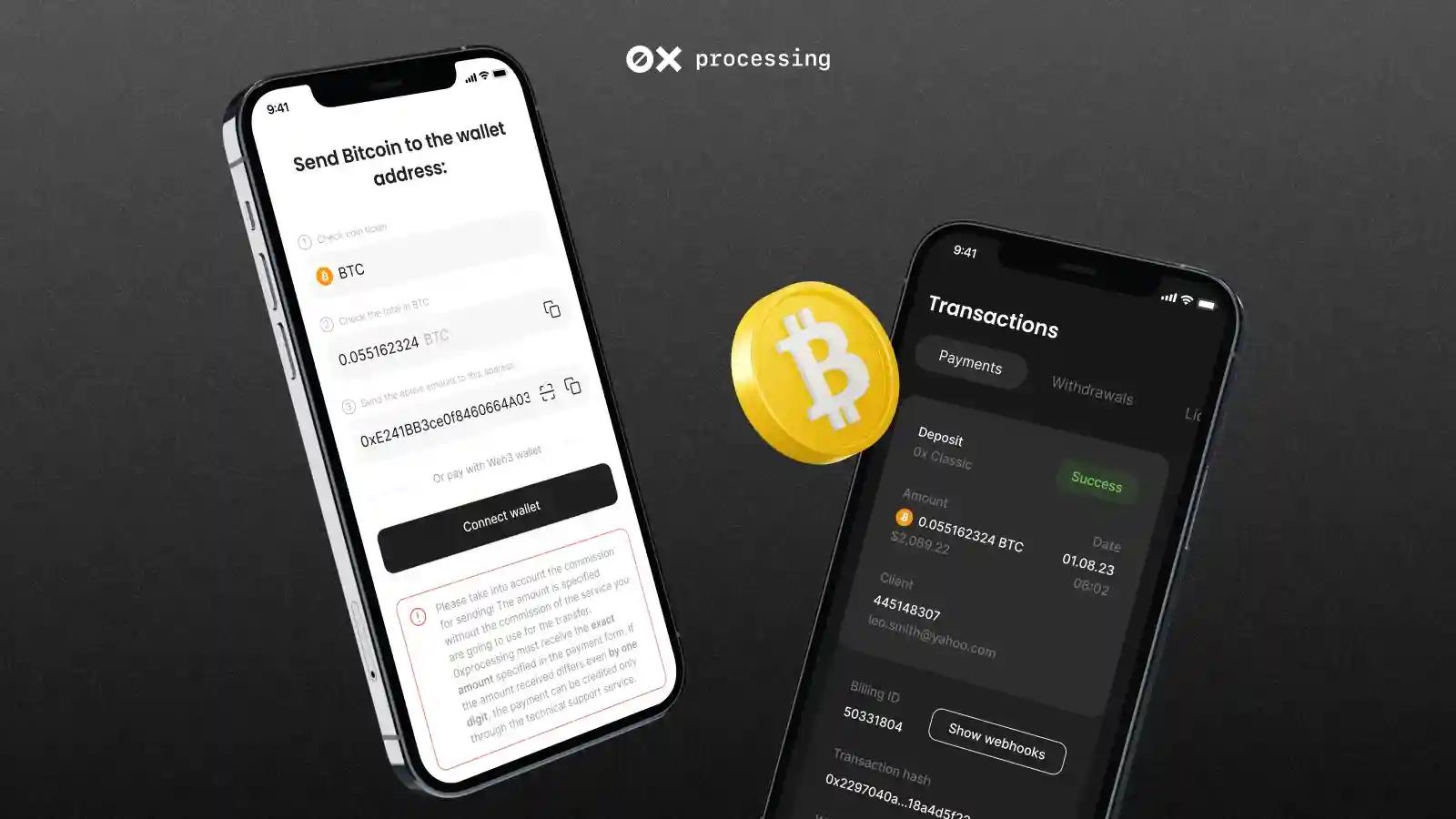
What a gateway does instead: spin up a fresh address and QR for each order, track the incoming transfer on-chain, count confirmations, pin the exchange rate when the customer pays, and ping your system once funds clear.
The flow in four steps:
- Customer selects Bitcoin at checkout and chooses on-chain or Lightning.
- The gateway issues a unique invoice – a one-time address or Lightning invoice, the exact amount, and a payment window with the rate fixed.
- The customer sends BTC from any wallet. On-chain confirms in 10–60 minutes; Lightning settles in under a second.
- Funds clear and settle to your balance, optionally auto-converted to a stablecoin or fiat so you don't carry price risk.
0xProcessing runs this on its own node infrastructure rather than third-party aggregators, which keeps confirmation fast and the acceptance rate near 99.9%.
Direct acceptance vs payment processor: which should you choose?
This is the first real decision, and it comes down to who carries the operational burden.
Direct acceptance means BTC lands straight in your self-custody wallet. You hold the keys, you owe no processing fee, and you answer to no one. You also handle volatility, accounting, refunds, address generation, and compliance yourself. Open-source software like BTCPay Server makes this viable – fully open-source, self-hosted, with 30+ e-commerce integrations and over a million GitHub downloads – but it needs a server, maintenance, and technical hands. For a Bitcoin-maximalist business at scale, the zero platform fee can win on pure economics.
A payment processor handles all of that for you: address generation, blockchain monitoring, rate locking, auto-conversion, fiat off-ramp, AML screening, and support. You pay a processing fee in exchange for not having to run infrastructure. For most businesses – especially regulated or high-risk verticals – this is the pragmatic choice.
The honest split: pick direct acceptance if you have technical staff, want self-custody, and process enough volume to absorb the operational cost. Go with a processor if running a node sounds like a chore and you'd rather have settlement, conversion, and compliance off your plate.
How do you choose a Bitcoin payment processor?
Once you've settled on using a processor over self-custody, the shortlist comes down to a handful of questions. If you can't answer two or more, you're not ready to sign.
- Does it support both on-chain and Lightning, so you can match the rail to the payment size?
- What's the all-in cost at your volume, not just the headline rate – including conversion spread and withdrawal fees?
- Is settlement custodial or self-custody, and does that fit your risk posture?
- Can it automatically convert incoming BTC to a stablecoin or fiat to reduce volatility exposure?
- What's the fiat off-ramp, and what does it cost? Free SEPA, or a $25–50 SWIFT wire?
- Does the licensing and AML setup cover your jurisdiction and vertical, especially for high-risk?
- How long does onboarding take, and what KYB documents are required?
- Are there withdrawal minimums that trap funds on the platform?
Run any candidate through this before committing. The headline fee is rarely the thing that bites later – it's the off-ramp cost, the onboarding delay, or a missing network.
Want to accept crypto payments on your website?
How does the Lightning Network change Bitcoin payments?

Without Lightning, Bitcoin doesn't really work for day-to-day spending. The base layer caps out around seven transactions per second and charges real fees during congestion. Lightning moves transactions off-chain into payment channels, settling them instantly for fractions of a cent.
The numbers tell the story. An on-chain BTC transfer in 2026 can normally cost a few dollars and spike to $10–50 during heavy mempool periods, with confirmation in 10–60 minutes. A Lightning payment of the same value typically costs under a cent and settles in under a second. For anything small – a coffee, a digital subscription, a $5 top-up – on-chain fees can exceed the payment itself, which is exactly the problem Lightning solves.
Capacity has grown to roughly 5,000 BTC across the public network, and processors like Strike convert Lightning payments to local fiat within seconds across 85 countries. Taproot Assets even brought stablecoins like USDT onto Lightning rails. What this means for a merchant is simple enough. Run Lightning for retail and small payments. Keep on-chain for the big transfers, where a few dollars in fees barely register against the total.
How to accept Bitcoin payments: step-by-step
Most of the work here is paperwork, not code. Zero to live in five steps.
- Register a merchant account with a Bitcoin gateway and provide basic business details.
- Pass KYB. Company documents and beneficial ownership – standard onboarding. For high-risk verticals, a specialist processor's AML logic earns its keep.
- Choose a settlement. Decide whether to keep BTC or auto-convert incoming payments to a stablecoin or fiat to remove volatility.
- Integrate. Drop in the API, a payment link, a checkout button, an invoice flow, or a point-of-sale QR for in-person payments.
- Test, then go live. Run a small on-chain and Lightning transaction, confirm the webhook fires and the balance updates, then switch on real traffic. Most merchants go live within a week.
Want a transparent setup for your volume? T0xProcessing onboards merchants across 85+ coins and 18 blockchains, with auto-conversion to stablecoins and 0% withdrawal fees.
Get startedHow do you settle Bitcoin for fiat and protect against volatility?
BTC's price swings are the main reason businesses hesitate to accept it. Auto-conversion answers that.
With conversion enabled, the gateway locks the exchange rate when the customer pays and immediately settles the amount to a stablecoin or fiat. A $500 invoice stays $500 regardless of what Bitcoin does an hour later. You capture the sale, not the volatility.
For a fiat off-ramp, the rails matter. SEPA transfers in the EU are typically free; SWIFT wires run $25–50 and take a few days. 0xProcessing offers SWIFT/SEPA settlement with bank deposit in 3–5 working days, depending on location, plus the option to hold a stablecoin balance and convert on your own schedule. If volatility is a dealbreaker, accepting USDT instead of or alongside BTC sidesteps it entirely.
What integrations are available for Bitcoin acceptance?
There are two broad routes: ready-made CMS plugins or a more flexible custom integration.
Many processors ship plugins for popular platforms like Shopify, WooCommerce (WordPress), and Magento. They install in minutes, need little to no code, and add a crypto option to your existing checkout out of the box. The upside is speed and simplicity. The downside is less control over the payment flow and dependence on the plugin's update cycle.
Beyond plugins, there are other ways to add Bitcoin acceptance to a site.
REST API
Full control over the flow – generate invoices programmatically and listen for webhook callbacks – the backbone of high-volume and automated setups.
Payment links
No site required. Generate a link, send it over email or chat, and get paid. Ideal for invoicing and social-media sales.
Checkout button or hosted page
Minimal-code embeds – drop a button into an existing page or redirect to a hosted checkout.
Point-of-sale QR
For physical stores: the customer scans and pays on Lightning in seconds.
Invoice flows
Structured B2B billing with itemized invoices.
0xProcessing works for e-commerce through these flexible integration paths rather than off-the-shelf plugins, and provides white-label forms you can brand as your own. See our e-commerce crypto payments page for the commerce side.
What are the benefits of accepting Bitcoin for business?
The case rests on four things that cards can't match.
- Lower fees. Card acquiring runs 2.9% + $0.30 plus 1–3% cross-border, landing at 4–6% all-in internationally. Bitcoin on Lightning costs cents.
- No chargebacks - confirmed BTC transactions are final, which kills friendly fraud, a chronic drain for digital goods and high-risk merchants.
- Global reach. Anyone with internet can pay, including the underbanked and customers in regions with unreliable banking.
- Settlement speed - cross-border BTC clears in minutes, versus days for a wire, with no correspondent banking chain.
The trade-off is volatility, which auto-conversion neutralizes, and the irreversibility cuts both ways – send to the wrong address, and there's no recall. A gateway with address validation reduces that risk.
Who accepts Bitcoin in 2026?
Adoption splits into two camps: companies that accept BTC as payment and companies that hold it in treasury.
On the payments side, Newegg takes BTC through processors, AMC Theatres accepts it for tickets, travel platforms like Travala book flights and hotels in Bitcoin, and most major VPN providers (NordVPN, ExpressVPN, Proton) accept it for subscriptions. Gift-card services like Bitrefill let you spend BTC at thousands of brands indirectly.
On the treasury side, the story is dominated by one name. Strategy (formerly MicroStrategy) is the largest corporate Bitcoin holder in the world, holding roughly 845,000 BTC as of mid-June 2026, after raising over $25 billion in 2025 to build the position (per the company's 8-K filings and bitcointreasuries.net). As of late 2025, trackers counted more than 190 public companies holding BTC, though most allocations are modest next to Strategy's.
How are Bitcoin payments taxed and accounted for?
This is where finance teams need to pay attention. In most jurisdictions, BTC is treated as property, not currency, which means accepting it can trigger a taxable event and capital-gains tracking on any change in value between receipt and conversion.
Auto-conversion simplifies this enormously: if incoming BTC is immediately settled into fiat or a stablecoin, the gain-or-loss window collapses to near zero, and your books look like ordinary revenue. Holding BTC, by contrast, means tracking cost basis and unrealized gains. The practical advice is to settle on conversion unless you're deliberately building a treasury position, and to keep transaction-level records that a gateway generates automatically.
On legality, the picture in 2026 is clear in major markets. The US treats crypto as taxable property and permits its acceptance; the EU regulates under MiCA at the issuer and service provider levels, not the merchant; the UK and Singapore both permit BTC acceptance under maturing frameworks. None of these markets bars a business from accepting Bitcoin – the obligations are tax and record-keeping, not prohibition. As always, confirm specifics with a local advisor.
How to start accepting Bitcoin with 0xProcessing
The setup is the easy part. 0xProcessing supports Bitcoin on-chain and through Lightning, with auto-conversion to stablecoins via VRCS (Volatility Risk Control System), 0% withdrawal fees, and SWIFT/SEPA off-ramp. The platform has been live since 2020, has undergone four external audits (2022–2025), and runs on its own node infrastructure with real-time AML/KYT. For the neighboring asset, our Ethereum gateway guide covers ETH acceptance.
Ready to accept Bitcoin? Settle across 85+ coins and 18 blockchains, with on-chain and Lightning support, stablecoin auto-conversion, and 0% on withdrawals.
Start accepting BTCBottom line
Bitcoin processing in 2026 is a solved problem for any business willing to choose its model. Have the technical depth and want to hold your own keys? Run BTCPay Server. Want settlement, conversion, and compliance handled for you? Use a processor.
Lightning makes BTC work for everyday spending in both cases, and auto-conversion takes the volatility problem off the table, which is what kept most finance teams away in the first place. The question isn't whether Bitcoin can work as a payment rail. It's whether you'd rather hold it or bank it.
FAQ
What is Bitcoin processing?
A gateway verifies, confirms, and settles the BTC payment for you. That covers generating the address, watching the chain, pinning the rate, and crediting your balance. Conversion to fiat or a stablecoin is optional.
How do I accept Bitcoin payments for my business?
Sign up with a gateway, clear KYB, set how you want funds to settle, plug in via API or a payment link, then test before you switch on real traffic.
Is it cheaper to accept Bitcoin than cards?
Usually, cards run 4–6% all-in for international payments; Bitcoin on Lightning costs cents in network fees plus your processor's rate.
What's the difference between on-chain and Lightning Bitcoin payments?
On-chain settles in 10–60 minutes and can cost several dollars during congestion. Lightning clears in under a second and costs less than a cent, which is why it fits retail and small payments.
Do I have to hold Bitcoin if I accept it?
No. Turn on auto-conversion, and incoming BTC settles into a stablecoin or fiat right away, so there's no price exposure and the bookkeeping stays clean.
Is accepting Bitcoin legal?
In most major markets, yes. The US, EU, UK, and Singapore all permit merchant acceptance of BTC; the obligations are tax reporting and record-keeping, not prohibition.