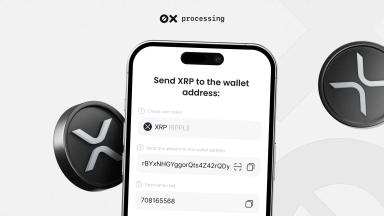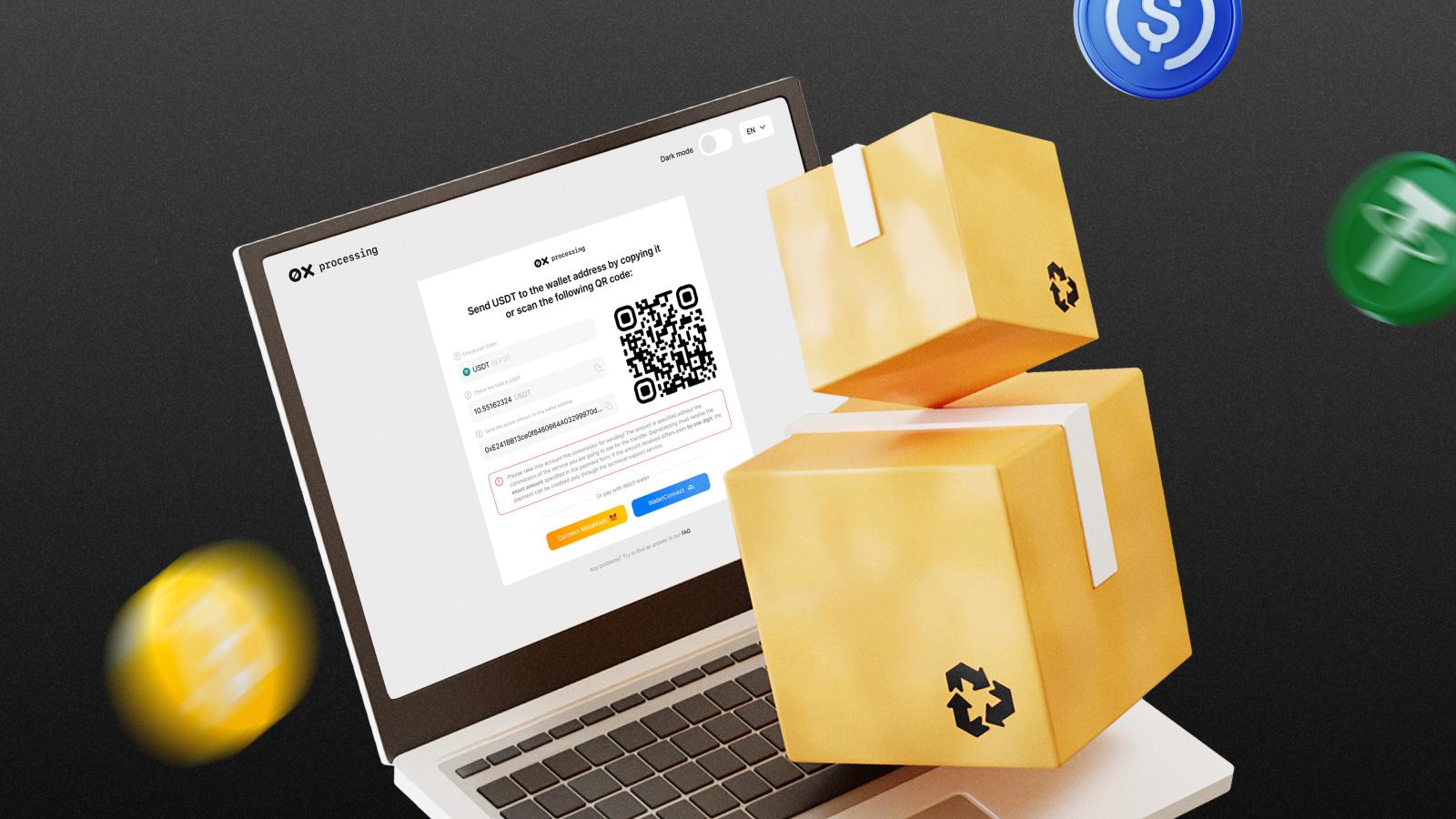
Here's the basic idea. You sell crypto payments to your merchants under your own brand, and someone else quietly runs all the hard machinery behind it. Your merchants see your logo, your domain, your checkout, and never the provider doing the actual work, the blockchain, the wallets, the compliance, the settlement.
For a PSP or a fintech, that's the gap between going live with crypto in a few weeks and burning a year-plus building the thing yourself.
The rest of this walks through how it works, who it's really for, what build-versus-buy costs in practice, and how to size up a provider before you sign.
How does a white-label crypto payment gateway work?
The split is simple: you own the brand and the merchant relationship, the provider owns the technology.
When a customer pays, the transaction runs through the provider's backend – address generation, blockchain monitoring, exchange-rate locking, AML screening, settlement – but every screen the merchant and customer touch carries your branding. The provider stays invisible. Your merchants think of it as your gateway, because to them, it is.
That arrangement matters more than a logo swap. The catch is that you keep the merchant relationship, which means if a payment fails or a withdrawal is delayed, the merchant blames you, not the hidden provider.
You keep the customer relationship and the revenue. You hand off the engineering and most of the compliance load. The provider's quality becomes your quality, which is why the choice of provider is the whole game.
Who needs a white-label crypto gateway?
Anyone who sells payments as part of their product but doesn't want to become a blockchain engineering shop. Several business types fit.
PSPs and ISOs are the obvious ones. Traditional card and bank processors that face merchant demand for crypto can add it to their portfolios without building a blockchain team. Merchant acquirers extend their offering into digital assets under their existing brand. Fintech platforms and neobanks whose users expect crypto alongside cards and transfers. Marketplaces that want to offer crypto acceptance to their sellers. E-commerce platforms are adding crypto as a checkout option for their merchant base. And agencies are packaging crypto payments into what they deliver to clients.
The common thread: your edge lies in merchant relationships, distribution, and support – not in proprietary blockchain infrastructure. If that describes you, white label moves you faster.
Build vs buy: develop in-house or use a white-label solution?
This is the decision that shapes your timeline, budget, and risk. The numbers make the trade-off concrete.
Building from scratch means owning every layer: wallet architecture, node infrastructure, multi-chain support, compliance stack, and security. Estimates for a full-custom crypto gateway run $300,000+ and take 9+ months, and that's before ongoing maintenance, node updates, and tracking hard forks across every chain.
Want to accept crypto payments on your website?
A white-label solution, by contrast, launches in weeks rather than the
12–18 months custom development takes.
| Build in-house | White label | |
|---|---|---|
| Time to market | 9–18 months | 3–6 weeks |
| Upfront cost | $300,000+ | Far lower, mostly operational |
| Blockchain expertise | Full team required | Provided |
| Maintenance | Yours (nodes, forks, upgrades) | Provider's |
| Compliance stack | Build it yourself | Built in |
| Control | Total | Within the provider's framework |
| Best for | Crypto-first companies where infrastructure is the product | PSPs/fintechs where merchant relationships are the product |
The honest rule: build if proprietary crypto infrastructure is your competitive advantage. Buy a white-label if your advantage is in distribution, packaging, and support. As our deeper breakdown lays out, a white-label route can cut costs by up to 70% and compress time-to-market by 10–20×.
What can you customize and brand?

The point of white label is that it looks entirely yours.
Customization typically covers four layers: your logo and visual identity across the checkout and dashboard; your brand colors and UI so the interface matches your product; your own domain so merchants and customers never leave your brand; and the merchant-facing dashboard presented as your platform.
The depth varies by provider – from a simple logo swap to near-source-level control – so it's worth asking exactly how far branding goes before you commit.
What features should a white-label gateway include?
Branding is the visible part. The engine underneath is what actually has to work.
Multi-currency support
Acceptance across a broad set of coins and chains, so your merchants' customers can pay in what they hold. 0xProcessing covers 85+ cryptocurrencies across 18 blockchains, including 31 stablecoins.
Auto-conversion
Volatility protection through instant conversion to stablecoins. VRCS (Volatility Risk Control System) locks the value at the moment of payment, so merchants bank the amount they expected.
Merchant API
A clean, documented API with webhooks, idempotency, and clear status transitions, so your merchants can integrate without friction.
Settlement and payouts
Reliable settlement, plus mass payouts for merchants who pay out at volume, and fiat off-ramp via SWIFT/SEPA.
Built-in compliance
Real-time AML/KYT screening and KYB tooling, so regulatory obligations are handled in the stack rather than bolted on later.
How do partners make money from a white-label gateway?
The revenue model is straightforward: you offer crypto acceptance to your merchants and take a margin on the processing.
Because the provider gives you wholesale-rate infrastructure, you set your own merchant-facing pricing on top of it. The spread between what you pay the provider and what you charge your merchants is your revenue, recurring, and scaling with your merchants' volume.
For PSPs and ISOs already billing merchants for card processing, adding crypto is a new line on an existing relationship rather than a new customer acquisition cost.
Our partnership program lays out how that works in practice.
What about compliance and regulation under your own brand?
Operating under your brand doesn't place the regulatory burden entirely on you, but it doesn't remove it either, and the split is worth understanding.
A reputable white-label provider embeds the heavy compliance machinery: AML/KYT screening for every transaction, KYB tooling for merchant onboarding, and sanctions checks.
What you still own is the merchant relationship and your own regulatory standing in your jurisdiction.
The rules vary by region: MiCA is fully enforced across the EU with a July 1, 2026, deadline; the US GENIUS Act governs stablecoins at the issuer level; and Singapore (MAS) and the UAE (VARA) run licensing regimes of their own.
The advantage of white label is that the provider's compliance investment becomes yours, rather than you building an AML program from scratch.
How to choose a white-label provider: a checklist
The vendor decision goes far deeper than "can we add our logo?" Run any candidate through these questions:
- How many coins and chains are supported, and do they cover your merchants' markets?
- Is the settlement custodial or non-custodial, and does that fit your risk model?
- How deep does branding go – logo only, or domain and UI?
- What's the API quality – sandbox, webhooks, documentation, status handling?
- Is auto-conversion to stablecoins included, and at what cost?
- What compliance is built in – AML/KYT, KYB, sanctions screening?
- What are the settlement options and payout fees?
- Can you migrate off later, or are you locked in?
- What's the support model, and who answers when a merchant has a problem?
- How long is onboarding, and what's the real time-to-launch?
If two or more of these come back vague, keep looking. The headline "white label" hides significant differences beneath the surface.
Why choose white label: the advantages
Three benefits drive the model, and they reinforce each other.
Speed first. You launch in weeks, not the year-plus a custom build demands, which matters when merchants are asking for crypto now.
Cost second. You convert a $300K+ capital project into a predictable operating expense, with up to 70% savings compared to building.
Expertise third. You skip needing a blockchain engineering team entirely – the provider handles nodes, forks, multi-chain support, and security – while you focus on what you're actually good at: merchants, distribution, and support.
Launch your white-label crypto gateway with 0xProcessing
Getting to market is mostly a setup decision.
0xProcessing's white-label crypto payment gateway gives you a fully branded solution covering 85+ coins across 18 blockchains, auto-conversion via VRCS, mass payouts at 0% processor fee, and real-time AML/KYT, all under your brand.
It's been live since 2020, carries four external security audits (2022–2025), and runs on its own node infrastructure.
For the revenue side, the partnership program covers how partners monetize crypto acceptance.
Ready to launch under your own brand? Offer crypto payments to your merchants across 85+ coins and 18 blockchains, fully branded, with compliance and settlement handled.
Get startedOverall
A white-label crypto payment gateway turns a yearlong, six-figure engineering project into a few weeks of setup, allowing PSPs, ISOs, and fintechs to offer branded crypto payments without becoming blockchain companies.
The model works because it cleanly splits the value: you keep the brand, the merchants, and the margin, while the provider handles the infrastructure and most of the compliance.
The decision that matters isn't whether to go white label – it's which provider, since their reliability becomes yours the moment a merchant's payment runs through it.
Pick on depth of branding, compliance, coin coverage, and support, not on the logo-swap headline, and the rest follows.
FAQ
Who accepts Tether (USDT) as payment in 2026?
VPN providers (NordVPN, Surfshark, ExpressVPN), travel platforms (Travala, Alternative Airlines, CheapAir), electronics retailers via BitPay (Newegg, AMC), hosting providers, and thousands of brands indirectly through gift-card services like Bitrefill and Coinsbee.
Can I buy from Amazon with USDT?
Not directly – Amazon doesn't accept crypto. The workaround is to buy an Amazon gift card with USDT on Coinsbee or Bitrefill, then redeem it normally at checkout.
Does PayPal accept USDT?
PayPal's "Pay with Crypto" is rolling out to US merchants and accepts USDT among 100+ assets, settling to PYUSD for the merchant. You can also buy PayPal gift cards with USDT via Bitrefill.
Which USDT network do most companies accept?
TRC-20 (Tron) is the most common for consumer payments because fees run under a dollar. ERC-20 (Ethereum) is widely recognized for institutional flows. Many processors also support Solana and BNB Chain.
Is it legal for a business to accept USDT?
In most major markets, yes. The US GENIUS Act, EU MiCA, UK FCA rules, and Singapore's MAS framework regulate stablecoin issuers, not merchants that accept them.
How do I start accepting Tether for my own business?
Register with a crypto payment gateway, pass KYB, choose your networks, and integrate via API or payment link. A processor handles AML screening and auto-conversion so you avoid manual wallet management.