Accepting crypto comes down to wiring a processor or gateway into your checkout, choosing the coins and networks you'll take, and deciding how you want to settle: in crypto, a stablecoin, or straight to fiat. Most businesses are up and running within a week. This guide covers the difference between a gateway and a processor, what they cost, where your funds sit, how to convert to fiat, and the regulations you need to know in major markets.
The state of crypto payments in 2026
Crypto's not a fringe option anymore. A January 2026 report by PayPal and NCA put US merchant acceptance at 39%, with 88% saying customers had already asked about paying in crypto. Among the big players, those above $500M in revenue, half are already taking it.
What's pulling merchants in isn't speculation. It's stablecoins. They account for around 60% of all crypto payment activity now, and USDT by itself moves roughly a third of merchant volume. Real-world stablecoin payments hit about $390 billion in 2025, more than twice the prior year, with B2B making up the bulk of it. The logic writes itself. No merchant wants to hold something that might shed 15% before it settles, and a dollar-pegged token kills that risk without giving up the speed or reach.
Costs explain the rest. Crypto gateways charge between 0.23% and 1%, against 2–3% for card acquiring. Go cross-border, and the gap stretches wider, since cards tack on another 1–3% in FX markup. If you run thin margins or sell internationally, that difference adds up to real money.
What does it mean to accept crypto payments?
It means taking digital assets, Bitcoin, Ethereum, and USDT, as payment for what you sell, then turning them into whatever form your business actually needs. That last part is what separates a real payment setup from simply owning a wallet.
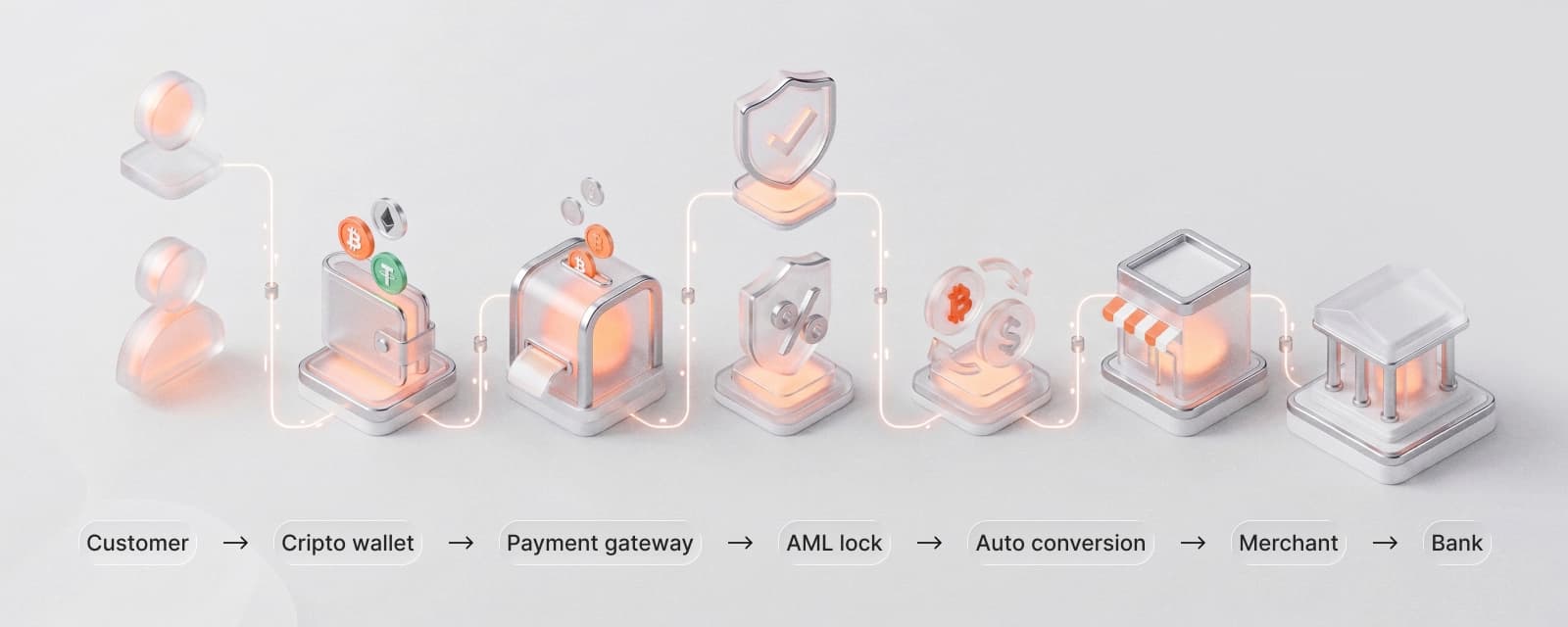
A customer pays in crypto. The blockchain confirms the payment, and the value lands in your account, converted to a stablecoin or fiat if you want it that way. What makes that flow reliable is the infrastructure underneath it. A fresh address for every order. Blockchain monitoring. A locked exchange rate. Final settlement. You wire it in through a hosted checkout, an API, a payment link, or a plugin, then either hold the crypto or move it to your bank.
As for who actually needs this: cross-border sellers, e-commerce stores chasing emerging markets, iGaming and forex operators, SaaS companies with customers everywhere, and anyone watching card fees and chargebacks eat their margin.
Payment gateway vs payment processor: what is the difference?
The terms get used interchangeably, but they describe different layers of the same flow. A crypto payment gateway is the customer-facing piece. A
crypto processor is the engine behind it. Most modern providers, including 0xProcessing, bundle both.
A payment gateway is the interface through which the transaction begins. It generates the payment request, displays an address or QR code to the customer, and captures the incoming payment. Think of it as the checkout layer the customer actually sees and touches.
A payment processor handles everything after that. It validates the transaction on-chain, checks the amount, locks the rate and handles conversion, runs AML screening, and drops the funds into your balance. That's the back-end machinery.
Honestly, the gateway-versus-processor split matters less than it once did. Almost every provider bundles the two now, so signing up with a crypto processing company today gets you both as a single product. Where providers genuinely differ is custody, the coins they support, fees, and compliance. That's what your evaluation should weigh, not which label a vendor sticks on the box.
| Payment gateway | Payment processor | |
|---|---|---|
| Role | Customer-facing checkout layer | Back-end settlement engine |
| What it does | Generates the payment request, shows address/QR, captures payment | Validates on-chain, locks rate, converts, screens AML, settles funds |
| What the customer sees | The whole interaction | Nothing |
| Analogy | The storefront till | The bank behind it |
| In 2026 | Almost always bundled with the processor as one product | Almost always bundled with the gateway as one product |
How to accept crypto payments: step-by-step
The setup is more administrative than technical. Six steps from zero to live.
Choose a crypto payment provider.
Match the provider to your vertical, volume, and the coins your customers use. The checklist further down covers what to weigh.
Register and pass KYB.
Sign up, then complete business verification: company documents, beneficial ownership, the standard onboarding. Regulated and high-risk verticals get more scrutiny here.
Pick coins, networks, and settlement.
Decide which assets to accept (BTC, ETH, USDT, USDC), which networks, and whether to auto-convert incoming crypto to a stablecoin or fiat.
Want to accept crypto payments on your website?
Integrate.
Drop in the API, a hosted checkout, a payment link, a button, or a CMS connection. No deep dev work is required for the lighter options.
Test.
Run a small transaction on each coin and network, confirm the webhook fires and your balance updates.
Go live.
Switch on real traffic. Most merchants reach this point within a week.
Ready to start? 0xProcessing onboards merchants across 85+ coins and 18 blockchains, with auto-conversion to stablecoins and 0% withdrawal fees.
Get startedCrypto processing fees and how they compare to cards
Crypto processing costs less than card acquiring in almost every scenario, but the headline rate hides layers of complexity. The base fee ranges from 0.23% to 1% across most providers. On top of that, there are possible conversion spreads (0.2–0.5%), network fees (cents on Tron or Solana, more on Ethereum mainnet), and withdrawal fees (0% at some processors, up to ~1% at others).
Compare that to cards. Acquiring runs 2.9% + $0.30 per transaction, plus 1–3% on cross-border, landing at 4–6% all-in for international payments. At $100K in monthly volume, the difference between a 1% crypto rate and a 4% card rate is $36,000 per year.
The honest read: crypto clearly wins on cross-border and high-volume flows. For small domestic transactions, the network fee can eat into the savings, though stablecoins on low-fee chains keep that minimal. Always compare the effective rate, base fee plus every layer, against what you actually pay on cards today.
Where does 0xProcessing land on this?
Pricing is turnover-based and set during onboarding rather than published as a flat rate, which is standard for processors serving high-volume and high-risk verticals where the right number depends on your mix. What's fixed is the structure: 0% processor fees on withdrawals (network gas still applies), VRCS auto-conversion folded into the standard rate rather than billed as a separate convert fee, and mass payouts at 0%. For a like-for-like comparison, ask any processor for the all-in effective rate at your projected volume, not the homepage headline.
Custodial vs non-custodial: where are your funds held?
This is the trust question, and it splits providers into two camps.
Custodial means the processor holds your funds between payment and settlement. You get managed settlement, auto-conversion, AML screening, and fiat off-ramp handled for you, at the cost of trusting the provider with custody. 0xProcessing is custodial by design, which fits regulated and high-risk verticals where having compliance managed for you beats holding your own keys.
With non-custodial, the funds drop straight into your wallet and the keys stay with you. Full control, nobody to trust with custody, but volatility, conversion, accounting, and compliance all become your job. That works for merchants who are privacy-focused or have the technical chops to run it.
There's no winner here in the abstract. One swaps control for convenience and managed compliance; the other swaps convenience back for control. Pick based on your risk posture and how much operational work you want to own.
| Custodial | Non-custodial | |
|---|---|---|
| Who holds funds | The processor, until settlement | You, in your own wallet |
| Settlement & conversion | Managed for you | Your job |
| AML / compliance | Handled by the processor | Your responsibility |
| Fiat off-ramp | Built in | You arrange it |
| Control | Lower | Full |
| Best for | Regulated and high-risk verticals | Privacy-focused or technical merchants |
| Example | 0xProcessing | Self-hosted / wallet-direct setups |
Fiat conversion and volatility protection
Volatility is the objection that kept finance teams away from crypto for years. Auto-conversion is the answer.
With conversion enabled, the gateway locks the exchange rate the moment a customer pays and immediately settles the amount to a stablecoin or fiat. A $500 invoice stays $500 no matter what the market does an hour later. You capture the sale, not the swing. 0xProcessing handles this through VRCS (Volatility Risk Control System), which converts incoming crypto to stablecoins at the moment of payment with no extra fee.
For the off-ramp to fiat, the rail matters. SEPA inside the EU is usually free; a SWIFT wire runs $25–50 and takes a few days; instant rails like PIX in Brazil or UPI in India settle near-instantly at near-zero cost. A good processor offers bank settlement plus the option to hold a stablecoin balance and convert on your own schedule.
Ways to accept crypto: checkout, API, plugins, links, and more
There's no single integration path. The right one depends on whether you run an online store, a SaaS product, or a physical location.
Hosted checkout
A ready-made payment page the customer is redirected to. Minimal setup, no design work, handles the whole flow.
REST API
Full control for custom integrations. Generate invoices programmatically and listen for webhook callbacks. The backbone of high-volume and automated setups.
CMS plugins
Ready-made connectors for Shopify, WooCommerce, and Magento install in minutes with little code. Fast, but you trade some control for that speed.
Payment links
No site required. Generate a link, send it over email or chat, and get paid. Ideal for invoicing and social-media sales.
Buttons and widgets
Embed a crypto-pay button into an existing page with minimal code.
Invoices
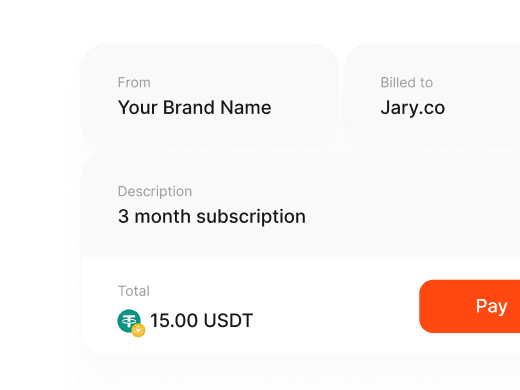
Structured B2B billing with itemised invoices and a payment window.
POS and QR
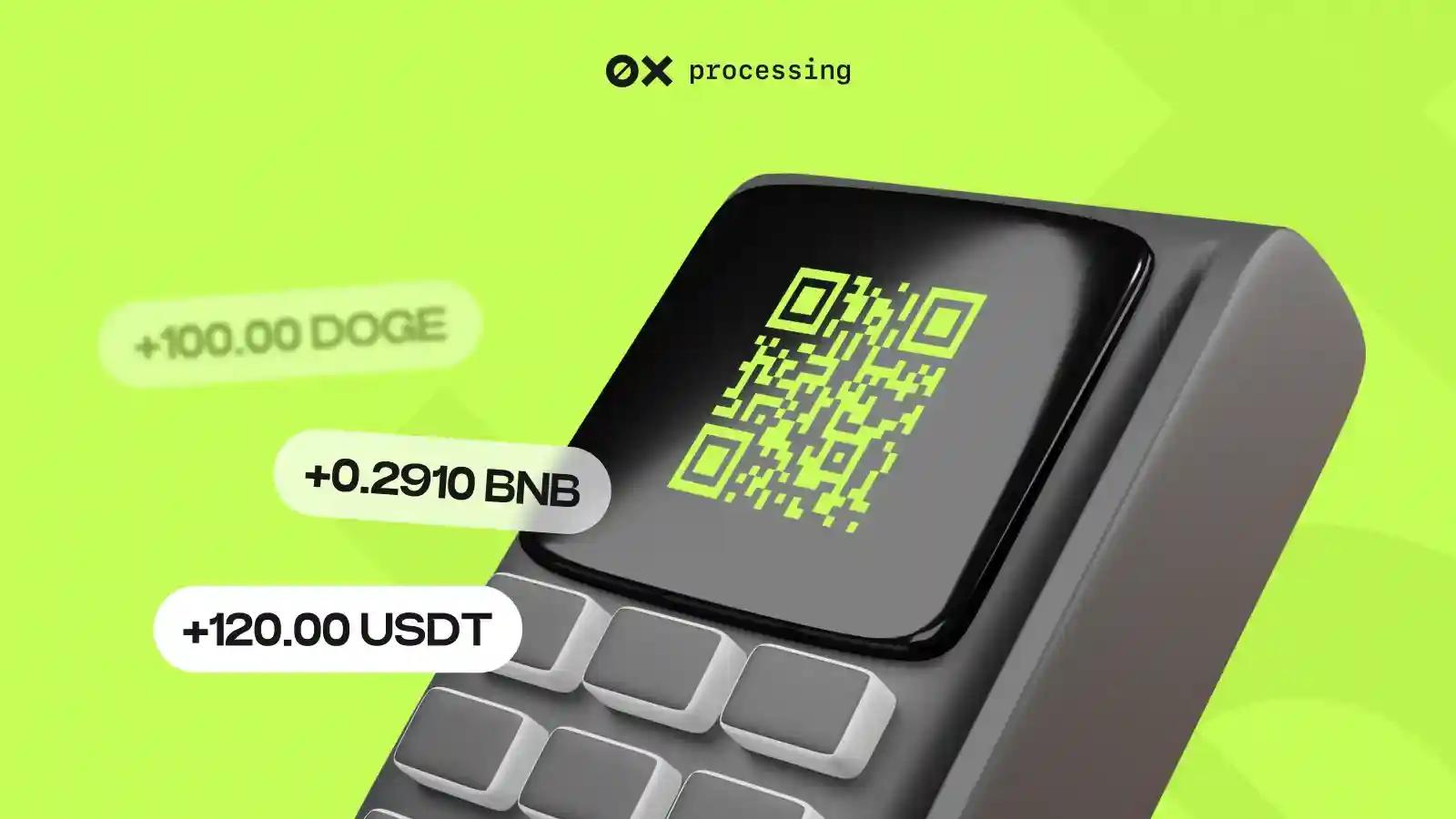
At physical stores, customers scan a QR code and pay from their wallet in seconds.
Mass payouts
The reverse direction: pay many wallets at once. For affiliate-heavy models and iGaming operators with constant withdrawals, this is the feature that determines whether a processor is a good fit. For Web3-native flows, the Web3 payment gateway handles wallet-connect and on-chain settlement together.
Which cryptocurrencies should you accept?
Start with what your customers actually hold, then add the obvious staples. Four cover most of the demand; add the rest as needed.
Bitcoin (BTC)
Is still the name everyone recognises, and for some buyers it's the only coin they own. On-chain, it's slower and pricier; over Lightning, it settles in under a second for a fraction of a cent. Our Bitcoin processing guide covers both.
Ethereum (ETH)
Brings the largest Web3 audience and the programmability that powers recurring billing and escrow. The full picture is in our Ethereum gateway guide.
USDT (Tether)
Is the workhorse of crypto payments, dollar-stable and widely accepted, especially on Tron for cheap consumer flows. See the USDT gateway guide.
USDC
Is the other major stablecoin, leaning on fuller reserve transparency and the compliant default on regulated EU venues under MiCA.
Past those four, a processor that supports a broad catalogue lets you take whatever a customer brings without forcing them to convert first. 0xProcessing covers 85+ coins across 18 blockchains, including 31 stablecoins; the full list lives on the supported coins page. The practical move is to accept the big four plus a handful your audience asks for, and skip the long tail until there's demand.
Is accepting crypto legal? Regulation by region
Short answer: yes, in every major market, and 2026 made it clearer than ever. Regulators have largely settled on governing issuers and custodians, not the merchants who accept stablecoins and crypto. Here's where the big markets stand.
United States
The GENIUS Act, signed in July 2025, created the first federal framework for payment stablecoins, with final rules targeted for mid-2026. It regulates issuers, not the businesses that accept crypto, so you can take and hold it freely. Crypto is taxable property for accounting purposes.
European Union
MiCA is fully in force, with a July 1, 2026, authorisation deadline for issuers and service providers. The practical effect for merchants: USDT has been pushed off regulated EU venues in favour of USDC, which is now the compliant default. A merchant taking crypto into self-custody isn't a CASP and sits outside the tightest rules, but EU-facing businesses should plan around USDC.
United Kingdom
The FCA is finalising its regime under the Financial Services and Markets Act 2023, converging on licensed issuers, reserve backing, and AML. Merchant acceptance is permitted.
Singapore
A clear MAS framework requires 100% reserves and redemption at par within five business days. One of the friendliest markets for stablecoin payments, with real legal certainty.
India
No dedicated stablecoin framework yet, and crypto stays heavily taxed. Acceptance happens, but treat compliance conservatively and lean on peer-to-peer or gift-card routes where direct rails are thin.
The throughline: a licensed processor carries the compliance weight for you. That's the single strongest reason to use one rather than to wire up a self-custodial stack and own AML yourself.
How to choose a crypto payment processor: a checklist
Once you've decided to accept crypto, the shortlist comes down to a handful of questions. If two or more answers come back blank, you're not ready to sign.
- Which coins and networks do my customers actually use, and does the processor support all of them?
- What's the all-in rate at my volume, not just the headline base fee?
- Is settlement custodial or non-custodial, and does that fit my risk posture?
- Does it auto-convert to a stablecoin or fiat to neutralise volatility?
- What's the fiat off-ramp, and what does it cost? Free SEPA, or a $25–50 SWIFT wire?
- How long does onboarding take, and which KYB documents are required?
- Does the licensing cover my jurisdiction and vertical, especially for high-risk?
- How's the support, and is there an audit trail for reconciliation?
The headline fee is rarely what bites later. The off-ramp cost, an onboarding delay, or a missing network usually does.
What are the risks, and how do you close them?
Crypto payments carry real risks, but each one has a standard fix. None of them is a reason to stay out. All of them are reasons to pick the right setup.
Volatility
Crypto prices move. Auto-conversion to a stablecoin or fiat at the moment of payment removes the exposure entirely, which is what VRCS-style systems do.
Compliance
AML and KYC obligations vary by market. A licensed processor with real-time KYT screening handles this, checking incoming transactions against blacklist data, so tainted tokens don't land in your balance.
Security
Wallet and account compromise is the main threat. Multi-sig, 2FA or higher, and a processor running its own node infrastructure rather than third-party aggregators reduce the attack surface.
Irreversibility
On-chain transfers are final, which kills chargeback fraud but means a wrong address can't be recalled. Per-invoice unique addresses and address validation keep that risk low.
Wrong-network sends
Customers occasionally send on a chain you don't support. A gateway that shows the correct address per network, and accepts across several at once cuts this down.
Why accept crypto: the benefits for business
The case comes down to five things cards can't match, and they compound.
Fees run lower. Crypto processing sits at 0.23–1% against 4–6% all-in for international card payments. There are no chargebacks, since confirmed transactions are final, which alone saves high-risk and digital-goods merchants a chronic drain. Reach goes global, including the underbanked and customers in markets where the dollar is scarce or banking is shaky. Settlement is quick too, clearing cross-border in minutes rather than days. And you open up to a new audience: roughly 740 million crypto owners worldwide as of early 2026, a number that keeps climbing. 84% of merchants expect crypto to be a routine payment method within five years.
None of it requires betting on price. With auto-conversion, you take the sale value in dollars and avoid volatility. The question has shifted from whether crypto payments will go mainstream to which merchants will be ready when they do.
Get started with 0xProcessing
Setup is the easy part. 0xProcessing covers 85+ coins across 18 blockchains, including 31 stablecoins, with auto-conversion via VRCS (Volatility Risk Control System), 0% processor fees on withdrawals (network gas may apply), and mass payouts for affiliate-heavy models. It's a custodial gateway built for regulated and high-risk verticals, live since 2020, with four external security audits (2022–2025) and its own node infrastructure running real-time AML/KYT.
Ready to accept crypto? Take payments across 85+ coins and 18 blockchains, with stablecoin auto-conversion included, 0% processor withdrawal fees, and SWIFT/SEPA off-ramp.
Get startedConclusion
Accepting crypto in 2026 isn't the gamble it once looked like. Stablecoins took volatility off the table, fees undercut cards by a wide margin, and regulation across the US, EU, UK, and Singapore settled into frameworks that target issuers rather than the businesses that accept payments. What's left is a setup decision: gateway or processor, custodial or non-custodial, which coins, and how fast you convert. Get those right, and crypto stops being an experiment and starts being a margin advantage, one your competitors are already reaching for.
FAQ
How do I start accepting crypto payments?
Choose a crypto payment processor, register and pass KYB, pick your coins and networks, integrate via API or a hosted checkout, then test and go live. Most merchants are processing within a week.
What's the difference between a crypto payment gateway and a processor?
A gateway is the customer-facing checkout layer that captures the payment. A processor is the back-end engine that validates, converts, screens, and settles. Most providers, including 0xProcessing, bundle both into one product.
How much does it cost to accept crypto?
Crypto processing runs at 0.23–1% in base fees, against 2–3% for cards (4–6% all-in on cross-border). Add network fees (in cents on Tron or Solana) and any conversion spread to get the true all-in rate.
Do I have to hold crypto if I accept it?
No. Auto-conversion settles incoming crypto to a stablecoin or fiat at the moment of payment, so you avoid price exposure and keep clean books.
Is accepting crypto legal for my business?
In most major markets, yes. The US GENIUS Act, EU MiCA, UK FCA rules, and Singapore's MAS framework regulate stablecoin issuers, not the merchants accepting them. Obligations are tax reporting and record-keeping.
Which cryptocurrencies should a business accept?
Start with BTC, ETH, USDT, and USDC, which cover most demand. Add others as your customers ask. A processor with a broad catalogue lets you take whatever buyers bring without forcing a conversion.
Custodial or non-custodial: which is better?
Custodial handles settlement, conversion, and compliance for you, which suits regulated and high-risk businesses. Non-custodial keeps funds in your own wallet for full control. Pick based on your risk posture and how much operational work you want to own.