Remember when one Ethereum transaction could eat $50 in gas? That's over. These days it's a few cents on mainnet, and on Arbitrum or Base you're paying a fraction of a cent. For a business, that changes everything. We'll get into how an Ethereum gateway works, how Layer 2 brings your costs down, how to take stablecoins like USDT and USDC alongside ETH, and what it actually takes to start accepting payments.
Why accept Ethereum (ETH) in 2026?
Two reasons: it settles most of crypto's economic activity, and it's finally cheap to transact on. ETH trades around $1,700–1,800 as of June 2026, and no other chain secures a bigger DeFi and stablecoin ecosystem. Take it as payment, and you're reaching a Web3 audience that already keeps its balance in ETH and ERC-20 tokens.
Much of the case mirrors other crypto rails. Transfers are final, so chargebacks disappear. Fees undercut card acquiring's 2–3%. Anyone with a wallet can pay. Where Ethereum pulls ahead is programmability. Smart contracts let a payment carry logic, enabling recurring billing, escrow, and automated payouts – none of which a plain transfer can do.
What is an Ethereum payment gateway, and how does it work?
It's the layer that lets a business convert ETH and ERC-20 tokens into a usable balance. Dropping a wallet address into your checkout doesn't qualify, and it skips everything that makes acceptance reliable.
Here's what a gateway does instead. It spins up a fresh address and QR code per order, tracks the chain for the incoming transfer, counts confirmations, pins the exchange rate the moment someone pays, and pings your system once funds clear. A raw wallet can't pin that rate – and the rate is what keeps ETH price movement from eating your margin between click and confirmation.
How do smart contracts fit in, in plain terms?
A smart contract is code that runs on Ethereum and executes automatically once conditions are met. For payments, picture a programmable escrow. Funds are released when an order ships. A subscription renews on its schedule. A payout fires when a milestone lands.
None of this is yours to build – a gateway abstracts the contract layer, so you get the automation without ever touching Solidity. It's the same machinery behind dApps (decentralized apps) and recurring crypto billing.
How do gas fees work, and how do you reduce them with Layer 2?
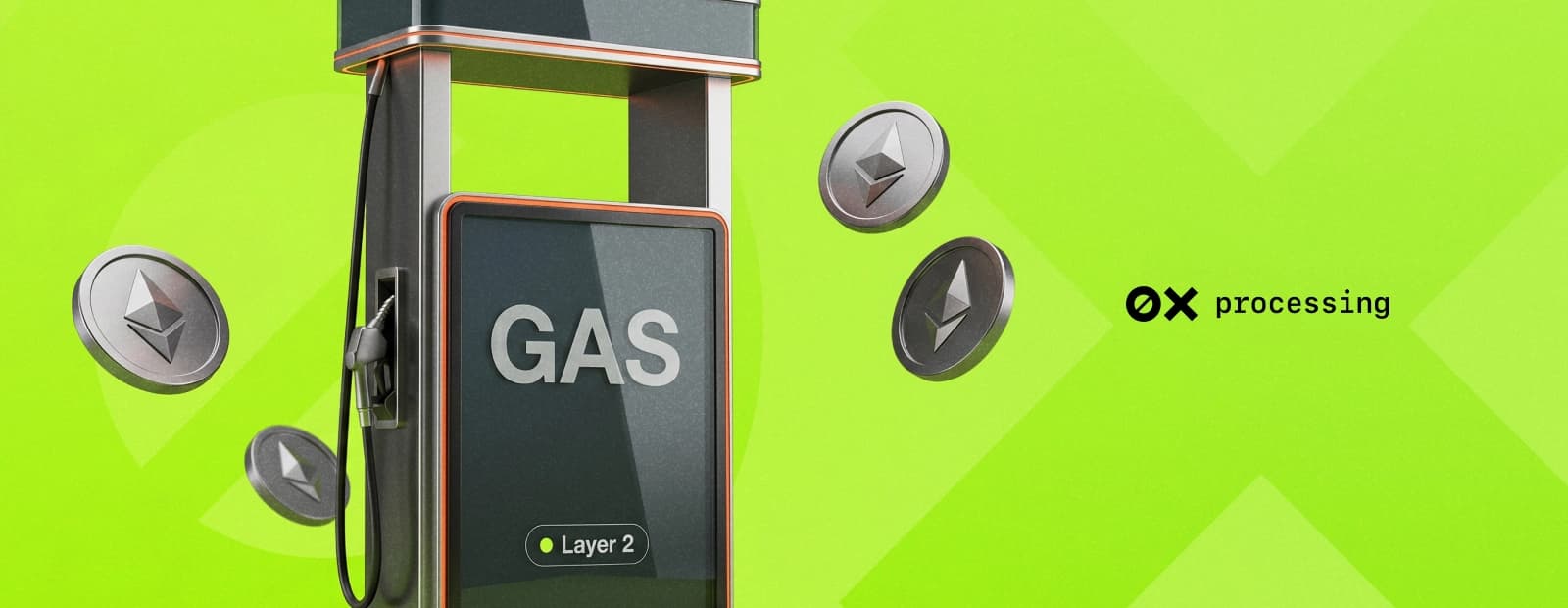
Gas is the fee you pay to have the network process a transaction, and it rises with demand. Strictly, the base-fee portion is burned, not pocketed by validators – only the priority tip goes to them.
Gas used to be the dealbreaker. Not anymore. Mainnet gas averaged roughly 3 gwei in early 2025 and had fallen to around 0.7 gwei by early 2026.
Two upgrades drove that down. EIP-4844 (Dencun, March 2024) introduced blob transactions that cut Layer 2 fees by over 90%, and Pectra (May 2025) doubled blob capacity, pushing even more activity onto L2. On L1 itself the effect was indirect: as activity migrated to Layer 2, demand for mainnet block space dropped and average gas settled below 5 gwei.
Want to accept crypto payments on your website?
What you'll actually pay to move an ERC-20 token on mainnet is ten or twenty cents on a normal day. It can jump to a couple of dollars when DeFi heats up, but that's the exception. Those $50–100 fees from the 2021 boom are gone.
Layer 2 networks push it lower still. They process transactions off-chain and batch-settle to Ethereum, borrowing its security for a fraction of the cost.
| Network | Typical fee | Notes |
|---|---|---|
| Ethereum mainnet | $0.10–0.20 | Institutional, large transfers |
| Arbitrum | $0.001–0.05 | One of the largest L2s by TVL, deep DeFi |
| Optimism | $0.001–0.05 | Wide protocol support |
| Base | Under $0.01 | Coinbase L2, deep exchange ties |
| Polygon | ~$0.01–0.02 | Cheap, widely integrated |
So, the rule of thumb is this. Use Layer 2 for everyday payments, and keep the mainnet for large transfers above ~$50K, where settling directly on L1 is worth the fee.
Pick a gateway that covers mainnet plus the big L2s, and your customers just pay from whatever network their wallet's already on – no juggling, no "wrong network" headaches.
Can you accept ERC-20 tokens and stablecoins on Ethereum?
Yes – and for most merchants this matters more than taking ETH itself. ERC-20 is Ethereum's token standard, and it covers the biggest stablecoins. Both USDT and USDC run as ERC-20 tokens on the network.
Taking USDT or USDC on Ethereum gives you dollar-stable settlement without leaving the ecosystem. A $500 invoice in USDC stays at $500, and ETH's volatility never comes into play.
If your customers lean toward stablecoins, an ERC-20-capable gateway handles both ETH and dollar-pegged tokens via a single integration. Our USDT gateway
guide digs into the networks and fees.
How to accept ETH payments: step-by-step
Most of the work is paperwork, not code. Zero to live in five steps.
- Register a merchant account with an Ethereum gateway and provide basic business details.
- Pass KYB. Company documents and beneficial ownership – standard onboarding, with AML logic that matters most for regulated verticals.
- Choose networks and settlement. Decide which networks to accept (mainnet, Arbitrum, Base) and whether to auto-convert incoming ETH to a stablecoin or fiat.
- Integrate. Drop in the API, a payment widget, a checkout button, a payment link, or an invoice flow.
- Test, then go live. Run a small transaction on mainnet and one L2, confirm the webhook fires and the balance updates, then switch on real traffic.
Most merchants go live within a week.
Want a transparent setup for your volume? 0xProcessing onboards merchants across 85+ coins and 18 blockchains, with auto-conversion to stablecoins and 0% processor fees on withdrawals (network gas may still apply).
Get startedWhat integration options exist for ETH acceptance?
Broadly, you've got two ways in. The quick one is a ready-made plugin – Shopify, WooCommerce, Magento all have them, and they're a few minutes' work with barely any code. You trade some control for that speed.
The other way is a custom integration, which takes more setup but bends to whatever your site needs. Past plugins, these are the main paths.
REST API
Full control over the flow – generate invoices programmatically and listen for webhook callbacks.
Payment widgets and buttons
Embed checkout into an existing page with minimal code.
Payment links
No site needed. Send a link, get paid – handy for invoicing and social sales.
Invoice flows
Itemized B2B billing.
Web3 wallet connect
Customers pay straight from MetaMask, WalletConnect, Coinbase Wallet, or Rabby.
For businesses built around Web3 wallets, the Web3 payment gateway handles the wallet-connect layer. 0xProcessing also offers white-label forms you can brand as your own.
How do you convert ETH to fiat and manage volatility?
Price swings are the main thing that makes businesses hesitate on ETH. Auto-conversion settles it.
Switch conversion on, and the gateway locks the rate when the customer pays, then settles straight to a stablecoin or fiat. You keep the sale value, not the volatility – a $500 payment stays $500 no matter what ETH does an hour later.
For the off-ramp, the rail matters. SEPA inside the EU is usually free; a SWIFT wire runs $25–50 and takes a few days. 0xProcessing settles via SWIFT/SEPA with bank deposit in 3–5 working days depending on location, or you can hold a stablecoin balance and convert on your own schedule.
Is accepting ETH secure and legal?
A few security basics aren't optional. Put 2FA or higher on your account. Validate addresses before sending. Use multi-sig for large balances.
On top of that, a custodial gateway with real-time AML/KYT screening checks incoming transactions against blacklist data, so tainted tokens don't quietly land in your balance.
Legally, 2026 is clear across major markets. The US treats crypto as taxable property and lets you accept it. The EU regulates under MiCA at the issuer and service provider levels, not at the merchant level. The UK and Singapore both allow ETH acceptance under frameworks that continue to mature.
Not one of them bars a business from taking Ethereum – what you owe is tax reporting and record-keeping. Check the specifics with a local advisor.
What are the benefits and best industries for ETH payments?
The upside builds on the usual crypto advantages – no chargebacks, lower fees, global reach – and adds the programmability smart contracts bring. That last piece is why some industries lean Ethereum-first.
GameFi and NFT projects operate on Ethereum and its L2s, using ETH and ERC-20 tokens as the native currency for in-game assets and marketplace sales; our
NFT payments case studies cover this.
SaaS and Web3 services run subscriptions on smart-contract billing. DeFi-adjacent platforms serve an audience already holding ETH. And e-commerce stores take it to reach crypto-native shoppers, with auto-conversion handling the volatility.
How to start accepting Ethereum with 0xProcessing
Setup is the easy part. 0xProcessing takes ETH on mainnet and across the major Layer 2 networks, plus ERC-20 stablecoins, with auto-conversion via VRCS (Volatility Risk Control System), 0% withdrawal fees, and a SWIFT/SEPA off-ramp.
It's been live since 2020, has completed four external security audits (2022–2025), and runs on its own node infrastructure with real-time AML/KYT.
For the neighboring asset, our Bitcoin processing guide covers BTC.
Ready to accept Ethereum? Settle across 85+ coins and 18 blockchains, with mainnet and Layer 2 support, stablecoin auto-conversion, and 0% processor withdrawal fees (network gas may apply).
Start accepting ETHBottom line
Accepting Ethereum in 2026 is nothing like it was at the peak of gas fees. Layer 2 made it cheap enough for everyday use; ERC-20 support lets you take dollar-stable tokens through the same setup, and auto-conversion strips out the volatility that kept finance teams wary.
What's left to decide is which networks you accept and how fast you convert. Get those two right, and Ethereum turns into a low-cost rail straight into the largest Web3 audience in crypto.
FAQ
How do I accept Ethereum payments for my business?
Register with an Ethereum gateway, pass KYB, choose your networks and settlement preference, integrate via API or a payment widget, then test and go live. Most merchants are processing within a week.
How much does it cost to accept ETH in 2026?
Mainnet ERC-20 transfers run about $0.10–0.20 normally. On Layer 2 networks like Base or Arbitrum, fees drop to $0.001–0.05 – effectively free for everyday payments.
Can I accept USDT and USDC on Ethereum?
Yes. Both run as ERC-20 tokens on Ethereum. A gateway that supports ERC-20 lets you accept ETH and dollar-stable tokens via a single integration.
Do I have to hold ETH if I accept it?
No. Auto-conversion instantly converts incoming ETH to a stablecoin or fiat, so you avoid price exposure and simplify accounting.
What is a Layer 2, and why does it matter for payments?
Layer 2 networks (Arbitrum, Optimism, Base) process transactions off-chain and settle to Ethereum, cutting fees by 90–99% while keeping mainnet security. They make ETH viable for small, everyday payments.
Is accepting Ethereum legal?
In most major markets, yes. The US, EU, UK, and Singapore permit merchant acceptance of ETH; the obligations are tax reporting and record-keeping, not prohibition.
