The best alternatives to Stripe in 2026 are specialised payment gateways such as 0xProcessing, Adyen, and Braintree. They work with high-risk niches and cryptocurrencies. While Stripe blocks entire business categories – online casinos, forex brokers, NFT marketplaces, and adult SaaS – these competitors offer legal white-label solutions with crypto payment support.
If Stripe has blocked your account or won't allow you to accept cryptocurrency, you are not alone. Many growing businesses face these barriers. But that doesn't mean you have to shut down your business. It means it's time to find a payment gateway that is designed for your reality, not against it.
Why businesses are looking for alternatives to Stripe in 2026
Stripe is a great tool for a standard online store or SaaS. But its policies are not designed for entire industries.
Industry restrictions
Stripe explicitly prohibits working with online casinos and gambling, forex brokers, unlicensed financial services, and adult businesses. If you work in one of these areas, Stripe will sooner or later discover this and close your account, often freezing your funds for 90-120 days.
Difficulties with cryptocurrency and NFT
Stripe's support for cryptocurrencies is unstable. The company launched and then stopped accepting Bitcoin in 2018. In 2022, Stripe announced the return of crypto payments, but only for stablecoins (USDC) and through specific partners. For most Web3 projects, NFT marketplaces, or crypto services, this is not a solution.
Sudden account blocks and freezing of funds
Stripe, like other public processors, uses automated fraud monitoring. Unusual activity — a surge in transactions, payments from new countries — can trigger a block. Unfreezing an account is difficult and time-consuming. For businesses, this means an instant halt in cash flow.
PayPal is not a solution either
Many who encounter problems with Stripe choose PayPal as an alternative. But PayPal has almost identical restrictions for high-risk sectors and is also unstable in its support for cryptocurrencies. We need not just PayPal alternatives, but specialised solutions.
Criteria for choosing a worthy competitor to Stripe
Choosing a new payment gateway is not just a matter of finding a replacement. It is a chance to build a more reliable and scalable financial infrastructure. Focus on these four key criteria to avoid repeating the painful experience with Stripe.
Transparent policy on high-risk industries
The first and most important criterion is the provider's honesty regarding your niche. Universal processors such as Stripe claim to support "businesses of all sizes," but their user agreement contains a long list of prohibited activities. If your industry is included, your account will be frozen sooner or later.
A real alternative should not just "tolerate" high-risk businesses, but have transparent, published terms and conditions for working with such verticals. Look for sections on the gateway's website such as "For iGaming" or "Solutions for Forex". Direct answers from support to questions such as "Do you work with online casinos?" and "What documents are required for connection?" are a green light. Working with such a provider is based on legal compliance, not on the hope that you will go unnoticed.
Cryptocurrency support and working with stablecoins (USDT, USDC)
In 2026, the absence of crypto payments is a conscious rejection of part of the market. But support must be deep, not just marketing. Check whether the gateway allows you to accept not only Tron, but also popular stablecoins (USDT, USDC) in several networks (ERC-20, TRC-20, BEP-20). This is important for reducing fees and transaction speeds.
Want to accept crypto payments on your website?
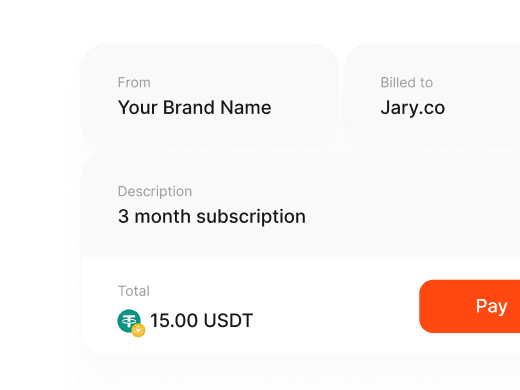
The second aspect is volatility management. A good gateway offers tools for automatically converting received crypto funds into stablecoins. This insures your revenue against sharp exchange rate fluctuations. Thus, you get the benefits of cryptocurrencies (speed, global reach) without their main risk, turning digital assets into a stable financial instrument.
White label and customisation for your brand
For high-risk businesses, privacy and control over the customer experience are more important than ever. A white label solution allows you to completely hide the payment provider's brand. All elements of the payment form, notifications and success pages are displayed under your domain and logo. This strengthens customer trust and reduces the risk of them refusing to pay when they see an unfamiliar gateway name.
Customisation should be technical, not cosmetic. Check whether the process can be flexibly configured via API: create your own payment links, integrate special anti-fraud methods. The gateway should be an "invisible" tool that works according to your rules, not the other way around.
Global licences and coverage (Europe, Asia, Latin America)
The gateway's own payment licences, for example in the EU or the UK, are a guarantee of legality and stability. Licensed companies undergo regular audits and their activities are regulated, which minimises the risk of sudden service termination. This is a fundamental difference from intermediaries who lease other people's acquiring capacities.
Overview: Top 3 alternatives to Stripe for 2026
We have selected solutions that address specific pain points. These are not just Stripe-like services, but gateways with a clear specialisation.
0xProcessing: The #1 specialist for high-risk and crypto
If Stripe or PayPal has blocked your account due to a high-risk niche, 0xProcessing is not a workaround, but a direct solution. This gateway is designed to work with business models that traditional processors refuse: iGaming, forex dealing, NFT marketplaces, crypto services, and adult SaaS.
Unlike universal aggregators, 0xProcessing is a specialised platform focused on crypto payments. The gateway supports over 65 popular cryptocurrencies and 14+ blockchains, including all major networks for Bitcoin, Ethereum, TON, Tether (USDT), and USD Coin (USDC). Users can pay from their usual wallets, from Trust Wallet to MetaMask.
The main technological advantage is the flexible configuration of financial flows. You can set up instant auto-conversion of all incoming payments in cryptocurrency to stablecoins (USDT) to fully insure your revenue against volatility. Withdrawals are available 24/7: you can receive money to your crypto wallet. Withdrawals via SEPA and SWIFT are possible, but each request is processed individually. This makes 0xProcessing an ideal infrastructure alternative to Stripe for Web3 and the high-risk segment, offering not just a replacement, but a more advanced and controllable tool for business.
Adyen: A global giant for legal enterprises
Adyen is a Stripe alternative for a different level. The company serves not start-ups, but large international businesses: from Netflix and Spotify to Uber and eBay. Their key strength is their own global acquiring network. Adyen connects directly to payment systems around the world, reducing fees and increasing the percentage of successful transactions for legal retail, travel, and digital goods.
However, this power is not available to high-risk businesses. Adyen publicly states that it has a strict compliance policy and does not work with gambling, cryptocurrencies or other regulated niches without special licences, which are extremely difficult to obtain. Their platform is a model of technological excellence, but only for those who play by the classic financial rules. For such companies, Adyen is not just a competitor to PayPal and Stripe, but their evolutionary replacement.
Braintree (from PayPal): A tool for developers in the PayPal ecosystem
Braintree is often called the best API on the market, and for good reason. Acquired by PayPal, this service has maintained its focus on developers, offering incredibly detailed documentation, powerful SDKs, and flexible tools for creating complex payment logic, including subscriptions, marketplaces, and split payments. If your main pain point is not the niche but the technical limitations of the Stripe API, Braintree may be an excellent choice.
It is important to understand its limitations: Braintree is part of the PayPal ecosystem. This means that it inherits all of its policies. Working with cryptocurrencies or in high-risk industries through Braintree is just as difficult as through PayPal itself. This gateway is ideal for "clean" SaaS startups, marketplaces with physical goods, and other legal tech projects that need maximum control over the payment UX.
Shopify Shopify Payments
Shopify Shopify Payments, if your business is built on the Shopify platform, then Stripe's own ecosystem solution can be an alternative. This is an international acquiring service, which is built into all stores on the Shopify platform by default, which greatly simplifies connection and sales management.
However, it is important to understand the nuances. Shopify Payments is based on Stripe. This means that, despite the convenience of integration, it inherits most of the limitations of its technology partner. The gateway is supported in 30+ countries and handles major currencies. Shopify Shopify Payments charges merchants a commission for each successfully processed transaction, the amount of which depends on the selected Shopify tariff plan. On average, the commission ranges from 2.4% to 2.9% + a fixed fee for the payment, while there are no separate fees for using a third-party payment gateway. The main disadvantage is the basic restrictions for working with high—risk businesses, plus the main link to Shopify-based projects.
CoinsBank
CoinsBank is a service that combines a payment system that supports a variety of bitcoin and other altcoins, as well as a platform for exchanging cryptocurrencies. The trading terminal has a simple and intuitive interface that provides real-time transaction management and tracking of changes in quotes on the market.
A distinctive feature of this payment gateway is the issuance of a debit card linked to a wallet inside the system. The user can use this card to make purchases in cryptocurrency and fiat money due to the possibility of conversion. What CoinsBank gives is that it can be one of the world's largest cryptocurrency exchanges, which can be useful for companies wishing to promote their client as it sees fit.
Paystand
Paystand's main product is a customer—oriented, real-time system called the Paystand Bank Network. This is not just a Stripe brand, it is a specialized platform for the B2B sector.
The pay kiosk fully automates paid services for corporate clients. For example, the company allows insurance companies to receive insurance premiums digitally and send notifications of insurance claim payments. The manufacturing, transportation, and pharmaceutical industries are also benefiting from the digitalization of the money cycle.
The key difference between a paid kiosk is model education. The pay kiosk does not contain anything that could be used to pay for purchases. The company works with its clients on a subscription model – they are charged a fixed fee for using the software. For large B2B companies with large turnover, this can be much more profitable than traditional models with a transaction fee. Discover the tools that power more than 500 brokerage companies. Learn everything about the company, from accessibility to CRM and computer infrastructure.
Comparison table: Stripe vs. Top competitors 2026
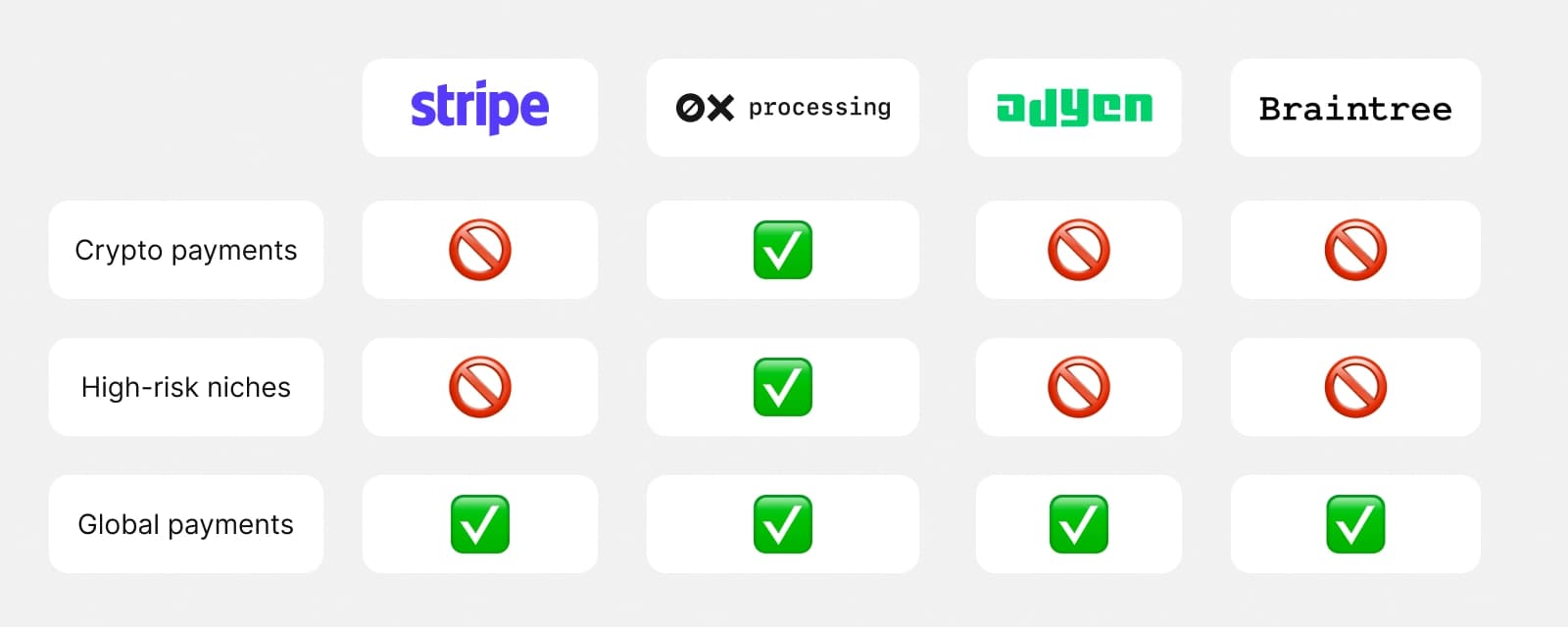
| Solution/Criterion | Working with High Risk | Crypto Payments | Integration Cost | Global Reach | Ideal Niche |
|---|---|---|---|---|---|
| Stripe | No | Limited | No | Wide | Standard retail, SaaS |
| 0xProcessing | Yes | 85+ cryptocurrencies | Free | Wide | iGaming, Crypto, Forex, High-Risk SaaS |
| Adyen | No | No | No | Wide | Large-scale retail, travel |
| Braintree | No | Limited | Depends on the tariff | Broad | Technical SaaS, marketplaces |
| Paystand | No | Limited | Subscription (0% per transaction) | Wide | B2B, manufacturing, insurance |
| Shopify Payments | No | USDC | Transaction fee | Limited | Stores on Shopify |
| CoinsBank | Yes | Yes | Depends on the tariff | Wide | Stores focused on accepting cryptocurrencies |
Why is 0xProcessing the best alternative for crypto and high-risk businesses?
Choosing 0xProcessing is a strategic move away from fighting restrictions and towards leveraging opportunities. Here are the key reasons why it is becoming the preferred solution for those who have been rejected by Stripe.
Legal certainty instead of grey areas. While many try to mask high-risk activity in Stripe, 0xProcessing works with such niches legally, based on transparent rules, AML and KYB checks. This removes the constant risk of sudden blocking and loss of funds. Your business ceases to be a rule breaker and becomes a customer of a payment company.
An integrated crypto ecosystem, not an add-on. For Stripe, cryptocurrencies are an experiment. For 0xProcessing, they are the core of the platform. You get a single tool for accepting, converting and withdrawing crypto and fiat. This simplifies accounting, reduces operating costs, and gives customers the seamless payment experience they expect in 2026.
Control over cash flow and volatility. The ability to configure auto-conversion to stablecoins is not just a feature, but financial protection. You can accept payments in Ethereum, but your balance is replenished in stable USDT. This provides predictability that neither Stripe nor traditional high-risk processors that only work with fiat can offer.
Focus on scaling, not survival. Payment infrastructure is the foundation for growth. While you spend time arguing with Stripe support about unfreezing your account, competitors with a reliable gateway are already entering new markets and launching products. 0xProcessing removes this systemic risk, allowing businesses to focus on growth rather than maintaining the status quo.
Example: An NFT marketplace increased its payment conversion rate by 25%. The project faced a Stripe block for "unconfirmed activity." After switching to a provider with native crypto support, the conversion rate at the payment stage increased by 25%, and the number of successful transactions increased by 40%.
Check if 0xProcessing is right for your niche. Get a payment strategy audit from high-risk experts.
Choosing an alternative to Stripe is not about finding something "similar but cheaper." It's about finding a solution tailored to your needs. If you are growing in a high-risk niche or your monetisation is tied to cryptocurrencies, choose a narrow specialist. Universal solutions will only slow down your growth and create risks.
Frequently asked questions
Is it technically difficult to migrate from Stripe?
Migration is a structured technical project rather than a fundamental obstacle.
Modern alternative providers offer APIs that are comparably well documented and REST-oriented, similar to Stripe’s architecture. Many provide migration scripts, SDKs, and direct developer support to accelerate onboarding.
The critical implementation step is correctly reconfiguring webhooks for payment status updates, refunds, chargebacks, and subscription events to ensure transactional consistency.
Will I get the same developer convenience as with Stripe?
Leading alternatives such as Braintree and 0xProcessing invest heavily in developer experience.
They typically provide structured API documentation, SDK libraries, sandbox environments, and clear webhook schemas. From an engineering standpoint, integration complexity is comparable when proper technical planning is applied.
Is it safe to work with high-risk providers?
Working transparently with a provider that officially supports high-risk industries is significantly safer than attempting to misclassify your business model with a mainstream processor.
0xProcessing explicitly supports high-risk verticals and structures its compliance and risk policies accordingly. Operational stability is achieved through regulatory alignment and disclosure — not concealment.
What to do with existing customer subscriptions in Stripe?
Subscription migration is one of the most complex elements of gateway transition.
You will need to:
- Notify customers in advance.
- Create equivalent recurring billing profiles in the new system.
- Coordinate billing cycles to avoid double charging or service interruption.
This stage must be carefully planned to preserve recurring revenue and minimize churn.
What about transaction history and accounting data?
Before terminating your Stripe account, export complete reports covering transactions, refunds, disputes, and fees.
In the new gateway, configure accounting integration via API or pre-built connectors to maintain financial continuity.
Data reconciliation during migration is essential for audit readiness and compliance integrity.