The growth in the use of cryptocurrencies in business is one of the most notable trends in the digital economy. More and more companies are integrating crypto payments into their payment systems: from online retail to B2B services.
According to analysts' estimates, by the end of 2025, the daily volume of cryptocurrency transactions will reach $300 billion, three times more than at the end of 2024.
Along with the popularity of crypto payments, the need for reliable ways to store digital assets is also growing. Losing private keys or having your wallet hacked can result in millions in losses. Therefore, choosing the right type of crypto wallet is a critical task for any business working with cryptocurrencies. Let's compare the three main types of wallets – hot wallets, cold wallets, and custodial solutions – in terms of security, ease of use, service cost, scalability, and regulatory compliance. We will analyse which type of wallet is optimal for daily payments and which is optimal for long-term storage of reserves. We will also look at the role of 0xProcessing as a crypto payment processor for business, providing secure integration of all types of wallets.
What are business wallets for cryptocurrencies?
A business wallet for cryptocurrencies is a specialised solution for companies to store, receive and send crypto assets. Unlike consumer wallets, it meets the specific requirements of the corporate sector.
- Secure storage of reserves;
- Processing crypto payments for business;
- Employee access management (role-based model);
- Compliance with AML/KYC and other regulatory requirements;
- Integration with accounting and ERP systems;
- Auditing and reporting for tax authorities.
Standard wallets (e.g., mobile or browser-based) do not provide role-based access, adequate protection against internal threats, APIs for integration with accounting systems, tools for corporate auditing, or regulatory compliance.
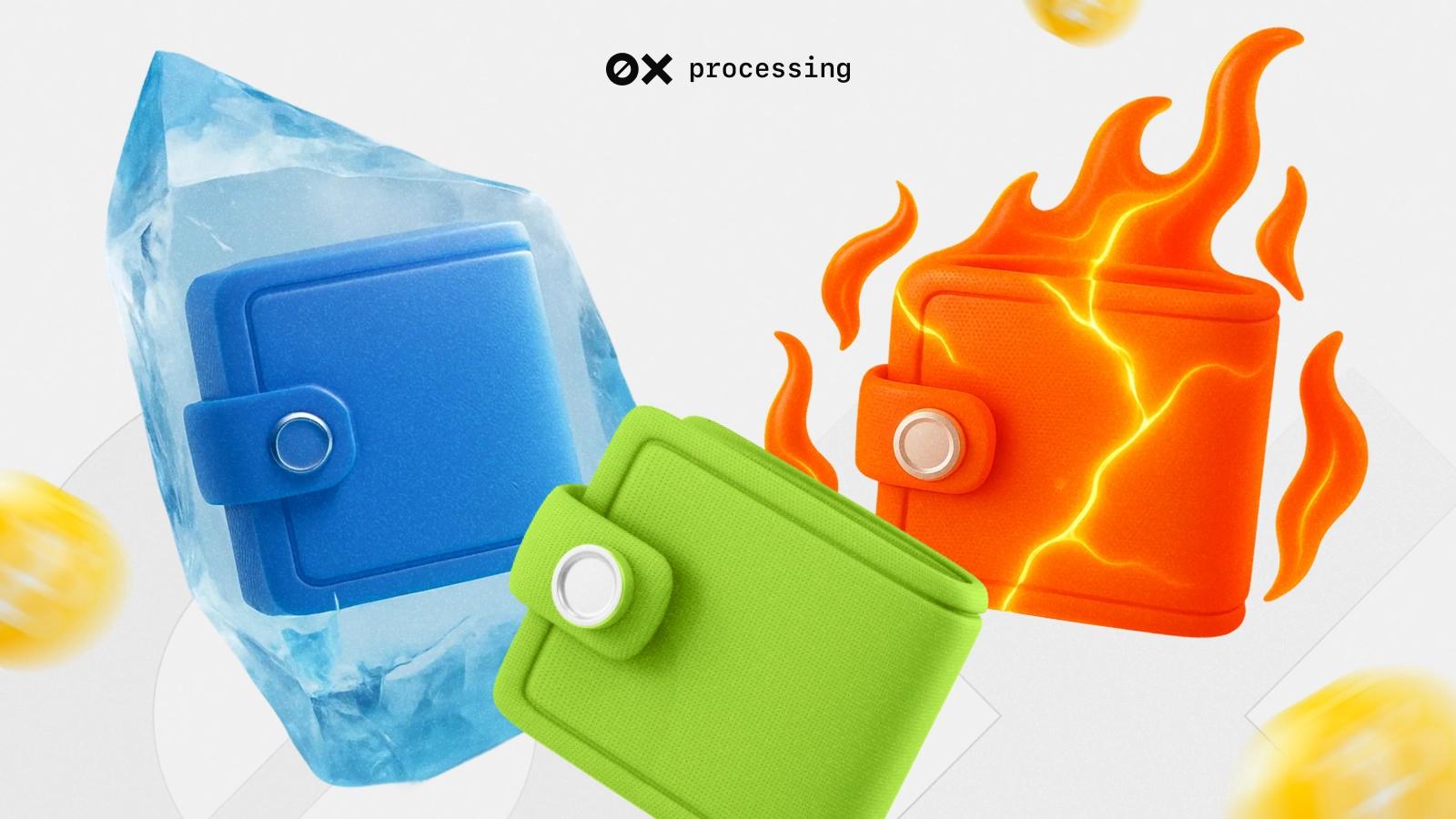
Hot Wallets: Speed vs. Risk
Hot crypto wallets are online wallets with a constant connection to the network. They provide instant access to funds and easy integration with payment systems.
Examples of hot wallets include web interfaces (exchange wallets), mobile apps with online access, and API solutions for payment automation.
Advantages of hot wallets:
- Instant access to funds – ideal for processing current payments;
- Convenience for accepting crypto payments for business – easy to integrate into online stores and services;
- Easy setup and use – no special technical knowledge required;
- Support for bulk payments – hundreds of transactions can be sent automatically;
- Compatibility with crypto payment processors for business – for example, with 0xProcessing.
Use cases: daily transactions with customers, processing small payments (up to £10,000), testing new crypto services, integrating with payment gateways, and working with high-turnover assets.
Want to accept crypto payments on your website?

Disadvantages of hot wallets:
- Vulnerability to hacker attacks – online connection makes them a target;
- Dependence on the service provider – server failures can block access to funds;
- Risk of losing funds if the device or account is hacked;
- Limited protection against phishing – employees may accidentally disclose keys.
Cold Wallets: Security Above All
Cold wallets are offline solutions without a constant internet connection. They are considered the most reliable way to store crypto assets.
Types of cold wallets:
- Hardware wallets (Ledger, Trezor, SafePal) – physical devices storing keys in an isolated environment;
- Multi-signature storage – multiple keys required to confirm transactions;
- Air-gapped solutions – computers never connected to the network.
Advantages:
- Maximum protection against online threats;
- Full control over private keys;
- Resistance to phishing and hacker attacks;
- Protection against unauthorised access;
- Compliance with strict regulatory requirements for asset storage.
Disadvantages:
- Slow transaction processing – manual confirmation and device connection required;
- Complexity of mass use – inconvenient for frequent payments;
- Risk of physical loss or damage;
- Need to train staff;
- High initial costs for purchasing equipment.
Use cases: storing large reserves (over £100,000), long-term investments, backups, funds not requiring immediate access, complying with capital reserve requirements. Cold wallets are relevant for exchanges, investment funds, large retailers, and companies handling regulated assets.
Custodial Wallets: Convenience Through Control
Custodial wallets are solutions where private keys are stored by a third party: an exchange, payment provider, or specialised custodian. Examples include Coinbase Custody, BitGo, and Fidelity Digital Assets.
Advantages:
- Ease of management – no technical knowledge required;
- Access recovery in case of loss;
- Built-in AML/KYC support;
- Integration with crypto payment processor for business;
- Fund insurance – some providers cover theft risks;
- Compliance with regulatory requirements – custodians undergo audits and obtain licences.
Disadvantages:
- Dependence on the provider – funds can be frozen;
- Risk of custodian bankruptcy;
- Less transparency of operations – private keys not controlled by the company;
- Service fees – usually 0.1–0.5% of transaction volume;
- Withdrawal restrictions.
Use cases: companies without technical resources, regulated assets, quick start without complex setups, integration with payment gateways, jurisdictions with strict data storage requirements.
Want to start accepting crypto payments without the headache? Connect 0xProcessing – a crypto payment processor for business that supports all wallet types, provides automatic conversion to fiat or stablecoins, integrates via API in 1–2 days, and complies with AML/KYC requirements. Submit a request for a personal consultation.
Comparative Analysis: How to Choose the Best Option
| Criterion | Hot wallet | Cold wallet | Custodial wallet |
|---|---|---|---|
| Security | Low: connected to the network, vulnerable | High: offline, eliminates online threats | Medium: depends on provider, funds may be frozen |
| Transaction speed | Instant | Low: manual confirmation | Medium: provider dependent |
| Cost | Service fees for API and transactions | One-time equipment costs | Monthly fees (0.1–0.5% of volume) |
| Scalability | Medium | Low | High: API supports thousands of transactions |
| Asset support | Wide | Limited | Wide |
| API integration | Yes | Limited | Yes |
| Optimal application | Daily payments, testing services | Long-term reserves, backups | Quick start, regulated assets |
Conclusions: hot wallets – speed and integration; cold wallets – security and long-term storage; custodial wallets – simplified management. Recommendation: combine wallet types: hot for payments, cold for reserves, custodial for conversions and compliance.
How to Implement a Business Wallet: Step-by-Step
- Needs analysis: determine transaction volume, asset types, geography, regulatory requirements, team skills, budget.
- Select wallet type: hot for daily operations, cold for reserves, custodial for quick start and compliance.
- Security settings: multi-signature for large transactions, role-based employee access, 2FA, physical cold wallet storage.
- Integration with payment system: register in 0xProcessing, get API keys, configure webhooks, conduct sandbox tests, start accepting crypto payments.
- Staff training: keys and seed phrases handling, phishing recognition, transaction monitoring responsibilities.
Optimise crypto payments with 0xProcessing! Automatic conversion to fiat or stablecoins, integration with cold and custodial wallets, commission from 0.5%, AML/KYC compliance, API access, personalised consultation.
Security and Compliance: Key Aspects
- Hot wallets – software updates, isolation, suspicious login monitoring, VPN, limited employee access;
- Cold wallets – physical safes, divided keys, seed phrase backups, emergency preparedness;
- Custodial wallets – check licences, audits, NDAs, fund freezing and insurance coverage;
- AML/KYC – automated verification, logging, blacklist integration, GDPR/CCPA compliance.
The Future of Business Wallets: Trends and Forecasts
- MPC – private keys shared securely between parties;
- Hybrid wallets – combining hot and cold features;
- Integration with DeFi – staking, lending, passive income;
- Regulatory pressure – stricter custodian requirements, mandatory insurance, transparency standards.
Conclusion
Hot wallets vs cold wallets – not a confrontation, but synergy. Hot wallets – for payments; cold wallets – for reserves; custodial solutions – for simplified management. 0xProcessing combines all wallet types, provides instant conversion, API integration with ERP, and compliance with FATF, MiCA, and other regulators. Optimal strategy: hot for transactions, cold for reserves, custodial for management. 0xProcessing ensures minimal cost and maximum security.
Connect 0xProcessing – a crypto payment processor for business that automates asset conversion, reduces fees with volume growth, ensures AML/KYC compliance, and supports all wallet types. Submit a request for access and personal consultation.
Frequently Asked Questions (FAQ)
What type of wallet is best for a start-up?
Start with a custodial wallet (e.g., via 0xProcessing) for a quick launch, supplementing it with a hot wallet for accepting payments.
How can I protect a cold wallet from physical loss?
Store the device in a safe, create backups of the seed phrase, and use multi-signature schemes.
Can wallet types be combined?
Yes: hot wallets for transactions, cold wallets for reserves, custodial wallets for conversions.
What are the fees for custodial solutions?
Typically 0.1–0.5% per transaction, with fixed monthly fees also available.
How do I integrate a wallet with 0xProcessing?
Register, obtain API keys, configure webhooks, conduct tests, and start accepting payments.