The vast majority of failed crypto payments are not due to blockchain failures, but rather to interface and integration errors: the user sends funds to the wrong network, does not specify the required Memo/Tag, or sets the gas fee too low. The solution is a payment gateway that validates addresses, suggests the current fee, and displays the transaction status in an understandable way. This reduces the error rate from 15–20% to a fraction of a percent and reduces the load on technical support.
Why is every failed transaction a double loss?
In the fiat world, a payment either goes through or it doesn't. There is no third option. In cryptocurrencies, there is a state of ‘pending’ transaction – it has not failed, but it has not been credited either. It just hangs in the mempool for hours, and sometimes days.
Loss of immediate revenue
The client has reached the cashier, sent USDT from his wallet, and sees "Pending". An hour later, he still hadn't received confirmation, decided that something was broken, and went to a competitor. You're not just losing a payment, you're losing a customer you've almost convinced.
Loss of customer trust and loyalty
Crypto already scares ordinary users. When, after the very first payment, the money is frozen for an indefinite period, the person decides that ‘it's all too complicated’ and goes back to bank cards. It is almost impossible to get them back later.
Increased load on technical support
Every “frozen” transaction is a ticket. The user writes, ‘I sent it, but it wasn't credited to my account.’ Support goes to the block explorer, searches for the hash, checks the status, explains about commissions and networks. One such request takes 15-20 minutes. With 50-100 failed transactions per day, this turns into a full-time job for an employee who does nothing but sort out other people's mistakes.
Diagnostics: Top 5 technical reasons for failed crypto payments
Let's look at the main ‘404 errors’ in the world of crypto payments. These are not abstract failures, but specific situations that cost thousands of merchants money and nerves every day.
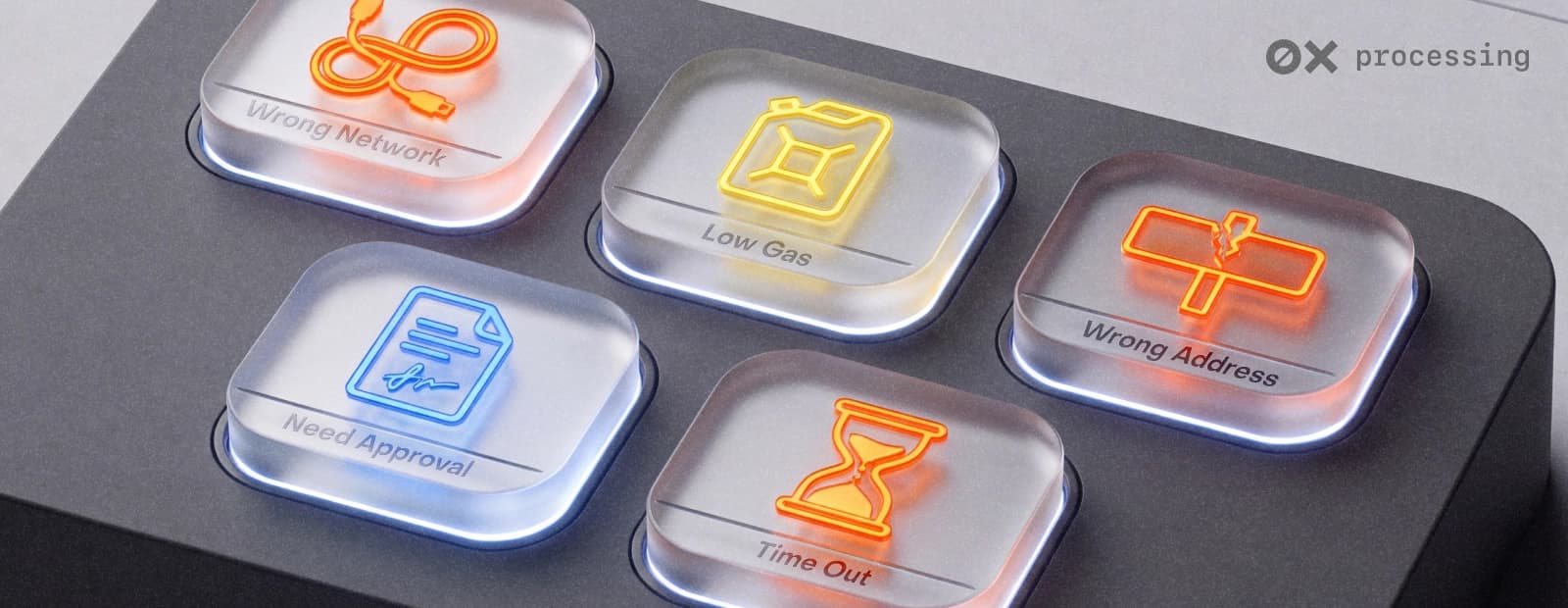
Error 1: Wrong Network
Symptoms: The user sends USDT to the gateway address, but the funds are not credited. The transaction is successful in the block explorer, but the merchant's balance does not change.
Why: Addresses in EVM networks (Ethereum, Polygon, BSC) have the same format – they all start with 0x.... The user does not notice that they are sending USDT on Ethereum to a Polygon address. The wallet does not complain, and the transaction goes to a network that the gateway does not listen to.
Diagnostics: Open the block explorer of the network to which the user sent the funds. Check the recipient's address.
Want to accept crypto payments on your website?
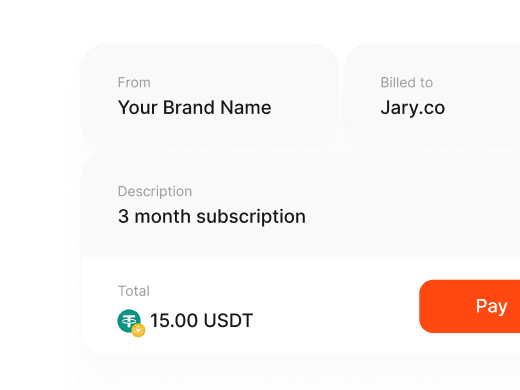
Solution: The 0xProcessing documentation states: ‘If a payment is sent to a static address in a currency from another network, it is not possible to return or credit the amount.’ The only protection is to generate a unique address for each account in a specific network. Then the address for Ethereum (ERC-20) is physically different from the address for BSC (BEP-20), and the wallet will not allow you to send to the wrong network - because each address is generated specifically for one network.
Error 2: Insufficient Gas Fee
Symptoms: A transaction in Ethereum, BSC or Polygon freezes with the status ‘Pending’ for hours or disappears (dropped).
Why: Miners sort transactions by commission size. Whoever pays more will get through faster. The user set a very low gas fee, and the transaction froze in the mempool.
Diagnosis: Enter the txhash in the block explorer and check the Gas Price. Compare with etherscan.io/gastracker or mempool.space.
Solution: For EVM, the transaction can be sped up (Speed Up) or cancelled (Cancel) by sending a new one with the same nonce and a higher commission.
Error 3: Error in the recipient's address
Symptoms: The user sends funds, the transaction is successfully confirmed on the blockchain, but the money went to the wrong recipient. The blockchain browser shows that the funds have been transferred to the wrong address.
Why: The most common reason is infection of the device with a virus that replaces the address in the clipboard. The user copies one address and inserts a completely different one. There may also be an error during manual input: a typo or a missing character.
Diagnostics: Compare the address that the user copied with the one that was inserted in the sending field. Check the first 4 and last 4 characters. In the blockchain browser, look at which address the funds went to.
Solution: If the address has been replaced by a virus, there is almost no chance of returning the funds - transactions in the blockchain are irreversible. If there is a network error (for example, you have sent ERC-20 to an address that supports only BEP-20), and the recipient controls the private key, funds can be restored by importing the wallet. The best protection is to always check the address by the first and last characters and use white lists of addresses.
Error 4: Webhook delivery failed
Symptoms: The user has paid, the blockchain has confirmed, but the status on the website is ‘Awaiting payment’. The goods are not being shipped, and support is on fire.
Why: The gateway sent a POST request to the merchant's server, but the server did not respond or went down, was undergoing maintenance.
Diagnostics: Check the server logs for incoming requests from the gateway IP. Check the HTTP status of the response.
Solution: The gateway must have a retry mechanism. In September 2025, BVNK restarted webhooks and resent notifications for all failed transactions. Stripe added a processing status and recommends listening for the payment_intent.processing event.
Error 5: Payment to an expired address
Symptoms: The transaction exists, the amount is correct, and the address looks real. But it does not belong to the merchant.
Why: A typo during manual entry, address substitution by malicious software, the user copied an old address from a previous invoice.
Diagnostics: Compare the address in txhash with the merchant's reference address in the database.
Solution: The gateway should generate a new address for each invoice - this is the only reliable protection. In 0xProcessing, a unique one-time address is created for fixed-amount payments, and even if the user sends to an old address, the system can still credit the payment because the address remains permanently linked to that specific order.
Table: Quick diagnosis guide for ‘Error 404’ in payments
| Symptom | Cause | Check | Urgency | Prevention |
|---|---|---|---|---|
| Transaction hangs for hours | Low gas fee | Gas Price / sat/vB in the block explorer | Medium - funds not lost, just stuck | Use gas estimation tools, set higher fee for urgent txs |
| Money debited, order not paid for | Webhook failure | Server logs, POST requests | High — customer angry, order not delivered | Retry mechanism, idempotence keys |
| Wallet says Invalid address | Wrong network / Checksum | Compare address and network | Low — transaction won't execute | Generate unique addresses for each network, UI network hints |
| Sent XRP/USDT, account balance 0 | No Destination Tag/Memo | DestinationTag field in txhash | High — funds arrived but not credited | Require tag field in UI, generate unique deposit tags |
| The payment went through but requires confirmation | Approve + Transfer | Approve or Transfer? | Low — user just needs second step | Use EIP-2612 (Permit) for single-step approval, add progress bar |
How to build a fault-tolerant payment flow (Checklist)
Checklist: how to build a fault-tolerant payment flow:
- Input validation: No manual address entry. Only QR code or network selection from a list. For EVM – EIP-55 checksum verification.
- Impotence of webhooks: The gateway may send one notification twice. Your endpoint should return 200 OK on a repeat with the same event_id and not create a duplicate.
- Queues: Never process webhooks synchronously. Received a request – returned 200 and sent the task to the queue. If processing fails, the message will be repeated.
- Mempool monitoring: Subscribe to the blockchain node API or Etherscan. If a transaction is pending for more than 30 minutes, send an alert to Telegram support.
- Clear status tracker: Don't write "Processing". Write: "0/12 confirmations", "6/6 confirmations", "Funds credited". Specific statuses reduce anxiety.
- Alerts for the team: If the endpoint does not respond with 200 three times in a row, a message is sent. The same applies if the share of failed transactions is >3% per hour.
- Regular tests: Once a month, test transactions are made on the mainnet for minimum amounts. Check that webhooks are coming in, balances are updating, and refunds are working.
0xProcessing has a ready-made payment solution with API connection. Get integration details during a free consultation. Take advantage of the opportunity to accept 65+ of the most popular cryptocurrencies.
Conclusion: From fighting failures to preventing them altogether
Debugging every failed transaction manually is like putting out fires. The strategy of market leaders is not to extinguish, but to build with non-combustible materials. What this means:
- The user cannot send to the wrong network – the address only works on one network.
- The user cannot forget the tag – the tag is embedded in the QR code.
- Webhooks don't fail – the queue and retry ensure delivery.
- Status is not a mystery – a tracker with a confirmation countdown.
A modern crypto gateway is not just a way to accept money. It is a loss prevention system: it validates, warns, prompts, and automatically corrects what used to require hours of support work. The transition to a ‘smart’ payment gateway pays off. Conversion rates increase because users stop abandoning their shopping carts at checkout. Operating costs fall because support handles fewer requests.
Frequently asked questions
The user sent to the old address from the previous invoice. What should I do?
The resolution depends on your address model:
- If you use static addresses, manually locate the transaction on the blockchain and reconcile it with the corresponding order, then close the old order.
- If you use a gateway with unique addresses per invoice, the address is already linked to a specific order in the database. Once the transaction is detected, the balance is updated automatically and the order is closed.
How do I explain to the user what gas is?
The simplest approach is abstraction.
Use a payment gateway where the final payable amount already includes the network fee. The customer sees and pays a single total amount, without ‘gas’ appearing as a separate technical component.
The webhook crashed under load. What should I do?
There are typically two potential failure points:
- Your server infrastructure — implement request queues and proper load handling.
- The gateway — ensure it has a retry mechanism.
A robust gateway performs 3–5 automatic retries with exponential backoff in case of webhook delivery failure.
You sent USDT to BEP-20, but we only accept TRC-20. Is the money stuck?
The outcome depends on address ownership:
- If the BEP-20 address belongs to you, you can add network support and access the funds.
- If the address was generated by a gateway specifically for TRC-20, then BEP-20 and TRC-20 addresses are different. In this case, recovery is only possible through gateway support, typically minus network and service fees.