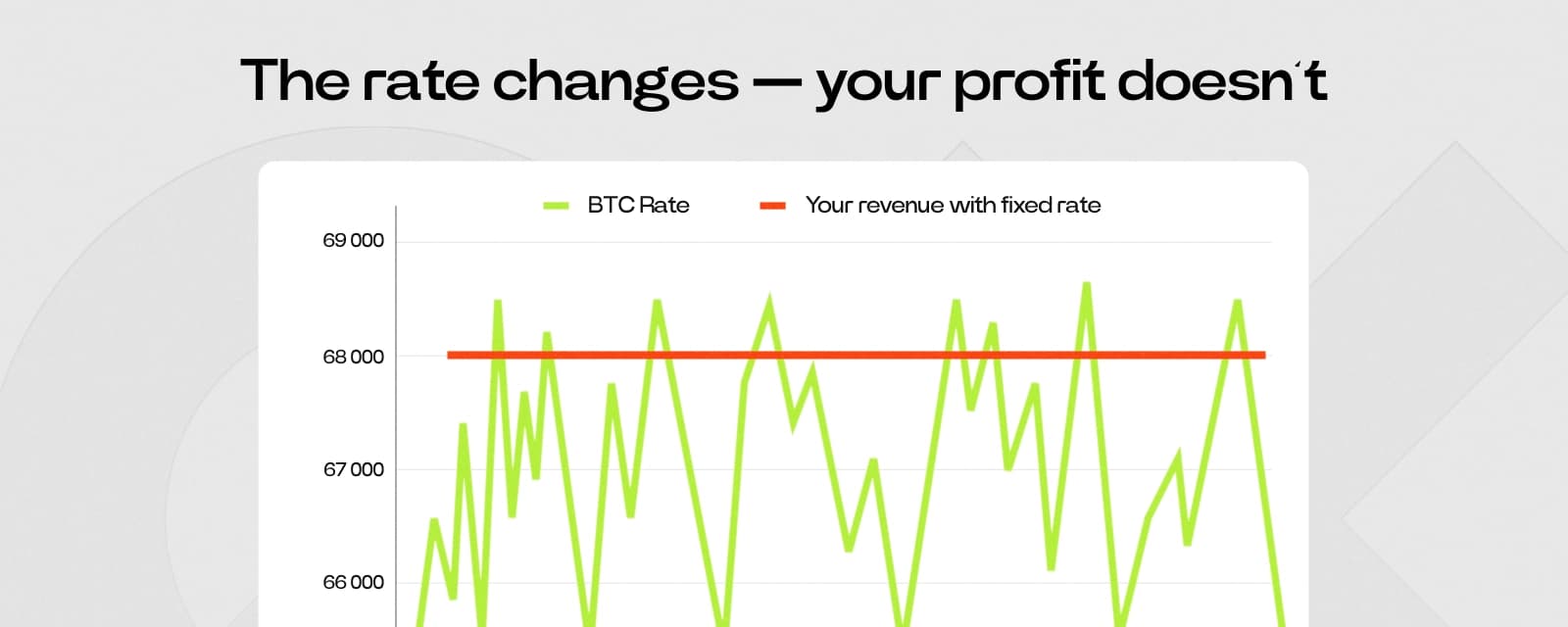
Fixed-rate crypto invoicing is a technology that fully protects your revenue from market fluctuations. You set the price in dollars, euros or cryptocurrency, and the system automatically ‘freezes’ the current exchange rate for the duration of the invoice, for example, for 1, 3 or 24 hours. The customer pays this fixed amount in crypto, and you are guaranteed to receive the exact amount in fiat or stablecoins that you specified. This turns cryptocurrency into a predictable tool for B2B settlements, freelancing, and SaaS.
Cryptocurrency exchange rate fluctuations are the main reason why businesses are afraid to accept them. You don't want to become a speculator. You want to get paid for your work. A fixed exchange rate solves this problem at the technological level. This is no longer a theory, but standard practice for thousands of companies around the world – from IT outsourcing to digital agencies.
Why is volatility the main enemy of B2B payments in crypto?
Business is built on planning. You cannot run a company if you do not know how much money you will receive tomorrow. Volatility is not just ‘numbers jumping on a chart.’ It is a direct threat to your operations and profits.
A real-life case of losses: an invoice for $5,000, but only $4,735 received
Let's say you're a web studio. You've completed a $5,000 project and send the client an invoice in cryptocurrency in the morning. The Ethereum to dollar exchange rate is $1,900. The client sees the amount: approximately 2.631 ETH. But the client is a busy person. They open their account in the evening to pay. The market has fallen during the day. Now the ETH rate is $1,800. To pay your $5,000 bill, the client now needs to send 2.777 ETH. They see that the amount has increased, and this raises questions. Or worse: they pay the original 2.631 ETH. Your account receives not £5,000, but only $4,735. You lose $265 (almost 6% of your profit) due to a simple delay. This is a real scenario. Now imagine that we are talking about a payment of $50,000. The losses are calculated in thousands.
Problems for accounting and financial planning
The introduction of floating-rate crypto payments creates chaos in accounting systems designed for fiat. Here's what happens in reality.
Inability to accurately plan cash flow. Your CFO cannot say how much money will be in the account at the end of the month. Crypto receipts are a variable value depending on payment times and market conditions. This blocks the ability to take out working capital loans, plan large purchases or pay dividends.
Complicated tax accounting. For tax authorities, income is the amount in pounds sterling (or other national currency) at the time of receipt. If you received 0.1 BTC, you need to:
- record the BTC/GBP market rate at the time of receipt;
- convert BTC to pounds sterling at the rate on the same date.
Want to accept crypto payments on your website?
Distortion of financial statements. Your P&L becomes unstable. High volatility can show an artificial ‘loss’ due to a drop in the exchange rate between shipment and payment, even if the business is actually profitable. This misleads investors, partners, and management.
How this slows down the mass adoption of cryptocurrencies by businesses
Fear of volatility is a systemic barrier that prevents cryptocurrencies from becoming a mainstream tool for businesses. Consequences:
- Lack of standards. Large corporations and government contractors cannot implement something that does not provide predictable financial results. They are waiting for tools that eliminate the speculative component.
- Conservatism of financial departments. CFO is one of the most risk-averse positions in a company. Its KPI is stability and predictability. Offering it a payment method where the final amount is unknown means immediate rejection. Without the CFO's approval, large-scale implementation is impossible.
- Restraining innovation in the B2B sector. Many promising business models (decentralised autonomous organisations, platforms for instant international settlements between legal entities) run into a simple question: ‘In what currency do we issue invoices if we receive payments in cryptocurrency?’ The lack of a simple answer slows down the development of entire areas.
The problem of volatility is not theoretical. It hits the most painful points of business: money, reporting, and decision-making. Until it is solved, cryptocurrencies will remain a niche tool for enthusiasts, rather than for the economy as a whole. To overcome this barrier, a fixed exchange rate is used when paying bills, and the 0xProcessing crypto gateway additionally offers automatic conversion of cryptocurrency into stablecoins. The latter are not affected by volatility, which allows you to take advantage of all the benefits of decentralised transfers without fear of a discrepancy between the invoice and the payment amount.
What is Fixed-Rate Invoicing?
It is a ‘freeze’ of the exchange rate. Technically, when you create an invoice in your payment gateway, the system instantly hedges this amount on the financial market.
How it works in practice:
- You issue an invoice for $1,000.
- You enable the Fixed Rate option in the gateway panel.
- The system fixes the current market rate. Let's say 1 ETH = $2000.
- The customer receives a link to the invoice with a clear amount: 0.5 ETH. This amount will not change within the set time frame, for example, for 12 hours.
- The customer pays exactly 0.5 ETH within this time frame.
- You receive exactly $1000 in your account. Even if the price of ETH has fallen to $1800 or risen to $2200 during this period.
The payment provider assumes the volatility risk. Your income is protected.
Comparison: floating rate vs. fixed rate – a clear difference
| Parameter | Floating rate | Fixed rate |
|---|---|---|
| Amount for the client | Changes constantly depending on the exchange rate | Fixed for the entire term of the account. Transparent and predictable |
| The amount for you | Unknown until the funds are actually received. Depends on the exchange rate at the time of transaction confirmation | Known in advance – equal to the amount in the account in USD/EUR or stablecoins |
| Risk of loss | You bear the risk. The customer may send ‘insufficient’ funds due to a drop in the exchange rate | The payment gateway bears the risk through a hedging mechanism. Your revenue is insured |
| Cash flow planning | Only for micro-donations or internal settlements, where the fact of the transfer is more important than the exact amount | For B2B, SaaS, freelancing, e-commerce – anywhere where there is a fixed price and financial discipline is important |
You can learn more about how to protect your revenue from losses during a free consultation at 0xProcessing. Take advantage of the opportunity to accept payments in 65+ of the most popular currencies with automatic conversion to stablecoins and round-the-clock withdrawal in crypto without additional fees (only network fees apply).
Step-by-step instructions: how to issue an invoice with a fixed exchange rate
The process takes minutes and does not require knowledge of financial markets. Let's look at an example using the crypto gateway panel.
Step 1. Create an invoice in USD in the gateway panel
Go to the ‘Invoices’ section. Click ‘Create invoice’. Fill in the usual fields: amount, invoice currency, customer details (email, name), service description. At this stage, you are only working with the amount you plan to receive from the customer.
Step 2. Activate the volatility protection option and select the payment currency (BTC, USDT, ETH)
Before sending, find the ‘Payment settings’ block. Activate the ‘Fix rate’ option. You will be offered to select cryptocurrencies for payment, you can select several: BTC, ETH, USDT, USDC and others. The system will instantly calculate and fix the final amounts in each of the selected cryptocurrencies.
Step 3. Send the customer a link to the invoice with the final amount in cryptocurrency
Set the period during which the exchange rate will be frozen. For B2B, 12-72 hours is optimal. The method of sending the invoice depends on the functionality of the gateway. 0xProcessing has buttons and payment forms, invoices, options for one-time and bulk payments. You can track the transaction process in your personal account.
Step 4. What your customer sees and pays
The customer opens the link. They see a clean and understandable interface:
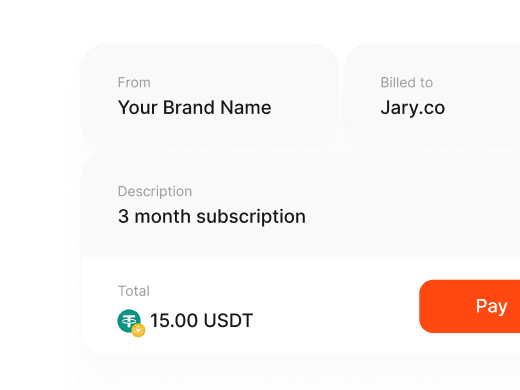
- A fixed amount to be paid in dollars (for example, $1,000.00).
- A fixed equivalent in the selected cryptocurrency (e.g., 0.4 ETH).
- A timer counting down the time this rate is valid.
- A "Pay" button or QR code for quick scanning with a wallet.
The customer pays exactly 0.4 ETH from their wallet (MetaMask, Trust Wallet, etc.). A few minutes later (after network confirmations), you receive a notification of successful payment and a guaranteed credit of $1,000 to your balance in the gateway.
Case study: How IT outsourcing increased the share of crypto payments to 40% with Fixed Rate
A software development company had several foreign customers who wanted to pay in cryptocurrency. The team agreed, but each time lost 5-15% of the amount due to market movements between invoicing and payment. This negated the financial sense of such settlements.
The company connected a gateway and began issuing all invoices to crypto-paying clients with protection against volatility. In the gateway settings, they specified that all receipts be automatically converted to USDT (stablecoin) for additional stability.
The result:
- The share of crypto payments in revenue grew from 5% to 40%. Customers got a convenient and predictable payment method.
- Financial losses from volatility fell to 0%. Margins on projects became protected.
- Accounting became simpler. Now they worked with fixed amounts in dollars, rather than with the constantly changing equivalent in crypto.
This proves that fixed exchange rate technology removes barriers not only for you, but also for your customers.
How to start accepting crypto without fear for your margins
A fixed exchange rate and automatic conversion to stablecoins are not just "another feature." They are a basic standard for any business that plans to work with crypto payments seriously. They move cryptocurrencies from the "risky experiment" category to the "reliable financial instrument" category.
Your actions:
- Choose a gateway that offers protection against volatility.
- Test it with small amounts. Set up an account for yourself and see the process through the eyes of a customer.
- Implement it with existing customers who wanted to pay with crypto.
- Use it as a competitive advantage when attracting new customers from the Web3 and crypto industries.
Technology has removed the last and most significant barrier. Now you can offer your customers a convenient payment method without playing roulette on the currency market. Protect your revenue. Set up B2B payments with a fixed exchange rate in 0xProcessing.
Frequently asked questions
How long is the exchange rate ‘frozen’ for?
The exchange rate freeze period is configurable.
- For B2B payments, 24 hours is typically sufficient.
- For quick retail purchases, 15–60 minutes is common.
With 0xProcessing, you can also enable automatic conversion to stablecoins. Customers can pay in 65+ popular cryptocurrencies, while USDT is credited directly to your balance.
What if the customer does not manage to pay within the allotted time?
If payment is not completed within the specified window:
- The system automatically generates a new invoice using the current exchange rate.
- The previous invoice becomes invalid.
A new payment link can be requested by you or the customer. This mechanism protects the provider from adverse market movements.
Who actually bears the risk if the exchange rate changes significantly?
The payment provider assumes the exchange rate risk.
To manage this exposure, providers use hedging strategies and maintain financial reserves.
You receive the exact fiat amount specified in the invoice, which represents a key commercial advantage of the Fixed Rate model.
Can Fixed Rate be used for regular subscriptions?
Yes. Subscriptions are typically processed using stablecoins such as USDT or USDC, which are pegged to the US dollar.
Even in this case, fixing the exchange rate at the moment of debiting provides additional protection for both merchant and customer against rare stablecoin deviations.