Tired of gas issues on Ethereum? New users don’t understand why they need to buy ETH just to send USDT, and your customers abandon their shopping carts halfway through because the transaction is “stuck” due to fees? Account abstraction (ERC-4337) solves this problem: thanks to Paymasters technology, users can pay fees in any tokens (USDC, USDT) or not pay at all – the gas can be sponsored by the application. By 2026, over 40 million smart accounts will already be using this technology, and 87% of all transactions using account abstraction will be paid for via gas sponsorship, which completely removes the barrier to entry for the mass user.
In this article, we will examine in detail what account abstraction is, how the ERC-4337 standard works, how it is supplemented by the new EIP-7702, how Paymasters operate, and why this is a “revolution in user experience” in Web3.
What is Account Abstraction (ERC-4337)
Account Abstraction is a standard (ERC-4337) that allows the creation of smart accounts with programmable logic instead of the rigid externally owned accounts (EOAs) that have been used in Ethereum since its launch.
How traditional EOAs worked:
- one private key = one account;
- any transaction requires the native gas token (ETH);
- loss of key = loss of all funds (no recovery options);
- cannot set limits, automatic payments or multi-signature without complex smart contracts.
How smart accounts (ERC-4337) work:
- an account is a smart contract with its own logic;
- gas payments can be configured in any tokens (USDC, USDT, DAI);
- supports social recovery – losing your key is no longer a problem;
- multi-signature, transaction limits and automatic payments are possible;
- support for session keys – sign an authorisation once, and the app can carry out transactions on your behalf (ideal for games).
To date, over 40 million smart accounts have been deployed, and more than 100 million UserOperations (transactions via account abstraction) have been executed, representing a 12-fold increase since 2023. This was supplemented by EIP-7702 (activated in May 2025 with the Pectra update), which allows over 300 million existing EOA wallets to be temporarily converted into smart contracts for a single transaction, ensuring backward compatibility.
How ERC-4337 works: UserOperations and the alternative mempool
To understand how account abstraction solves the gas problem, one needs to understand the architecture of ERC-4337. It differs fundamentally from standard Ethereum transactions.
Traditional transaction:
- the user signs the transaction with their private key;
- the transaction is sent to the mempool;
- a validator includes it in a block, deducting gas from the sender’s balance (necessarily in ETH).
Transaction via ERC-4337:
- the user creates a UserOperation (an object describing the desired action);
- The UserOperation is sent not to the standard mempool, but to an alternative mempool (a special pool for abstraction operations);
- Bundlers (special network participants) collect UserOperations into a bundle and send them as a single standard transaction to the blockchain;
- within this transaction, the user’s smart account performs all the requested actions.
Gas fees at this stage can be paid either via the standard method (native coin) or using an alternative option – payment in any token via a Paymaster or a free transaction fee covered by the application’s sponsorship.
Want to accept crypto payments on your website?
Paymasters – the key to gasless transactions
A Paymaster is a special smart contract that can pay gas fees on behalf of the user. It is Paymasters that make gas-free transactions possible for the end user.
How Paymasters work:
- Gas sponsorship. The app creates a Paymaster that is ready to pay gas for specific operations (for example, for a new user’s first 10 transactions or for all in-game operations).
- Gas payments in any tokens. A Paymaster can accept payment from the user in USDC, USDT or the app’s tokens, whilst paying gas in ETH. The user doesn’t even notice the conversion taking place – to them, the fee is deducted in USDC.
- Combined schemes. For example, a user pays 50% of the fee in app tokens, whilst 50% is sponsored by the project’s marketing budget.
Statistics: 87% of all UserOperations are paid for via Paymasters (gas sponsorship or payment in non-native tokens), which definitively solves the problem of “needing ETH to use Ethereum”.
Real-world example. Circle's Paymaster allows developers to sponsor gas for users paying in USDC. An app can set a limit: “We will cover gas for all transactions up to $1 per month per user”, and anything above that will be automatically deducted in USDC.
EIP-7702 – a bridge for existing wallets
One of the main problems with implementing account abstraction was that existing wallets (MetaMask, Rabby and others) are EOAs, and they cannot simply become smart accounts. Users would have had to create new wallets and transfer funds.
EIP-7702 (activated in May 2025 with the Pectra update) solves this problem. It allows existing EOA wallets to be temporarily converted into smart contracts for a single transaction.
How it works:
- the user signs a special message;
- for the duration of a single transaction, their EOA receives a smart contract code;
- after the transaction is executed, the wallet returns to its normal state.
Over 300 million existing wallets can now enjoy the benefits of account abstraction without migration. Users can now try gasless transactions in familiar interfaces, whilst developers gain an audience for new features.
How Account Abstraction solves the gas problem
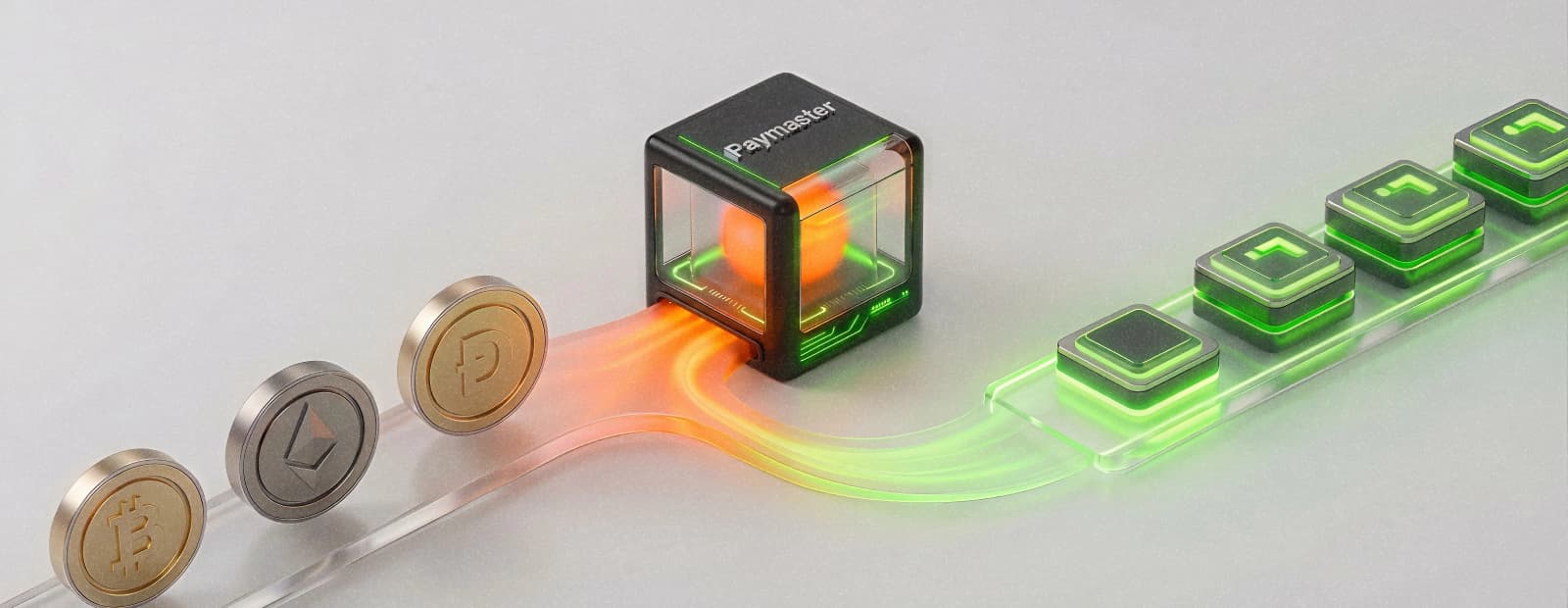
- Problem 1: the user has USDT but no ETH for gas. Before abstraction: The user had to buy ETH on an exchange, transfer it to a wallet, and only then send USDT. For a new user, this involves 3–4 extra steps and acts as a barrier to entry. After abstraction: The user simply sends USDT. Paymaster automatically converts a small amount of USDT into ETH to cover gas fees or accepts the fee directly in USDT. The user isn’t even aware that ETH exists.
- Problem 2: A new user doesn’t want to buy ETH for their first interaction. Before abstraction: To try out the app, you had to buy at least $10–20 worth of ETH. Many dropped out at this stage. After abstraction: The app can subsidise a new user’s first 3–5 transactions as part of onboarding. The conversion rate to paying users increases by 30–50%.
- Problem 3: The complexity of signatures for the average user. Before abstraction: Every transaction requires confirmation in a pop-up window. In a game where you need to fire 100 times, this is impossible. After abstraction: Session keys – the user signs the authorisation once, and the game client can automatically confirm in-game transactions (purchasing weapons, rewards, movement) without constant pop-ups. This makes the gameplay just as smooth as in traditional games.
- Problem 4: Losing your key = losing everything. Before abstraction: If you lose your seed phrase or private key, there is no way to recover your funds. After abstraction: Social recovery. You can designate trusted parties (friends, a second wallet of your own, a professional custodian) who will be able to restore access to your account. Losing your key is no longer a disaster.
Business applications: where it’s already working today
Payment abstraction technology emerged due to the internal limitations of the blockchain. ERC-4337 allows you to enjoy all the benefits of cryptocurrency whilst improving the user experience.
Gaming
The gaming industry has become the main beneficiary of account abstraction. Users don’t want to think about the blockchain – they want to play.
How it works:
- Upon first login, a wallet is created automatically (via email, social media or biometrics).
- Session keys allow the gaming client to sign in-game actions without pop-ups.
- The app covers the gas fees for all in-game transactions (or includes the fee in the cost of in-game purchases).
The result. Players are completely unaware that the game is built on blockchain. Conversion and retention rates are the same as in traditional games. The technology is being adopted particularly actively in South-East Asia, where mobile gaming dominates and users are sensitive to any additional steps.
DeFi and corporate wallets
For financial applications, account abstraction opens up new possibilities for security and automation.
How it works:
- setting spending limits for employees (e.g., no more than $10,000 per day);
- multi-signature for large transactions is built into the wallet’s logic;
- scheduled automatic payments (e.g., monthly salaries in crypto);
- auditing of all actions is built into the wallet.
Result. Corporate treasuries gain tools comparable to traditional banking systems, but with the advantages of blockchain.
Merchants and payments
For businesses accepting crypto payments, account abstraction means customers will be less likely to abandon their shopping baskets.
How it works:
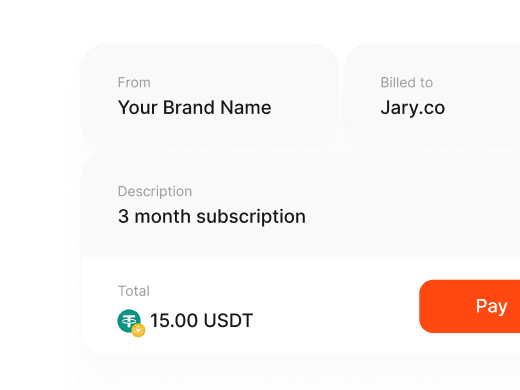
- the customer pays in USDT, and the gas fee is automatically deducted from the payment amount;
- there is no need to explain what gas is and why it needs to be paid;
- payments are processed faster and with fewer errors.
This helps to increase conversion rates for crypto payments.
Comparison: EOA vs smart accounts – table
| Features | Standard wallet | ERC-4337 |
|---|---|---|
| Gas payments | Native currency only (ETH) | Any tokens via Paymaster |
| Access restoration | Seed phrase | Social recovery |
| Bulk operations | Each transaction individually | Batch processing |
| Automation | No | Session key, auto-signature |
| Multi-signature | Requires complex contracts | Built-in |
| Number of accounts | 300 million+ | 40 million+ |
Account abstraction is radically transforming the user experience in Web3, and 0xProcessing is keeping a close eye on these technologies. Our
crypto payment processing platform already supports modern security standards and offers payments in over 65 of the most popular cryptocurrencies, with an option to hedge against volatility. This allows your customers to pay in their preferred coins, whilst you receive payments in stablecoins. Find out how 0xProcessing enhances the payment acceptance experience.
Implementation examples
A major gaming platform in South-East Asia implemented account abstraction for a mobile game with an audience of millions.
Problem: Users were abandoning the game at the stage of creating a wallet and making their first transaction. The requirement to buy MATIC for gas fees was an insurmountable barrier.
Solution:
- Onboarding via email (wallet created automatically)
- First 10 transactions covered by the platform (subsidised gas)
- Session keys for in-game actions (user only confirms major purchases)
Result: Conversion to paying users increased, and average revenue per user rose.
How 0xProcessing utilises modern UX standards
0xProcessing keeps abreast of the latest Web3 trends and is ready to integrate Account Abstraction-based solutions for its clients. Our platform already allows you to configure flexible payment scenarios. This means your customers will be able to pay in USDT or USDC and over 60 other cryptocurrencies.
Find out about all the payment options available on 0xProcessing and how they can help improve your cryptocurrency payment acceptance.
Conclusion and takeaways
Account abstraction is not merely a technological improvement, but a fundamental shift in the Web3 user experience. 2026 has become the year of mass adoption: over 40 million smart accounts, over 100 million UserOperations, and 87% of transactions using Paymasters.
Key technological achievements:
- Gas fees are no longer a barrier. Users can pay in any token, and apps can sponsor transactions for onboarding.
- Wallets are becoming smart and secure. Multi-signature, social recovery, limits and automation are built into the base layer.
- The user experience is approaching that of Web2. No seed phrases, pop-ups for every action, or complicated explanations about gas.
For businesses, this means increased payment conversion rates, reduced support workload, and the ability to enter mass markets (gaming, e-commerce) without barriers.
Do you want your business to accept crypto payments without any hassle for customers? Sign up to 0xProcessing and gain access to a modern payment infrastructure. We’ll help you set up payment acceptance so that users won’t even notice the difference from their usual transactions.
Frequently Asked Questions about Account Abstraction
What is Account Abstraction (ERC-4337)?
Account Abstraction (ERC-4337) is a standard for smart wallets that can have programmable logic: gas payments in any tokens, social recovery, automatic transactions, multi-signature and limits. This is the complete opposite of traditional EOA wallets with a single private key.
How does Account Abstraction solve gas fees?
Through Paymasters – special contracts that can subsidise gas (making transactions gasless for the user) or accept gas payments in other tokens (USDC, USDT). Users no longer need a native coin (ETH, MATIC, BNB) to carry out transactions.
What are gasless transactions?
Gasless transactions are transactions where the gas is paid not by the user, but by the application (sponsor) or a third party. This is critical for onboarding new users who do not want to buy cryptocurrency just to try out the application.
Is Account Abstraction live on mainnet?
Yes, ERC-4337 has been running on the Ethereum mainnet and all major L2 solutions (Arbitrum, Optimism, Base, Polygon) since 2023. By 2026, over 40 million smart accounts had been deployed and over 100 million UserOperations had been executed.
What is EIP-7702?
EIP-7702 is an update activated in May 2025 with the Pectra hard fork. It allows existing EOA wallets (such as MetaMask) to be temporarily converted into smart contracts for a single transaction, ensuring backward compatibility and access to abstraction features without creating a new wallet.
What are session keys?
Session keys are a mechanism that allows a user to sign an authorisation once, after which an application (such as a game) can automatically confirm in-game transactions on the user’s behalf without constant pop-ups. Ideal for gaming and applications with frequent microtransactions.
Which networks support Account Abstraction?
All major EVM-compatible networks: Ethereum mainnet, Arbitrum, Optimism, Base, Polygon, BNB Smart Chain, Avalanche and many others. It is most widely adopted on L2 solutions due to low fees.