The digital transformation of payments is rapidly changing the e-commerce landscape. Over the past few years, the cryptocurrency payments market has grown exponentially, and merchants are increasingly implementing support for digital assets. However, the main Ethereum blockchain (L1) has long been known for its high fees and relatively slow transaction confirmation times, which hinders the mass adoption of crypto payments in retail. This is precisely why there is growing interest in Layer 2 technologies. L2 solutions reduce gas fees, speed up transaction confirmation, and are becoming easier to integrate.
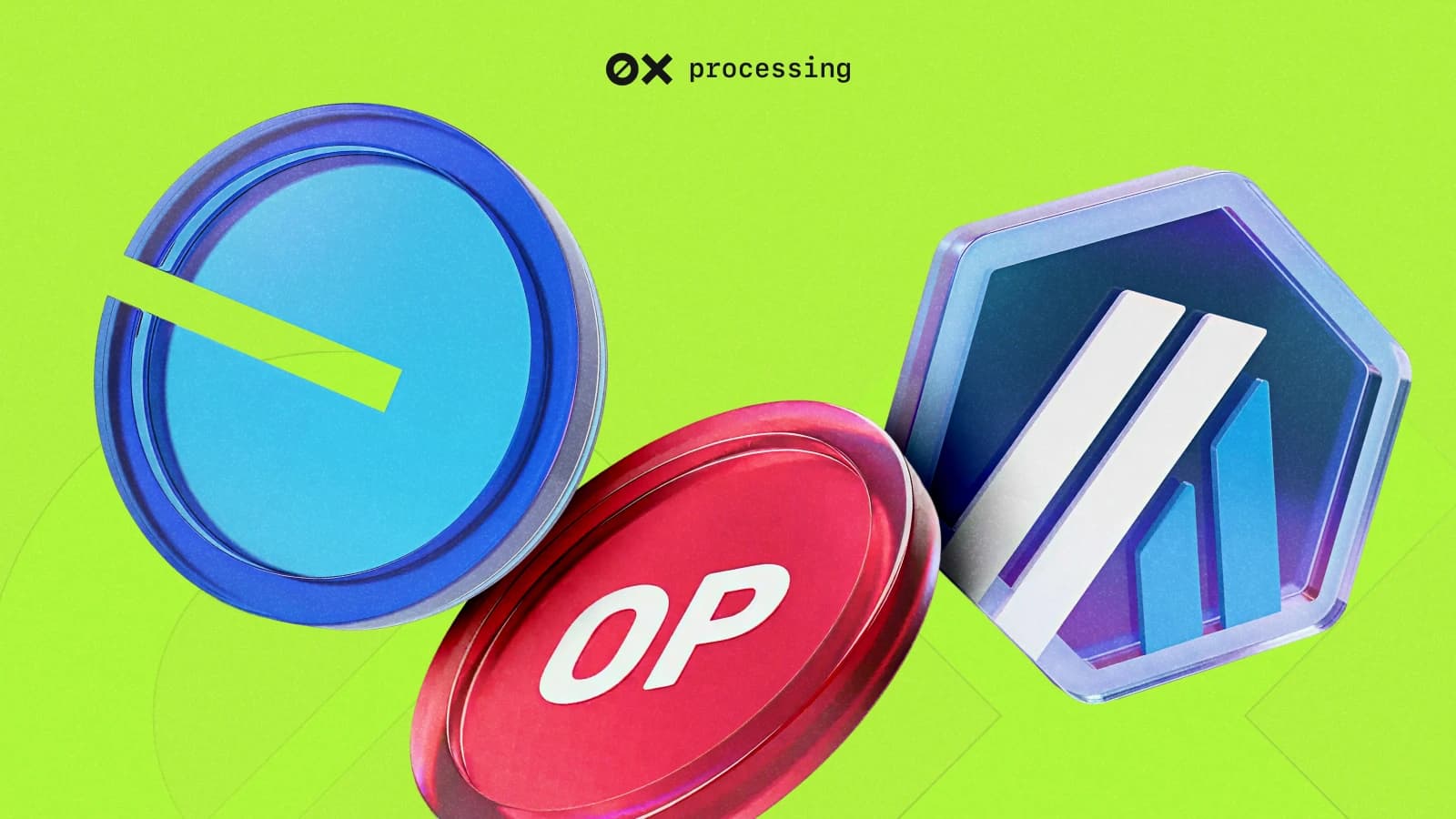
Today, Base, Arbitrum, and Optimism networks occupy the largest share of the L2 sector. Which solution should merchants choose for accepting payments? Where are the fees lower, the speed higher, the support for stablecoins better, and the integration more convenient for business? Let's take a look at each criterion.
Why are L2 solutions important for merchants?
The original Ethereum network is a highly loaded blockchain with limited throughput (about 15 TPS) and unpredictable transaction costs. During peak periods, the fee for a simple transaction on L1 can rise to £10–50. For e-commerce retail and B2C payments, this is a completely unsuitable scenario. Slow finalisation, from 15 seconds to several minutes, jeopardises the user experience and conversion growth.
Layer 2 solutions take transaction processing outside the main blockchain, then aggregate and send it to L1 in the form of compact records. Key advantages:
- Gas costs are 10–100 times lower than on L1.
- Confirmation time - up to 1–3 seconds (rarely – 5–10 seconds).
- EVM compatibility - the same tools can be used as for Ethereum.
- Floating commission - pay-as-you-go models often make microtransactions viable.
- Easy integration thanks to support for established libraries and SDKs.
This gives businesses the opportunity to accept micropayments, for example, for digital content, reduce customer churn due to high fees, and increase loyalty through speed.
Criteria for comparing L2 solutions
To choose the best L2 for merchant payments, consider the following parameters:
- Transaction cost: total commission for processing a payment/session.
- Finalisation speed: average and peak transaction confirmation time.
- Stablecoin support: availability of popular assets (USDT, USDC, DAI).
- Ecosystem: number of providers, wallets, partner services.
- Security: architecture, fund protection, level of centralisation.
- Ease of integration: ease of integration, API, documentation.
If you are looking for an effective and modern solution for accepting Layer 2 payments, take a look at 0xProcessing. It offers a comprehensive infrastructure for accepting 65+ popular cryptocurrencies and automating all stages of payment processing, taking into account modern market requirements.
Want to accept crypto payments on your website?
Base: pros and cons for business
Base is an L2 blockchain based on Optimistic Rollup technology, developed by the Coinbase team. Launched in 2023, the network has rapidly gained popularity among merchants and dApp developers.
Advantages of Base:
- Very low fees. The average transaction cost is $0.01 (significantly cheaper than L1).
- Integration via Coinbase - simplicity for businesses and access to a large user base.
- Confirmation speed: 1–2 seconds on average.
- A large number of partner payment gateways - 0xProcessing, BitPay, Coinbase Commerce, MoonPay, etc.
- A developed API ecosystem for quick integration.
- Base is ideal for businesses that target the Coinbase audience and value ease of integration.
The network has several drawbacks:
- Centralisation. Base is managed by Coinbase, which raises questions among proponents of fully decentralised solutions.
- It is a young network compared to Arbitrum and Optimism, which is reflected in the number of infrastructure solutions.
- Not all wallets support Base, but integration is expanding.
For businesses, Base seems to be the best option for starting crypto payments, especially if the focus is on the US audience and the use of stablecoins (USDC, USDT).
Arbitrum: analysis for merchant payments
Arbitrum is a large-scale and widespread L2 network based on Optimistic Rollup technology. Launched by Offchain Labs, it is supported by the largest centralised and decentralised exchanges.
Advantages of Arbitrum:
- Low fees. Average transaction cost is 0.005–0.20, with the exact amount depending on the load on the main ETH network.
- High speed. Finalisation takes 1–2 seconds.
- Wide support for stablecoins. USDT, USDC, DAI and others are fully integrated.
- Mature ecosystem. Over 1,000 applications, including payment gateways.
- Decentralisation. Arbitrum is managed by a DAO, which increases community trust.
- Regular updates aimed at optimising performance.
- Arbitrum is a standardised and proven solution for B2C and B2B payments.
This L2 solution has two drawbacks:
- Complexity of configuration. For beginners, integration may take longer than with Base.
- Periodic overloads. At peak times, fees temporarily increase.
Arbitrum is a reliable choice for businesses that value decentralisation and a broad ecosystem. It is suitable for large merchants with high transaction frequency.
Optimism: features and application
Optimism is another large L2 ecosystem based on the same Optimistic Rollup technology. Launched in 2021, it is actively developing as a community project with a view to mass adoption.
Advantages of Optimism:
- Fees: $0.01–0.20 per transaction.
- High speed: finalisation takes 1–2 seconds.
- Compatibility with a huge number of Dapps, open-source architecture and democratic governance.
- Growth in the number of payment gateways and wallets (0xProcessing, BitPay, Ankr, Rainbow, etc.).
- Customisation options and inexpensive deployment of proprietary smart contracts.
- Optimism is convenient for start-ups and small teams, as well as a ‘backup’ for merchants during peak loads on other networks.
The second-layer network has a number of disadvantages:
- Smaller ecosystem. Optimism lags behind Arbitrum in terms of the number of applications.
- Relatively lower TVL capitalisation, which may affect liquidity for large merchants.
- Dependence on centralised ‘sequencers’. As of 2026, some processes are managed by centralised nodes.
Comparison by key metrics
| Characteristic | Base | Arbitrum | Optimism |
|---|---|---|---|
| Confirmation time | 1-2 сек | 1-5 сек | 1-2 сек |
| Speed | 1000+TPS | 400 TPS | 300 TPS |
| Available stablecoins | USDT, USDC, DAI | USDT, USDC, DAI | USDT, USDC, DAI |
| Ecosystem | 500+ applications | 1000+ applications | 700+ applications |
| Decentralisation | Low (managed by Coinbase) | High (DAO) | Medium (partially centralised sequencers) |
| Ease of integration | High | Medium | High |
| Technology stack | General improvements Superchain | Evidence of fraud based on Nitro (WASM-based) | OP Stack (Bedrock) |
| TVL | $4.69 billion | $3.033 billion | $689 million |
It is important to note that, based on the results of the ‘Base vs Arbitrum’ comparison, Base wins in terms of transaction costs and ease of integration, while Arbitrum leads in terms of ecosystem breadth and stablecoin availability. The Arbitrum vs Optimism comparison often focuses on the nuances of fees (Arbitrum is usually cheaper) and ecosystem maturity.
What stablecoins will payers use in 2026?
In 2026, the main settlement tokens for L2 payments are USDC, USDT, and DAI. New players such as Euro Coin (EUROC) and PYUSD are gaining momentum, but their share of use largely depends on the region and type of business.
Factors influencing the choice of stablecoin:
- Regional restrictions and regulations (in some countries, USDT is preferred due to its wider coverage by exchanges).
- Liquidity - in large ecosystems (Coinbase, Binance), USDC is a must-have for any company.
- Availability of gateways and service support.
Recommendation for merchants: accept at least USDC and USDT - this will cover 90% of payments. DAI can be added to attract DeFi users.
How to implement L2 payments: a step-by-step plan
A step-by-step plan for adding an L2 solution for accepting cryptocurrencies:
- Analysis of the target audience and participants. Determine where the majority of your payers are concentrated (US, Europe, Asia) and what their habits are.
- Select an L2 platform. Based on the criteria analysed (cost, token support, infrastructure), decide on your choice - Base, Arbitrum, or Optimism.
- Integration of an L2-supporting gateway. Register on 0xProcessing, get advice and support on integration into your website.
- API connection. Install the 0xProcessing gateway using the API.
- Scenario testing. Check the operation of payments from different wallets (MetaMask, Trust Wallet, Coinbase Wallet).
- Update the info field. Add guides and FAQs for your users on L2 payments to the website.
- Monitoring and optimisation. Keep an eye on changes in fees and confirmation times, and be ready to switch the main gateway in case of congestion.
The 0xProcessing specialists are ready to help you quickly if you encounter any difficulties or have any questions. For quick implementation of Layer 2 payments without additional complications and with personal support from specialists, you can connect a solution from 0xProcessing. This is a convenient way to integrate crypto payments into any business without wasting time and unnecessary bureaucracy.
The future of L2 payments (2026-2028)
Over the next two years, the L2 solutions market will develop in the following directions:
- Protocol consolidation. Small L2s are expected to merge into the ecosystems of leaders (Arbitrum, Optimism, Base). This will increase liquidity and reduce fragmentation.
- Unification of standards. The emergence of cross-L2 bridges with minimal fees for users. Merchants will be able to accept payments from any network without reconfiguring their integration.
- Growth in the adoption of stablecoins. Regulatory easing in the EU and the US will lead to the legalisation of USDC and EURC in retail trade. By 2028, up to 40% of online payments could go through L2.
- Integration with traditional payment systems. Partnerships between L2 protocols and banks (e.g., Visa+Arbitrum) will enable real-time conversion of crypto payments into fiat.
- Development of zk-Rollups. Technologies such as zkSync and StarkNet will begin to compete with OP-Rollups (Arbitrum, Optimism), offering even lower fees and instant finalisation.
The Layer 2 market for merchant payments is developing rapidly. Arbitrium, Base, and Optimism are among the leaders in this area. Whichever L2 you choose, the advantage lies in speed, low cost, and accessibility for the mass market. It is important for businesses to test all the main solutions and keep an eye on the development of new tools.
FAQ
Which Layer 2 should merchants choose in 2026?
Choosing a Layer 2 network depends on business needs:
- Base: Ideal for a quick start and businesses targeting the US and Coinbase users.
- Arbitrum: A universal solution with broad infrastructure support.
- Optimism: Suitable for small shops and start-ups.
How secure are L2 payments?
All three protocols—Base, Arbitrum, and Optimism—inherit the security of Ethereum Layer 1.
Transaction data is periodically recorded on the main Ethereum network, protecting against fraud.
Note: Base is less decentralised due to Coinbase's control.
Which stablecoin should I choose?
Main options for stablecoins:
- USDC or USDT for general use.
- DAI as an alternative for DeFi-focused projects.
Is it possible to accept payments through all L2s simultaneously?
Yes. Modern payment gateways support multi-L2 functionality, allowing users to select their preferred network at the time of payment.
Are there any L2s with zero fees?
As of 2026, no Layer 2 network offers completely free transactions.
Some protocols, such as Optimism, provide ‘gas abstraction,’ where transaction fees are paid by a sponsor (e.g., a partner project).
Where are the lowest fees?
Transaction fees are generally lowest on Base or Arbitrum, though the difference is minimal—typically a few hundredths of a dollar.