With the development of the SaaS business, platforms are increasingly looking for new ways to optimize payment processes. One of the trends is the introduction of recurring crypto payments. As businesses move outside of countries, traditional payment methods are increasingly showing their limitations: high fees, difficulties with cross-border transactions, and the risk of refunds.
The reasons why SaaS platforms Choose cryptocurrency to optimize the payment process: Reduced fees. The cost of fees in crypto transfers is lower than what traditional banking services offer. This increases profitability and reduces transaction costs. Access to a global audience. Cryptopayments expand the geography of services. They can offer services in countries where there is no banking service. Minimisation of refunds. Blockchain transactions are irreversible, which virtually eliminates the risk of chargebacks and the associated financial and reputational losses.
However, the transition to recurring crypto payments poses an important question for businesses: how to implement regular crypto payments without losing conversion? How to ensure smooth auto-debit or an effective reminder system so that customers do not face subscription interruptions due to technical failures?
We tell you what difficulties companies may face when implementing common issues with recurring crypto payments, promising crypto SaaS ideas that allow them to stand out in the market, and criteria for choosing a reliable
crypto payment gateway for SaaS that ensures the smooth operation of the subscription model.
Why should SaaS businesses consider crypto subscriptions?
Traditional payment methods - bank cards and payment systems such as PayPal - have long been the standard for subscription models. But the more payments a company accepts, the more obvious the restrictions become. Below is a summary table showing the key differences between traditional payment methods (bank cards, PayPal) and recurring crypto payments.
| Criterion | Traditional methods | Cryptoprocessing |
|---|---|---|
| Transaction fees | Approximately 2-4% + fixed fees per transaction | Depends on tariffs, but usually less than 1.5% |
| Geographical accessibility | Limited to countries with payment system support; regions may be blocked | Global coverage: payments from anywhere in the world with an internet connection |
| Transaction speed | 1–5 business days (including holds and verifications) | Seconds to 10 minutes (depending on the network) |
| Irreversibility of the transaction | No: the customer can initiate a chargeback within 120 days | Yes: blockchain transactions are irreversible and do not allow for refunds |
| Customer privacy | Requires transfer of personal data and card details | A crypto wallet is sufficient without disclosing personal information |
| Currency restrictions | Conversion to local currency required, additional fees may apply | Payment in stablecoins, e.g. USDT, without conversion |
| Fraud risks | High: vulnerability to fraudulent returns and data falsification | Low: decentralised transaction verification, cryptographic protection |
| Accessibility for non-bank users | Bank account or card required | Crypto wallet sufficient: accessible to customers in regions with limited financial infrastructure |
Examples of crypto payments in SaaS
- Cloud services and hosting. Data storage and VPS hosting platforms accept cryptocurrency for monthly subscriptions, such as using stablecoins to pay for servers.
- Marketing and analytics tools. Services for email newsletters or traffic analytics offer crypto subscriptions to attract international customers without currency barriers.
- Productivity and project management. Task managers and CRM systems allow you to pay for access in BTC, ETH, or USDT, simplifying payments for freelancers and remote teams.
- Educational platforms. Online courses and LMS systems use crypto payments for global access to content without regional restrictions.
- Creative tools. Graphics, audio, and video editors offer subscriptions for cryptocurrency, attracting creators from countries with unstable currencies.
For these and other business areas that use a subscription model, the 0xProcessing crypto gateway is a good fit. We offer customised rates based on your business specifics, payment in 65+ of the most popular cryptocurrencies, and integration in as little as one day.
Want to accept crypto payments on your website?
Crypto subscriptions are not just a technological novelty, but a practical tool for: reducing operating costs; expanding your audience through global reach; increasing customer trust through transparency and privacy. For SaaS businesses focused on scaling, switching to recurring crypto payments is a logical step towards sustainability and competitiveness in the international market.
How recurring crypto payments work: mechanisms and implementation schemes
Implementing regular crypto payments into the SaaS model requires a clear understanding of technical solutions. Let's look at the main ways to automate payments.
Automatic debits via smart contracts
How it works: the customer approves the subscription terms once, after which the smart contract automatically debits funds from their wallet according to a set schedule. Example: a subscription to a service for $50 per month in USDC. The smart contract is activated on the 1st of each month, debiting the exact amount without user involvement.
Pros: full automation; transparency of terms - the contract code is unchangeable; no intermediaries.
Cons - initial trust in the contract code is required, and it is difficult to adjust the terms without restarting the contract.
Reminders + manual payments
How it works: the system sends the customer a notification before the payment date, for example, 24 hours in advance. The user manually confirms the transaction via their wallet. Example: a SaaS platform sends an email: "Your subscription expires in 24 hours. Pay 0.02 ETH to renew." The customer follows the link and signs the transaction.
Pros: control by the customer; flexibility - you can skip a payment without penalties.
Cons: risk of missed payments due to user forgetfulness, lower conversion compared to auto-debits.
Recurring invoices
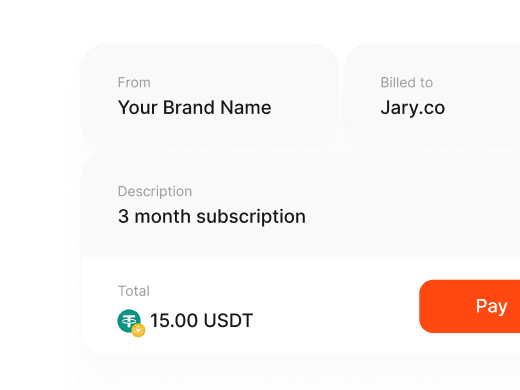
How it works: the payment gateway automatically generates a crypto invoice before each payment. The customer receives a link to the invoice and can pay it with one click. Example: every month, the system creates an invoice for $30 in USDT, the customer follows the link, sees the amount and network, and confirms the payment in a couple of clicks.
Pros: ease of use for users - no need to set up smart contracts; choice of assets - USDT, USDC, ETH, etc.
Cons: dependence on the payment gateway, need for manual confirmation.
The role of a crypto payment gateway for SaaS
A payment gateway is a key intermediary between a SaaS platform and a customer. Its functions: Template automation: saves subscription terms (amount, interval, asset) and initiates payments on schedule. Integration with smart contracts - ensures interaction between the SaaS system and the blockchain. Notifications - sends email/SMS/push notifications about upcoming debits or overdue payments. Multi-currency - supports various cryptocurrencies and stablecoins (USDT, USDC, DAI, etc.). Analytics - provides reports on subscription status and successful/missed payments. Security - encrypts data and verifies transaction validity.
After connecting the crypto gateway for regular debits, the payment process involves several steps. First, the customer selects a tariff, specifies a crypto wallet, and approves the terms and conditions. The payment gateway creates a template that records the amount, debit interval, asset, and date of the next payment. Then, on the appointed day, the system checks the wallet balance and initiates the transaction. The result depends on whether there are sufficient funds in the wallet: Automatic debit or manual confirmation - the transaction is completed instantly if there is sufficient balance. Decline: if there are insufficient funds or the customer cancels the transaction, the system launches a retry mechanism (repeated attempts after 1/3/7 days).
Recurring crypto payments is not a single technology, but a set of tools. The choice between smart contracts, invoices, and reminders depends on the target audience of the SaaS service, the level of customer trust, and the technical capabilities of the platform.
Common issues with recurring crypto payments and their solutions

The implementation of regular crypto payments is associated with a number of technical and regulatory challenges. Let's look at the key issues and proven ways to overcome them.
Cryptocurrency volatility
The price of assets (BTC, ETH, etc.) can fluctuate sharply throughout the day, creating uncertainty for both parties: the supplier risks receiving less than the expected amount due to a drop in the exchange rate; the customer may overpay if the asset's value rises sharply. The solution is to use stablecoins (USDC, USDT, DAI) pegged to fiat currencies (usually the USD). Stablecoins have a stable exchange rate - 1 USDC ≈ 1 USD. These coins are compatible with most payment gateways and are supported by popular blockchains. Recommendation: specify in the subscription terms that payments are accepted exclusively in stablecoins to avoid disputes due to exchange rate fluctuations.
No auto-debits in some networks
Some blockchains, such as Bitcoin, do not support the smart contracts required for automatic recurring payments. The customer is forced to manually confirm each transaction, which reduces conversion. The solution is to switch to ERC-20/BSC tokens. Use assets based on Ethereum (ERC-20) or Binance Smart Chain (BSC), where smart contracts allow for automatic debits. Integrating this method requires connecting a payment gateway. Payment process: the customer gives one-time authorisation to debit a fixed amount; the gateway automatically initiates transactions on a schedule; the user receives notifications about each payment. Example. A customer subscribes to a service for 100 USDT/month through the gateway. The system automatically debits the funds, and the customer receives a notification of the debit without having to confirm the transaction.
Transaction errors
Payment failures occur due to insufficient funds in the customer's wallet, network delays due to blockchain overload, or errors in entering the wallet address or amount. The solution is a comprehensive error handling system: Retries. Set up automatic retries 1/3/7 days after a failure. Notifications. Notify the customer of an upcoming payment (24 hours in advance), a failed transaction (with the reason), and a successful payment (with a receipt). Integration with network monitoring. Use API gateways to check the status of a transaction in real time. Recommendation: add a ‘Payment Status’ section to the subscription interface with transaction history and reasons for failures.
To minimise the risks of recurring crypto payments: use stablecoins for settlement stability; choose flexible gateways with support for smart contracts and retries; automate notifications at all stages of payment; comply with regulatory standards through integration with licensed providers; test failure scenarios (low balance, network delays) before launching a subscription. These measures will ensure smooth payments and customer confidence in crypto subscriptions.
Integrating crypto payments into SaaS: a step-by-step plan
There are only three steps separating your business from accepting subscription payments in cryptocurrency through 0xProcessing. Step-by-step plan: Registration. Fill out a simple form with your name, company name, website, and contact details. KYB verification. A provider representative will contact you and help you complete the KYB procedure. Selecting a payment method. Sign a service agreement and select an automatic payment method. All 0xProcessing customers get access to a personalised control panel, secure cryptocurrency payments with an approval rate of up to 99.9%, and an exclusive volatility risk control system.
Why choose 0xProcessing for your SaaS business
Ease of integration. You get easy integration via API. Support for multiple currencies. The gateway accepts payments in 65+ of the most popular cryptocurrencies. Security. 0xProcessing operates on its own blockchain system, complies with AML requirements, and uses modern transaction analysis algorithms. Cost-effectiveness. Lower fees compared to traditional payment methods. Global reach. The provider simplifies international transactions, allowing businesses to enter new markets. By leveraging the capabilities of cryptocurrencies, SaaS companies can optimise their operations, attract new customers, reduce overhead costs, and take a leading position in the fintech revolution.
The future of recurring crypto payments in SaaS
In 2025, the subscription and recurring payments market was worth $158.54 billion. By 2032, average growth of 7.2% is expected, and the market will grow to $257.93 billion. One of the main catalysts for growth will be the Asia-Pacific region, where the market will grow by an average of 20% per year. In terms of total market size, the United States will rank first with 40%, while Europe will rank second with 25%. The main reasons for the growth of the subscription business market are: B2B digital transformation; flexible payment options, including cryptocurrency; expansion of presence in emerging markets; integration of recurring payments with EPR systems.
The development of crypto payment solutions is rapidly transforming the SaaS business landscape. The introduction of recurring crypto payments is no longer an exotic option, but a real tool for reducing operating costs, entering the global market without geographical barriers, and increasing customer loyalty through privacy and flexibility. However, the successful integration of crypto payments requires a reliable technical base. Payment gateways such as 0xProcessing play a key role here, as they: provide seamless communication between the SaaS platform and the blockchain; support stablecoins (USDC, USDT) for settlement stability; automate recurring payments through smart contracts or invoices. Crypto payments are not a passing trend, but a long-term shift in the subscription economy. Using modern solutions from 0xProcessing, SaaS companies can stay ahead of the competition, reduce costs, and offer customers a new payment format. Don't wait for the market to make the choice for you. Integrate recurring crypto payments today and open up new horizons for your business growth.
FAQ
What are recurring crypto payments?
Recurring crypto payments are regular cryptocurrency payments for services such as SaaS subscriptions.
Funds can be debited automatically via smart contracts or manually upon customer confirmation through invoices or notifications.
Why switch to crypto subscriptions instead of cards and PayPal?
Crypto subscriptions offer several advantages over traditional payment methods:
- Lower commission costs compared to credit cards and PayPal.
- Global coverage without geographical restrictions.
- Elimination of chargebacks due to the irreversible nature of blockchain transactions.
How can you protect customers from cryptocurrency volatility?
The recommended approach is to use stablecoins such as USDC or USDT, which are pegged to the US dollar.
Their stable exchange rate reduces the risk of disputes arising from price fluctuations.
Can I set up automatic payments in Bitcoin?
No. Bitcoin does not support smart contracts.
For automatic recurring payments, it is recommended to use ERC-20 tokens on Ethereum or BSC assets on Binance Smart Chain through a payment gateway like 0xProcessing.
What if a customer does not have enough funds to make a payment?
The system handles insufficient funds through an automatic retry mechanism:
- Repeated attempts are made after 1, 3, and 7 days.
- The customer is notified about the failed payment.
In the subscription interface, a 'Payment Status' section can be added to track all transactions.