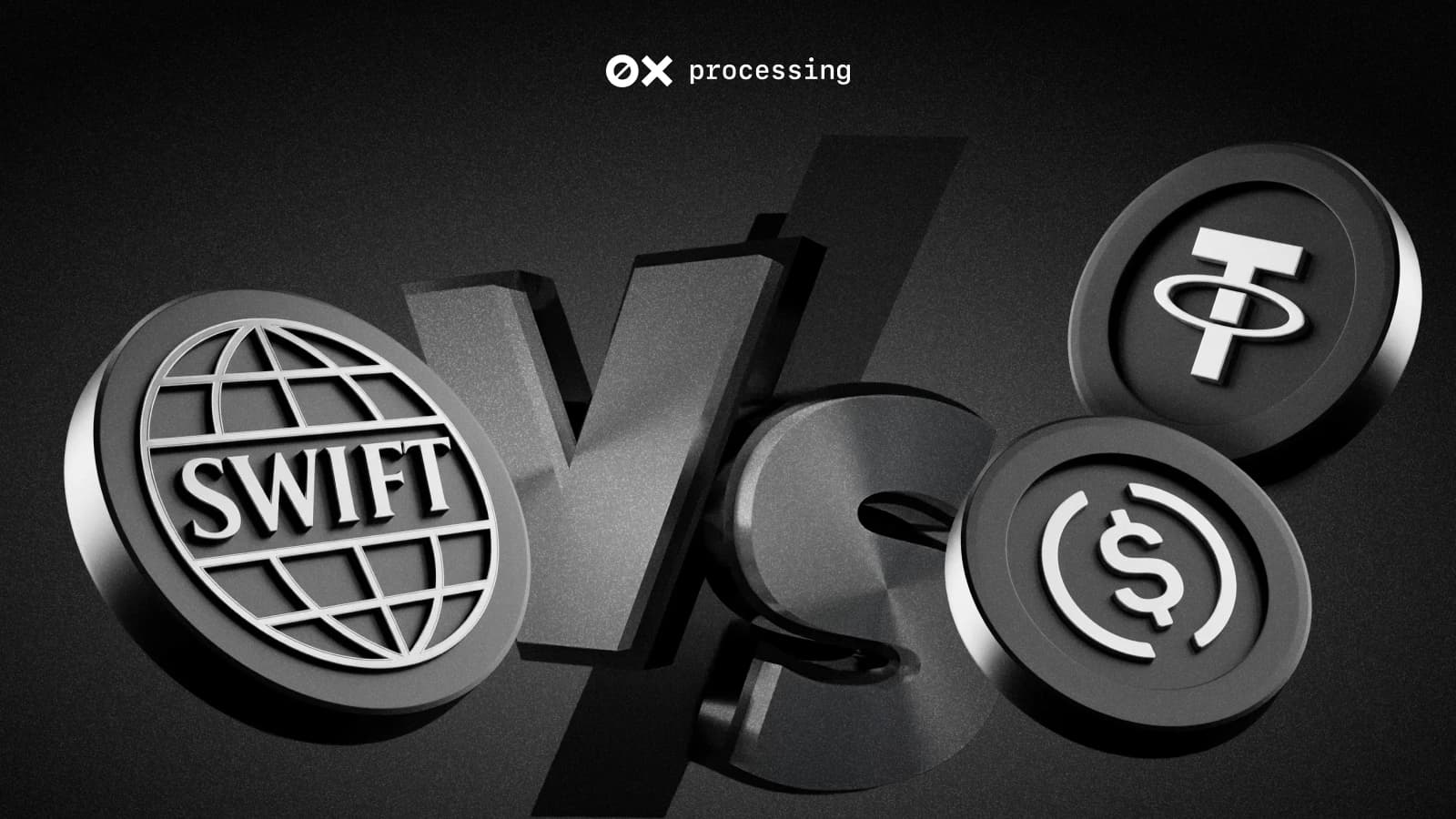
In 2026, stablecoins are actively replacing SWIFT in the field of international B2B settlements. Companies are increasingly choosing USDT and USDC - and the reason is not only technology, but also real savings in time and money.
Key advantages of stablecoins
- Speed. SWIFT transactions take several days, while stablecoins provide transfers in minutes - without being tied to banking hours and time zones.
- Lower fees. Unlike SWIFT, where fees consist of conversion, intermediary and operational payments, stablecoins only charge a blockchain network and crypto gateway fee.
- Accessibility. Stablecoins operate on open blockchains: payments can be made from anywhere in the world with an internet connection, even in regions with limited banking infrastructure.
Stablecoins have a market capitalisation of over $307 billion, with daily transaction volumes exceeding $100 billion. USDT and USDC hold leading positions in international trade.
Reliable infrastructure is critical for business, and crypto gateways such as 0xProcessing play a key role here. They provide: instant exchange of fiat for stablecoins and vice versa; AML compliance and reporting; API integration with ERP/CRM systems; exchange rate fixing to protect against volatility. Thanks to such solutions, companies get a hybrid payment model: the speed and low costs of blockchain + the familiar work with fiat currencies.
In 2026, stablecoins will no longer be an experiment, but the standard for cross-border B2B settlements. Their success is based on the maturity of the infrastructure - from blockchains to regulated gateways.
Why SWIFT will lose out to stablecoins in 2026: analysis of key shortcomings and alternatives
Despite its long-standing monopoly in international settlements, the SWIFT system will face a systemic loss of competitiveness in 2026. Its key limitations are becoming critical for modern business, especially against the backdrop of the growth of cross-border stablecoin settlement solutions based on USDT and USDC.
SWIFT's problems: what is slowing down cross-border payments
Main problems:
- Long transaction times. A typical SWIFT transfer takes 1 to 5 business days. The delay is caused by multi-stage verification through correspondent banks, differences in the working hours of financial institutions across time zones, and additional AML/KYC checks.
- High fees. The cost of a transfer consists of several components: a fixed fee for sending a message, correspondent bank fees, and hidden conversion costs when exchanging currencies. For small transactions, these costs make transfers economically unfeasible.
- Limited operating hours. SWIFT only operates during the business hours of financial centres (NYSE, LSE, TSE). Transfers sent on weekends or holidays are processed with a delay. This hinders the efficiency of business processes on a global scale.
- Complexity for small and medium-sized businesses. Small and medium-sized enterprises face high minimum transfer amounts, documentation requirements that are inaccessible to start-ups, and refusals due to the counterparty's ‘insufficient reputation’.
Against the backdrop of such difficulties, modern businesses are looking for alternatives for conducting international monetary transactions. These alternatives have become stablecoin transfers. Taking into account adjustments that exclude the actions of bots or artificial intelligence, approximately $9 trillion has been processed through stablecoins over the past 12 months, which is 87% more than a year earlier. This level represents more than half of Visa's payment volume and more than five times PayPal's payment volume.
How stablecoins solve SWIFT problems
The cross-border stablecoin settlement solution based on USDT, USDC and similar assets offers a fundamentally different model:
Want to accept crypto payments on your website?
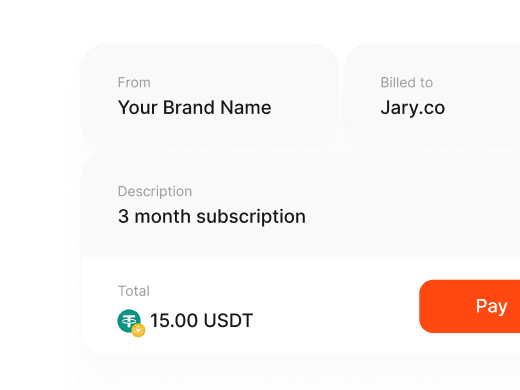
- Instant transactions. Transfers are executed on the blockchain in 1-10 minutes regardless of the amount and geography. For example: paying a supplier in Asia from Europe via USDT takes less than 5 minutes, and settlements with freelancers in Latin America occur in real time.
- Cost reduction. The commission is 6.4-13.4 TRX per transaction in USDT (TRC-20), for transfers in USDC (Ethereum/Polygon) it depends on the network load. This is 10-50 times cheaper than SWIFT analogues. Conversion to fiat is possible through crypto gateways with transparent rates.
- Operates 24/7/365. Blockchain networks do not have weekends or holidays. Companies can send payments at night, respond quickly to urgent contracts, and synchronise settlements with global partners without time restrictions.
- Accessibility for businesses of any size. Stablecoins remove barriers for small and medium-sized businesses: there are no minimum amounts for sending, wallet registration takes 5 minutes, and integration with ERP systems is possible via API crypto gateways, such as 0xProcessing.
Why is this important for business?
In 2026, cross-border stablecoin settlement solutions will become the standard for: B2B settlements: instant payment for deliveries without delays; freelance platforms: payments to contractors in any country without banking intermediaries; e-commerce: one-click settlements with foreign suppliers. Stablecoins don't just speed up payments - they redefine the logic of international trade, making it more transparent, accessible to different levels of business, and predictable.
SWIFT remains relevant for large interbank transactions, but stablecoins have already become the preferred tool for operational B2B business. Their advantages in speed, cost and accessibility are setting a new standard for cross-border payments.
USDT vs USDC: comparison for B2B settlements
USDT and USDC are the two most popular stablecoins pegged to the US dollar (1 token = 1 USD). The former has a market capitalisation of $185.9 billion, while the latter has $74.9 billion. The market capitalisation of other stablecoins does not exceed $7 billion. Both coins are widely used in cryptocurrency transactions, including B2B settlements, but they have significant differences that are important to consider when choosing a tool for business. The main differences are summarised in the table.
| Parameter | USDT | USDC |
|---|---|---|
| Issuer | Tether Limited (private company) | Coinbase and Circle consortium (American companies) |
| Year of issue | 2014 | 2018 |
| Transparency of reserves | Criticised for insufficient transparency and lack of regular independent audits. It is claimed that each USDT is backed by a dollar, but evidence is limited | Regularly audited, reports published monthly. Guarantees that reserves match declared volumes |
| Regulatory compliance | Weak compliance with laws, less control by regulators. | Fully compliant with US and EU legislation, actively cooperates with regulators. An important factor for institutional investors |
| Liquidity | Highest among stablecoins - used on all major exchanges, in P2P transactions, trading pairs. | High, but slightly lower than USDT. More commonly used in DeFi protocols and institutional environments |
| Supported blockchains | Operates on multiple networks (Ethereum, Tron, BSC, etc.). The USDT TRC20 version (on Tron) features minimal fees and high transfer speeds. | Supports multiple networks (Ethereum, Solana, etc.), but the selection is smaller than that of USDT |
| Transaction fees | Low, especially on the Tron network (TRC20). | Average, depending on the selected network (may be higher on Ethereum) |
| Scope of application | Versatile: exchanges, P2P platforms, trading, transfers. | Primarily DeFi protocols, institutional settlements, long-term storage |
| Level of centralisation | High (decisions are made by the private company Tether). | Lower due to the partner ecosystem and integration with regulated projects |
When to choose USDT?
Choose USDT for B2B settlements if: you need maximum liquidity - USDT is accepted almost everywhere and can be easily converted into other cryptocurrencies and fiat money; speed and low fees are important - especially when using the USDT TRC20 version on the Tron network; you frequently engage in trading operations - USDT is popular among traders and is suitable for fast transfers; you need a universal solution - USDT works on multiple blockchains and is supported by most crypto exchanges and wallets; your priority is speed of transaction execution rather than maximum transparency of reserves.
When to choose USDC?
Choose USDC for B2B settlements if: transparency and reliability are important - regular audits and reports guarantee reserve compliance; the business works with institutional partners - USDC is recognised in the institutional environment and complies with regulatory requirements; long-term storage of funds is planned - USDC is considered a safer choice for accumulation; settlements are related to DeFi projects - USDC is actively used in decentralised finance; compliance with legal regulations is required - USDC complies with US law, which is important for some jurisdictions; the business seeks to minimise risks through stricter control and less centralisation. The choice between USDT and USDC depends on your business priorities - speed and liquidity (USDT) or transparency, regulatory compliance and security (USDC). In some cases, it is possible to combine both stablecoins for an optimal balance between speed and reliability of settlements.
Regardless of which stablecoin suits you best, 0xProcessing will ensure smooth transfers with a transaction approval rate of up to 99.9%. The crypto gateway supports payments not only in USDT and USDC, but also in 63+ other popular cryptocurrencies. You can use settlements in other currencies and automatically convert them to stablecoins to avoid volatility. Sign up for a consultation to learn how to use cryptocurrency in international trade.
How stablecoins speed up cross-border payments
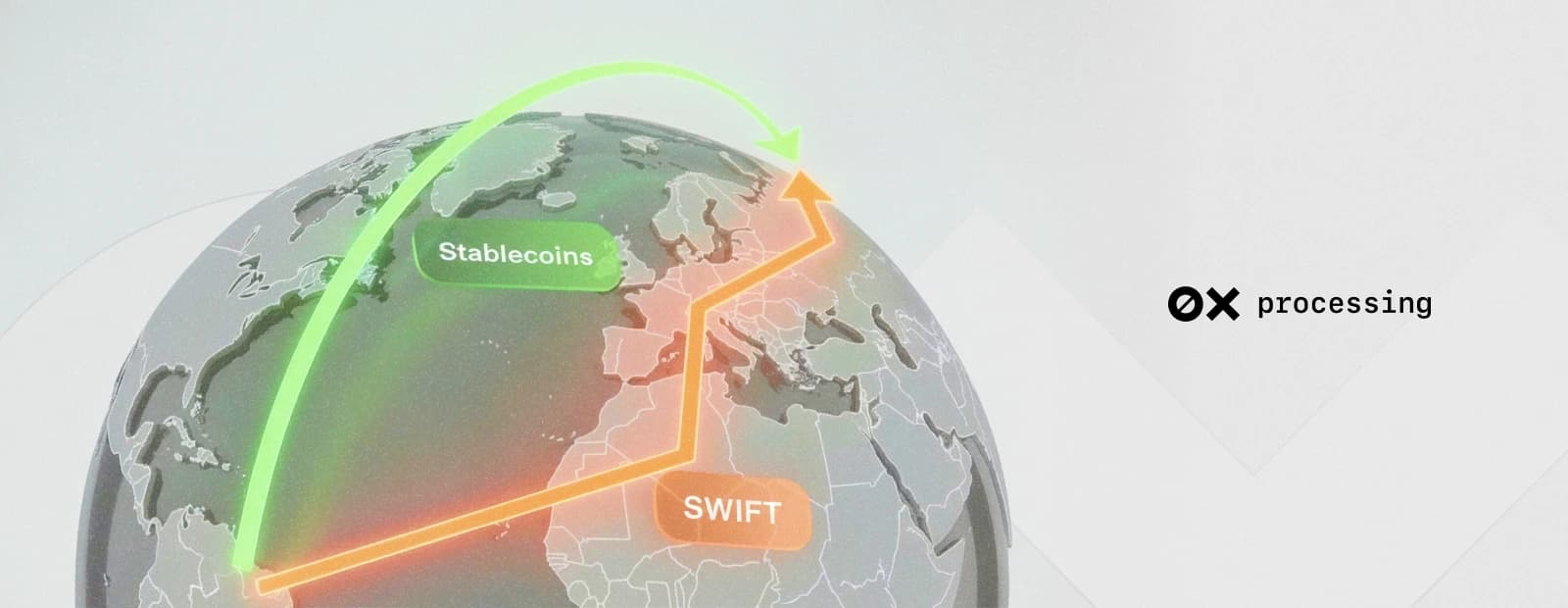
Traditional international transfer systems (SWIFT, correspondent banking) are slow (2-5 days) and expensive (on average 4.26% of the transfer amount). Stablecoins solve these problems by offering: Instant settlements - transactions are processed in seconds instead of days thanks to blockchain and the absence of intermediaries. Low fees - savings of up to 99% compared to traditional payments (fixed, predictable rates). Round-the-clock operation - payments are processed 24/7/365, without being tied to banking hours. Transparency - all transactions are recorded in a distributed ledger, and the status of a payment can be tracked in real time. Simplified conversion - stablecoins are denominated in USD or other fiat currencies, eliminating the need for currency exchange. Accessibility - suitable for small businesses and regions with limited banking infrastructure (only a smartphone and internet connection are required).
Large companies are already using stablecoins: PayPal (PYUSD), Visa (Tokenised Asset Platform), Stripe (Bridge.xyz), JPMorgan (JPM Coin). Regulation (GENIUS Act in the US, MiCA in the EU) increases trust in stablecoins. It is predicted that in the next 10 years, they could take over a large part of the global payments market.
The role of payment giants: Visa, Mastercard and Circle in the stablecoin ecosystem
Payment systems Visa, Mastercard and stablecoin issuer Circle (USDC) are actively integrating cryptocurrency technologies into traditional financial services, optimising settlements and expanding opportunities for businesses and users.
Visa Stablecoin Settlement
Visa has launched the Visa Stablecoin Settlement service, which allows US banks to make settlements using the USDC stablecoin (Circle Internet Group) on the Solana blockchain. Key features: first participants - Cross River Bank and Lead Bank; integration with the Circle Arc blockchain platform (Visa is a design partner in the project); faster settlements (unlike the traditional 3 business days, transactions are almost instantaneous, 7 days a week); the volume of annual settlements in stablecoins has already exceeded $3.5 billion, with a total Visa transaction volume of $17 trillion; partnership with Stripe Inc. (Bridge) to launch card programmes with stablecoins in Latin America.
MasterCard Circle Stablecoin Settlement EMEA
Mastercard is developing stablecoin payments in the EMEA region (Europe, Middle East, Africa): allows merchants to accept payments in stablecoins; is in talks to acquire Zero Hash (infrastructure for working with cryptocurrencies); focusing on integrating stablecoins into retail payments, while retaining conversion to fiat currency for merchants.
The role of Circle (USDC issuer)
Circle plays a key role as the issuer of one of the most popular stablecoins, USDC: ensures that USDC is pegged to the US dollar (1:1) using reserve assets (Treasury bonds, etc.); collaborates with Visa and other payment systems to integrate USDC into banking and retail payments; develops its own blockchain infrastructure (Circle Arc) to simplify the integration of stablecoins. The collaboration between payment giants and stablecoin issuers creates a hybrid financial ecosystem where the speed and transparency of blockchain are combined with the reliability and reach of traditional payment systems. This opens up new opportunities for cross-border payments, fintech startups, and retail users.
How 0xProcessing simplifies the transition to stablecoins
0xProcessing is a payment gateway that helps businesses seamlessly integrate stablecoins (USDT, USDC, etc.) into their operational processes.
Key features
- Instant conversion: fiat, cryptocurrency to stablecoin at market rates with transparent fees.
- API integration: ready-made solutions for connecting to ERP, CRM, and accounting systems - minimal customisation required.
- Regulatory compliance: built-in AML compliance, report generation.
- Multi-network support: work with USDT (TRC-20, ERC-20), USDC and other assets on popular blockchains.
- Exchange rate fixing: protection against volatility - use of the Volatility Risk Control System (VRCS) programme.
0xProcessing partners receive payments in minutes instead of days, with lower fees than banks, no hidden costs, settlements with partners from any country without banking corridor restrictions, and a single interface for managing all transactions. 0xProcessing turns stablecoins into a convenient tool for B2B settlements, combining blockchain technologies with the requirements of traditional business.
Stablecoin market development forecast: 2026–2028
According to JPMorgan estimates, by 2028 the stablecoin market will reach $500–600 billion, which is significantly lower than the optimistic forecasts of $1 trillion. Key factors for restrained growth: Demand structure. The main drivers are payments, trading and DeFi (derivatives collateralisation, crypto fund liquidity). Turnover efficiency. To service global cross-border payments ($10 trillion per year), $200 billion in circulation is sufficient – transaction speed is important, not the volume of issuance. Regulatory pressure. Banks and governments are developing alternatives: tokenised deposits (e.g., JPM Coin) and central bank digital currencies (CBDCs). These instruments are being integrated into the traditional financial system, reducing the need for private stablecoins. Leaders (USDT, USDC) will remain dominant, but their share may decline due to competition from CBDCs. Payment systems (Visa, Mastercard) will expand partnerships with stablecoins, but within regulated corridors. The market will continue to grow, but at an evolutionary rather than explosive pace. The key challenge is to balance innovation with regulatory requirements.
FAQ
Can stablecoins completely eliminate intermediaries in payments?
No. While stablecoins can reduce the number of intermediaries, banks and licensed payment operators are still necessary for converting to fiat currencies and ensuring compliance with regulatory standards.
Are stablecoin transactions always instantaneous?
Not always. Transaction speed depends on several factors:
- Blockchain congestion.
- Network type (Layer 1 or Layer 2).
- KYC/AML procedures.
In some cases, confirmation may take tens of minutes.
Is one blockchain network sufficient for global settlements?
No. Multi-network solutions are required for scaling globally.
Different blockchains provide a balance between transaction speed, cost, and security depending on the region and payment volume.
How are banks responding to the growing popularity of stablecoins?
Banks are adapting in several ways:
- Launching their own tokenised deposits (e.g., JPM Coin).
- Integrating stablecoins into payment gateways.
- Maintaining control over fiat corridors to ensure compliance and liquidity.
Does regulatory fragmentation affect the choice of stablecoin?
Yes. Companies tend to choose stablecoins based on regulatory transparency:
- USDC is preferred in regions with strict legal requirements.
- USDT is more commonly used in areas with softer regulation.
Can stablecoins be considered an alternative to SWIFT?
Partially. Stablecoins are more efficient for small and medium-sized transactions.
For large interbank transfers, SWIFT remains the standard due to established procedures and risk mitigation mechanisms.