
A white label crypto gateway is a ready-made infrastructure solution that enables the launch of crypto payments within 3–6 weeks, rather than the 1–2 years it would take to develop one from scratch. By 2026, this will be the primary method for PSPs, ISOs and neobanks to enter the digital assets market, particularly in the stablecoin segment, which provides predictability for businesses.
Fintech companies worldwide are facing growing demand for crypto payments, but developing blockchain infrastructure in-house requires enormous resources and deep expertise. White-label solutions allow these barriers to be bypassed and a product to be brought to market in a matter of weeks.
In this article, we will examine in detail what white-label crypto gateways are, why demand for them has skyrocketed in 2025–2026, what features they offer, who they are suitable for, and how fintech companies can launch their own solution at minimal cost.
What is a white-label crypto gateway
The white-label crypto gateway is a special platform that a merchant can use to accept payments under their brand. Instead of building blockchain infrastructure from scratch, payment providers and fintech companies integrate an existing platform and release it as part of their own service.
The differences compared to in-house development are shown in the table.
| Parameter | In-house development | White-label solution |
|---|---|---|
| Blockchain infrastructure | Nodes must be set up and maintained for each network | Ready-to-use and proven infrastructure |
| Security | Risk of coding errors; multiple audits are required | Already tested and secured |
| Network support | Each new network must be integrated separately | Built-in support for dozens of blockchains |
| Updates | The team must keep track of hard forks and updates | The provider takes care of |
Key components of the white-label solution:
- API for crypto payment integration with existing systems;
- Wallets with HD architecture (unique addresses for each transaction);
- Transaction processing and network routing;
- Built-in AML/KYC modules;
- Merchant interface (dashboard, reporting);
- Branding tailored to the partner company.
Why demand for white label solutions skyrocketed in 2025–2026
Several factors have led to an explosive growth in interest in white-label crypto gateways.
- Demand from merchants. According to a study by PayPal and the NCA, 88% of merchants report that customers ask them about the possibility of paying with cryptocurrency. The lack of crypto options is becoming a competitive disadvantage.
- Market growth. The white-label payment gateway market (including crypto wallet integration) was valued at approximately $2.02 billion and, according to forecasts, is set to reach $5.4 billion by 2030, with an average annual growth rate of 21.5%.
- The complexity of blockchain development. Supporting even a single network requires constant monitoring, node updates and tracking of hard forks. Working with dozens of networks requires an entire team of blockchain engineers.
- Regulatory pressure. MiCA in Europe, and licensing requirements in Singapore and the UAE, require crypto service providers to comply with strict regulations. White-label providers are already embedding the necessary compliance features into their solutions.
- Stablecoins as a driver. According to TRM, stablecoins accounted for around 30% of the total volume of on-chain transactions from January to July 2025. They provide predictability and low volatility, which is critically important for business.
Growing demand from merchants and the rapid development of the market are creating a unique window of opportunity for fintech companies. However, entering the crypto payments market requires a reliable technological foundation. 0xProcessing offers a ready-made white-label solution that allows you to start accepting cryptocurrencies under your own brand within 30 days, using our proven infrastructure supporting 85+ cryptocurrencies and 16+ blockchains. Find out how 0xProcessing helps fintechs launch crypto payments.
Want to accept crypto payments on your website?
Key features of the white-label solution
The main features a merchant gains when integrating a white-label solution from a cryptocurrency gateway.
Multi-currency and multi-chain support
A modern white-label gateway must support major cryptocurrencies (Bitcoin, Ethereum) and stablecoins (USDT, USDC) across all popular networks – ERC-20, TRC-20, BEP-20, Solana, Polygon. This allows merchants to accept payments from customers regardless of which network they prefer.
Flexible API for integration
The API is the heart of the white-label solution. It handles:
- the creation of payment forms and invoices;
- receiving transaction status notifications (webhooks);
- bulk payments to counterparties;
- balance management and conversion.
Built-in compliance (AML/KYC)
Regulators require payment service providers to screen transactions for risks. A white label solution must include:
- checking addresses against blacklists;
- transaction risk assessment;
- blocking of suspicious transactions;
- integration with KYC providers for user verification and AML checks.
White Label
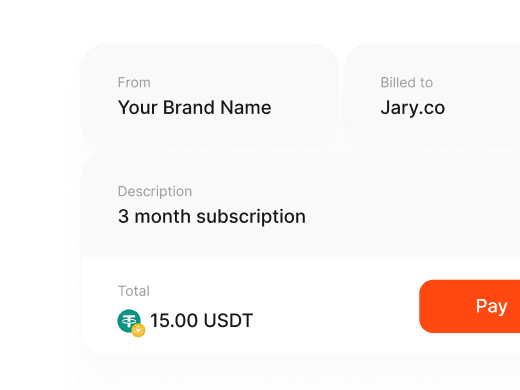
The end result is a fully branded solution tailored to your company. The payment solution features your logo, colour scheme, a dedicated domain for payment pages, customisable notifications, and your merchant name in the interface.
Conversion and risk management
A key feature for businesses that do not wish to hold volatile assets. The solution must offer:
- instant conversion to stablecoins (USDT/USDC);
- automatic withdrawal of cryptocurrency or the option to receive fiat via an affiliate network;
- configuration of conversion rules (e.g., automatically convert all incoming payments to USDT).
All this allows you to use the services of a trusted provider within a month, whilst the payment service interface will be tailored to the merchant’s requirements.
Comparison: in-house development vs White label
| Parameter | In-house development | White-label solution |
|---|---|---|
| Start-up time | 12–24 months | 3–6 weeks |
| Command | Blockchain devs, security, QA | Pre-configured API integration keys, support from the provider’s representatives |
| Network support | Added individually | Built-in support; for example, 0xProcessing allows you to accept payments in over 65 of the most popular cryptocurrencies |
| Security audits | Additional | Already implemented |
| Updates | Independent monitoring, ongoing support | All issues are resolved by the provider |
| AML/KYC integration | Separate development | Built into the provider’s system |
A white-label solution can save up to 70% in costs compared to in-house development and reduce time-to-market by a factor of 10 to 20.
Who needs a white label solution
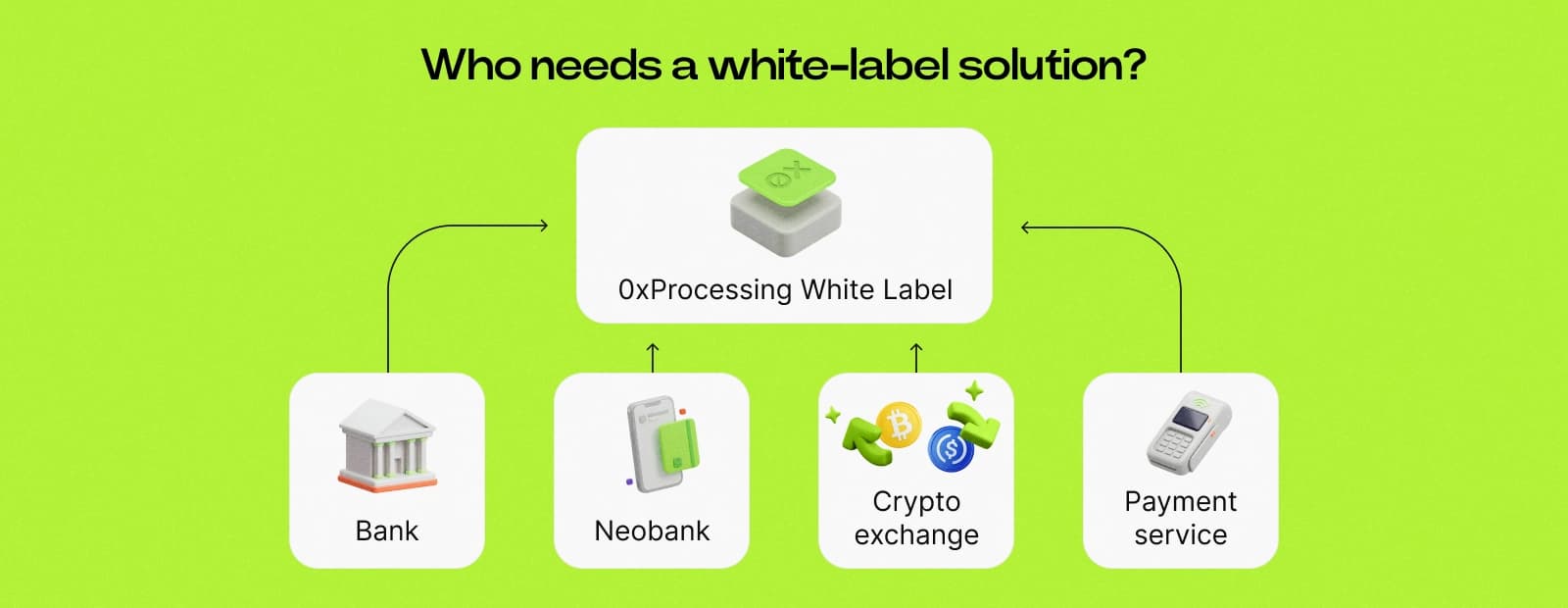
Any company planning to implement cryptocurrency payments may require a specialised solution from providers. Below are the main business categories, but the use of crypto gateways is not limited to these.
- Payment Service Providers (PSPs) and ISOs. Traditional payment service providers working with cards and bank transfers are facing growing demand for crypto options. A white-label solution allows them to quickly add cryptocurrency to their product portfolio, attract new merchants and increase revenue from transactions.
- Neobanks and fintech apps. Neobank customers expect digital services to cover not only cards and transfers, but also cryptocurrencies. An in-app white-label wallet allows users to store, send and receive crypto without switching to third-party platforms. The neobanking market is growing at an average annual rate of over 45%.
- SaaS platforms and marketplaces. For platforms with international clients and a subscription model, stablecoins are becoming the ideal tool for recurring payments. A white-label gateway allows you to automate the acceptance of subscriptions in USDT and USDC, avoiding high fees for international transfers.
- Crypto start-ups in new jurisdictions. Companies entering the markets of the UAE, Singapore and Latin America can use a white-label solution for a quick launch without having to obtain all licences at once – the provider already has the necessary regulatory framework in place.
Regional implementation specifics
- Europe – focus on MiCA and SEPA Instant. Europe offers the most developed regulatory environment. MiCA (Markets in Crypto-Assets) establishes clear rules for stablecoin issuers and stablecoin payment solutions. SEPA Instant allows euros to be credited to an account in seconds, which works perfectly with crypto payment gateways.
- USA – complex regulation, but a huge market. In the US, cryptocurrency regulation remains fragmented at state level (e.g., the BitLicense in New York). However, the market is vast, and demand for stablecoins for international payments continues to grow. White-label solutions help ensure compliance without the need for in-depth local expertise.
- Asia – Singapore and Hong Kong as hubs. Singapore offers 0% capital gains tax and a favourable regulatory environment. Hong Kong is actively developing licensing for crypto platforms. Both regions have become magnets for fintech start-ups in need of fast and reliable white-label solutions.
- The Middle East – UAE. The UAE has created ideal conditions for the crypto business: 0% tax, transparent regulators (VARA in Dubai, ADGM in Abu Dhabi). Family offices and banks are showing growing interest in white-label solutions to enter the digital assets market.
- Latin America – Stablecoins as a lifeline. High inflation in local currencies makes stablecoins (especially USDT) a critically important tool for businesses and the general public. P2P trading dominates, but professional white-label solutions for businesses are gaining momentum.
Real-world business cases
Chainbull – launching an exchange in 42 days. Chainbull, a new crypto exchange, used a white-label solution to enter the market. Results for the first 90 days:
- registered users: 21,400+;
- KYC-verified: 14,800+;
- active traders: 8,600+;
- geographical reach: 32+ countries;
- monthly trading volume: $18–24 million;
- monthly revenue: $180,000 – $260,000;
- net profit: $75,000 – $120,000.
The launch took just 42 days instead of 1–2 years if developed in-house.
Deel – global payments in stablecoins. Deel, a platform for managing international payments, uses stablecoins to pay contractors in different countries. This avoids slow and expensive international transfers, reducing payment times from days to minutes.
Launch process: 5 steps
Universal guide to integrating a white-label solution.
Step 1: Choosing a partner. The first and most important step is selecting a white-label provider. Key criteria:
- alignment with business needs;
- security level;
- regulatory compliance (AML);
- ease of integration and quality of documentation;
- scalability.
Step 2: Compliance, integration and branding. At this stage, the solution is customised to your needs. This includes API integration with existing systems, configuration of AML/KYC parameters, branding (domain, logo, colour scheme) and testing.
Step 3: Customer onboarding. Launch for the first users. It is important to ensure a smooth onboarding process:
- automatic wallet creation;
- clear instructions;
- support during the initial stages.
Step 4: Payment processing and conversion. Once customers start using the system, automated processes come into effect: receiving incoming payments, routing across networks, conversion to stablecoins, and payments to counterparties.
Step 5: Monitoring, reporting and scaling. After launch, it is necessary to constantly monitor transaction security, compliance and risks, volumes and fees, and the need to expand functionality.
How 0xProcessing helps fintechs launch crypto payments
0xProcessing offers a powerful white-label solution for fintech companies worldwide. You get a ready-to-use infrastructure for accepting 85+ cryptocurrencies, support for 16+ blockchains, built-in AML checks and the ability to fully brand the solution to your company’s specifications.
What you get:
- A ready-to-use API for quick integration – straightforward documentation and API.
- Support for all popular networks and tokens – Bitcoin, Ethereum, USDT (ERC-20, TRC-20, BEP-20), USDC and dozens more.
- Automatic conversion to stablecoins (VRCS) – protection against volatility for you and your customers.
- Full white-label – your domain, your logo, your interface.
- Built-in compliance and AML modules – transaction verification, blocking of suspicious addresses.
- Scalability – the solution grows alongside your business.
Find out more during a free consultation.
Conclusion and findings
White-label crypto gateways have become the industry standard for rapid entry into the digital assets market. By 2026, this will not simply be a convenient option, but a necessity for fintech companies wishing to remain competitive.
Key benefits of the white-label approach:
- speed: 3–6 weeks instead of 1–2 years;
- cost savings: up to 70% reduction in costs;
- security: proven, audited solutions;
- compliance: built-in AML/KYC modules;
- scalability: the ability to grow without overhauling your infrastructure.
The crypto payments market continues to grow, and demand from merchants is only increasing. For fintech companies, this means the time for experimentation is over – it is time to act. Ready to launch crypto payments under your own brand? Contact the 0xProcessing team for a personalised consultation on a white label solution.
Frequently asked questions about white-label crypto gateways
What is a white-label crypto gateway?
It is a ready-made payment infrastructure for accepting cryptocurrencies, which companies can use under their own brand. Instead of developing blockchain solutions from scratch, you integrate a ready-made platform and customise it to suit your needs.
How quickly can I launch with a white-label solution?
Typically 3–6 weeks, including integration, branding customisation and testing. By comparison, in-house development takes 12–24 months.
Which cryptocurrencies are supported?
Modern white-label gateways support 85+ cryptocurrencies, including Bitcoin, Ethereum, USDT (on ERC-20, TRC-20, BEP-20), USDC and major altcoins.
Do I need a crypto licence to use a white label gateway?
This depends on your region and business model. The gateway provides the technology, but you may need your own licence to provide services. Some providers offer support with obtaining licences.
Can I customise the user interface?
Yes, white label means full branding – your logo, colours, domain, and often customised payment pages and email notifications.
What is the role of stablecoins?
Stablecoins (USDT, USDC) provide price stability, which is critical for business. They allow you to accept crypto payments without the risk of volatility and simplify accounting.
Do white label solutions include AML/KYC?
Yes, modern white label gateways include built-in AML transaction checks and often integration with KYC providers for user verification.
 White label solutions, Crypto payment processors, Crypto gateways, Merchant solutions, Payment integration