
Imagine that your website, app or even an AI agent could pay each other for data and services just as easily as you send an HTTP request. No accounts, no credit cards, no monthly subscriptions – just pure, programmatic commerce. This is not a fantasy, but a reality made possible by the x402 protocol – a new standard for internet payments that revives the long-forgotten HTTP status code 402 ‘Payment Required’.
In May 2025, Coinbase introduced the open x402 payment protocol, and in September, together with Cloudflare, launched the x402 Foundation, which puts the code – which has existed since 1997– into practical use. x402 transforms ordinary web requests into payment transactions, allowing users to pay for API usage, access to content, or AI agent services instantly and without intermediaries.
In this article, we will examine in detail how AI agents use x402 protocol , why it is critically important for the development of the AI agent economy, what advantages the use of stablecoins offers, and how developers can integrate it into their APIs and microservices.
What is x402 protocol for AI agents? From HTTP code to payment standard
HTTP status code 402 (‘Payment Required’) was reserved back in the HTTP/1.1 specification in 1997. It was intended to indicate that payment was required to access a resource. However, for nearly 30 years, this code remained unused – there was no standard defining exactly how this payment should be made.
In September 2025, the situation changed dramatically. Coinbase, in collaboration with the Cloudflare Foundation, launched the x402 protocol – an open standard for HTTP-native payments that finally gave practical implementation to the 402 code.
How it works: the basic scheme
The x402 protocol embeds payments directly into standard HTTP data exchange. Here is what a typical transaction looks like.
The client (browser, application or AI agent) sends a request to access a resource (for example, a premium API endpoint).
The server responds with a 402 Payment Required status code and includes the payment terms in the response body:
- payment amount (e.g., $0.01);
- accepted token (usually USDC);
- payment address;
- blockchain network (Base, Solana, Polygon).
The client processes this response, generates and sends the payment to the specified address via their crypto wallet.
Once the transaction is confirmed, the client repeats the original request, adding a PAYMENT-REQUIRED header containing the signed payment proof. The server validates the payment using the PAYMENT-SIGNATURE header and, upon successful verification, returns a 200 OK with the requested data. Cloudflare’s implementation follows a similar pattern, combining HTTP headers with a JSON‑encoded payment details body.
The whole process resembles a conversation between two programmes: ‘How much does it cost?’ – ‘This much, pay here’ – ‘Here you go, here’s the confirmation’ – ‘Take it, use it’.
Why x402 is important right now: three factors
The maturity of stablecoins as a payment infrastructure. By 2025–2026, stablecoins had evolved from a speculative instrument into a fully-fledged payment system. USDC, USDT and other stablecoins process billions of dollars in transactions daily, with fees measured in cents and confirmation times in seconds. This is precisely what makes x402 stablecoin payments for AI agents economically viable.
The explosive growth of AI agents. ChatGPT, Claude, autonomous agents – they have ceased to be merely ‘useful assistants’ and have become entities capable of taking action. But until now, they have been cut off from the payment infrastructure. x402 for AI agents solves this problem: now an agent can pay for data itself, purchase API access itself, and pay for computations itself.
Support from the majors. When giants such as Cloudflare, Visa and Google start integrating the protocol, it sends a signal to the market: the standard is here to stay. Cloudflare has already built x402 support into its edge network, enabling the sale of AI services on a pay-per-request basis directly at the CDN level.
Want to accept crypto payments on your website?
How AI agents use x402: real-world scenarios
Autonomous data trading. Imagine an AI agent managing your investment portfolio. It detects another agent providing high-quality trading signals. Instead of waiting for your authorisation or setting up a monthly subscription, the agent simply pays $0.10 for each signal via x402 protocol autonomous payments. No human involvement, no bank cards – pure machine commerce.
Pay-per-use API instead of subscriptions. A developer creates a dApp that needs real-time price data from exchanges. Instead of paying $500 a month for unlimited access they don’t need, the app pays $0.0001 for each request. Micropayments for AI agents using x402 make the economics of development much more efficient – you only pay for what you actually use.
Decentralised oracles and data feeds. Smart contracts require external data – for example, the ETH/USD exchange rate. Previously, it was necessary to enter into long-term contracts with oracle providers. Now, a smart contract can request data itself and instantly pay for data feeds via x402, receiving up-to-date information exactly when it is needed.
Overcoming regional barriers. A developer from a country with limited access to international payment systems wants to pay for hosting or developer tools. Services that accept the x402 payment protocol allow them to pay directly from their wallet in USDC, bypassing the banking system entirely.
While AI agents and protocols like x402 are shaping the future of payments, your business can start accepting cryptocurrency today. 0xProcessing provides a ready-to-use infrastructure for integrating crypto payments via a simple API. Over 65 cryptocurrencies, support for all major networks, automatic conversion to stablecoins and instant crypto payouts – everything you need to accept payments from customers worldwide.
Even without complex protocols like x402, ordinary businesses already need a reliable crypto gateway to accept Bitcoin, Ethereum and stablecoins. 0xProcessing allows you to accept USDC, USDT and other cryptocurrencies with lower fees than banks, protecting your business from volatility through automatic conversion. Find out how 0xProcessing helps businesses accept crypto payments.
Technical implementation: how a developer integrates x402
Examples of technical implementation.
Simple server-side integration
On the server side, the developer adds lightweight middleware that determines the cost of accessing specific routes. For example, a premium API endpoint costs $0.01 per call.
// Example middleware for Express.js
app.use("/api/premium", async (req, res, next) => {
  // Check for PAYMENT-REQUIRED header with payment proof
  const paymentProof = req.headers["payment-required"];
  const paymentSignature = req.headers["payment-signature"];

  if (!paymentProof || !paymentSignature) {
    return res.status(402).json({
      error: "Payment Required",
      payment_details: {
        amount: "0.01",
        currency: "USDC",
        address: "0xPaymentAddress...",
        network: "base",
        message: "Send payment and retry with PAYMENT-REQUIRED and PAYMENT-SIGNATURE headers"
      }
    });
  }

  // Verify payment proof and signature
  const isValid = await verifyPayment(paymentProof, paymentSignature);
  if (!isValid) {
    return res.status(402).json({
      error: "Invalid Payment",
      message: "Payment verification failed"
    });
  }

  next();
});
Client-side: payment and retry
On the client side (whether it’s a browser application or an AI agent), the logic is just as simple:
// Function to execute a request with payment
async function callPaidAPI(url) {
  // First request – check the cost
  let response = await fetch(url);

  if (response.status === 402) {
    const paymentDetails = await response.json();

    // Send payment via wallet
    const txHash = await window.ethereum.request({
      method: "eth_sendTransaction",
      params: [{
        to: paymentDetails.payment_details.address,
        value: parseEther(paymentDetails.payment_details.amount),
        // ... other parameters
      }]
    });

    // Generate payment proof and signature
    const paymentProof = txHash; // In production, this would include more data
    const paymentSignature = await signPaymentProof(paymentProof);

    // Repeat the original request with payment confirmation
    response = await fetch(url, {
      headers: {
        "PAYMENT-REQUIRED": paymentProof,
        "PAYMENT-SIGNATURE": paymentSignature
      }
    });
  }

  return response.json();
}

// Helper function to sign payment proof
async function signPaymentProof(proof) {
  const accounts = await window.ethereum.request({ method: "eth_accounts" });
  const signature = await window.ethereum.request({
    method: "personal_sign",
    params: [proof, accounts[0]]
  });
  return signature;
}
This is a simplified example. In production, use the official Coinbase SDK for secure payment handling.
Integration with popular frameworks
Cloudflare Workers, Vercel Edge Functions, AWS Lambda – x402 can work anywhere HTTP is available. All you need to do is:
- Check for the PAYMENT-REQUIRED and PAYMENT-SIGNATURE headers.
- Verify the payment proof and signature (use official SDKs in production).
- Return a 402 status with the correct response body if payment is required.
- Return a 200 status with the requested data after successful verification.
For production implementations, refer to the official Coinbase x402 documentation and SDKs.
The PING case: the moment the protocol proved its worth
For a long time, x402 remained a purely technical protocol – interesting to developers, but unrelated to trading and mass adoption. Everything changed on 23 October 2025.
In October 2025, PING became the first token minted via the x402 protocol, demonstrating that the protocol could handle real-world distribution at scale. The token saw a 20x price increase, reached a peak market cap of $80 million, and generated millions in trading volume – proving that x402 is production‑ready under significant load.
Following PING, dozens of projects began launching their tokens via x402. Not because the protocol had changed, but because the market saw: it works.
Comparison of x402 with traditional methods and AP2
| Features | Traditional subscriptions | AP2 | x402 |
|---|---|---|---|
| Payment model | Fixed | Authorization layer (mandates) | Per request |
| Entry barrier | Account, KYC, card | AI agent + wallet | Wallet only |
| Settlement speed | Days | Varies (mandate execution) | Seconds |
| Support for AI agents | No | Yes (as authorization) | Available |
| Micropayments | Unfavourable (fees) | Limited | Cost-effective |
| Global reach | Restricted by banks | Full | Full |
| Settlement layer | Bank | Multi-layer (Google Pay, bank, blockchain) | Blockchain |
AP2 and x402 are complementary – AP2 works as an authorization layer (mandates), while x402 works as a payment execution layer.
x402 and AP2 agent payments – both protocols are designed for programmable payments, but x402 has the edge due to:
- An open standard not tied to any specific corporation.
- The use of stablecoins as the settlement layer.
- Native support for multi-chain architecture.
- Minimal transaction costs.
Benefits for businesses and developers
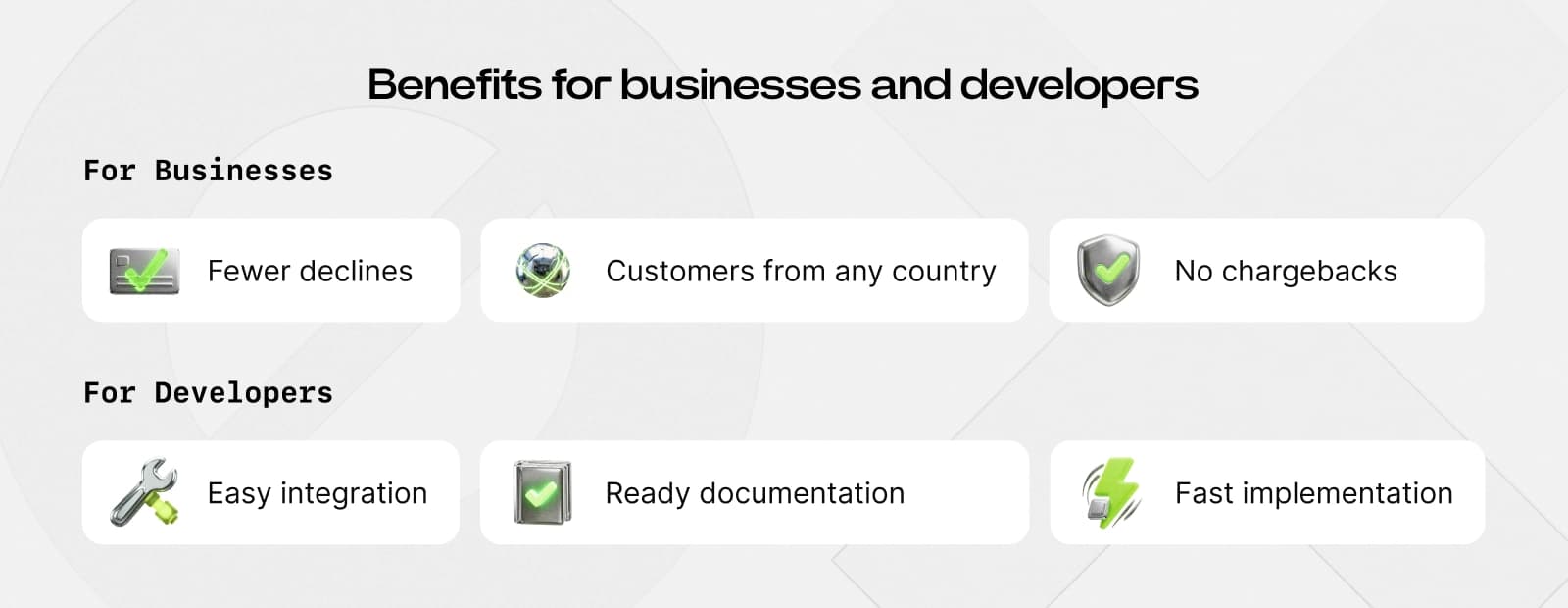
The emergence of the x402 protocol was made possible by market demand and the benefits it offers to both businesses and users.
For API and service providers
The x402 payment protocol opens up new monetisation models. Instead of selling an ‘all-inclusive’ package for $500/month, you can sell access for $0.001 per request. This attracts small developers who previously could not afford your services.
Programmatic payments allow you to automate billing to a level unattainable by traditional providers. No manual invoicing, no late payments – everything happens automatically at the moment of the request.
For consumers
Paying only for what you actually use is the main advantage of micropayments for AI agents using x402. If your agent makes 100 requests a day, you pay for 100 requests, rather than for an unlimited plan that you use 1% of.
Transaction costs are reduced to a minimum. On networks such as Base or Solana, the fee for transferring USDC is a fraction of a cent, making microtransactions cost-effective.
For the AI economy as a whole
x402 for AI agents lays the foundation for a whole new class of applications:
- autonomous agents that hire other agents;
- pay-per-query data markets;
- decentralised computing with instant settlement;
- data queries with micropayments at the moment of execution.
How businesses can prepare for the era of the agent economy
While x402 is only just gaining momentum, your business can and should start accepting cryptocurrency today. Integrating crypto payments via a crypto payment API is the first step towards ensuring your services are ready to interact with AI agents when they become mainstream.
The benefits of an early start:
- you gain access to a growing audience of crypto users;
- you learn to work with programmable money;
- your infrastructure will be ready for x402 autonomous payments when they become the standard;
- you reduce fees on international transfers today.
The x402 protocol is not just another technical standard. It is a fundamental shift in how the internet processes value. For the first time in 30 years, HTTP status code 402 has been given real-world implementation, and this paves the way for:
- micropayments, which were previously uneconomical;
- an economy of AI agents, where programmes pay programmes;
- programmable commerce, built directly into internet protocols.
PING’s success has shown that the protocol is ready for real-world use. Integration with Cloudflare, interest from Visa and Google, and dozens of projects in the pipeline all point to x402 becoming the de facto standard for machine-to-machine payments.
For developers, this is an opportunity to monetise APIs in a new way. For businesses, it’s a chance to enter an emerging market at an early stage. For AI agents, it means finally getting the payment infrastructure they need. The question is no longer whether x402 will be adopted, but how quickly you will become part of this ecosystem.
Are you ready to start accepting cryptocurrency payments today, so your infrastructure is ready for tomorrow’s agent economy? 0xProcessing offers a simple API for integrating 85+ cryptocurrencies, support for all major networks, and automatic conversion to stablecoins to protect against volatility. Sign up to 0xProcessing today and start accepting payments from customers worldwide, whilst your competitors are still just thinking about it.
Frequently asked questions about the x402 protocol
What is the x402 protocol in simple terms?
The x402 protocol is a standard that allows you to pay for access to web resources (APIs, content, services) directly via HTTP requests. Instead of a subscription or account, you simply send a micropayment from your crypto wallet and gain access.
How do AI agents use the x402 protocol?
x402 for AI agents allows agents to autonomously pay for data, computations and services from other agents. An agent can decide for itself that it needs access to a specific API and pay for it instantly via x402, without human intervention.
How does x402 differ from standard subscriptions?
The x402 payment protocol operates on a pay-per-use model, rather than a flat-rate one. You pay only for what you actually use, and do not commit to a month in advance. Furthermore, no accounts or bank cards are required – just a crypto wallet.
What is the PING moment in the history of x402?
PING was the first token minted via the x402 protocol. In October 2025, it demonstrated a 20x price increase, reached an $80 million peak market cap, and proved the protocol could handle real-world load.
Which networks does x402 support?
The x402 protocol is designed to be chain-agnostic, with native support for Base, Solana, and Polygon out of the box. Additional networks such as Arbitrum, Avalanche, and others can be integrated as needed.
Do you need to be a programmer to use x402?
To use the ready-made services – no, all you need is a crypto wallet. To integrate x402 into your own services, basic programming skills will be required, but the protocol is designed to be as simple as possible, with lightweight middleware and clear documentation.
What advantages does x402 offer over traditional payment systems?
The main advantages are: no intermediaries, instant settlements, global reach, support for micropayments (fractions of a cent), programmability, and native support for AI agents. Transaction costs are significantly lower, particularly for international transfers.
What are ‘programmable payments’ in the context of x402?
Programmatic payments are payments that are initiated and executed by programmes without human intervention. Smart contracts, AI agents and automated services can pay each other for data, computations and access, following the logic built into them.
