In February 2026, LayerZero Labs announced plans to launch its own Zero blockchain, designed for institutional financial markets. The architecture will use zero-knowledge proofs (ZKPS) to separate the execution of transactions and their verification. It is planned to increase the throughput to 2 million transactions per second in several zones, and the commission will be close to a millionth of a dollar.
This milestone marked the culmination of two years of development of the LayerZero protocol – an omnichain infrastructure that, by early 2026, connects over 150 blockchains. The network launch was followed by two major announcements: all fees on the new network will be directed to ZRO, and Citadel Securities, ARK Invest and Tether Investments announced strategic investments in the project.
In this article, we will explore what LayerZero and ZRO are, how the fee switch mechanism works, why institutional investors have joined the project, and what risks and opportunities await token holders in 2026.
What is LayerZero and why is ZRO needed
LayerZero is an omnichain protocol that enables applications to transfer messages and assets between different networks. It acts as a single layer of communication: developers do not need to write separate code for Ethereum, Solana and Arbitrum – integration with LayerZero is sufficient.
Scale. The protocol supports over 150 blockchains, including Ethereum, BSC, Arbitrum, Optimism, TRON, Base, Avalanche and others.
On 10 February 2026, LayerZero Labs announced Zero — a proposed Layer 1 blockchain currently in development DTCC is exploring it for tokenisation and collateral operations, while ICE is looking into it for organising 24/7 trading. The network is set to launch in fall 2026 with initial zones (permissionless EVM, privacy-focused payments, canonical trading environment).
The native LayerZero token utility, which performs three key functions:
- protocol governance;
- payment of fees for cross-chain messages and transactions on the Zero network;
- staking and network security.
On 19 February 2026, LayerZero CEO Brian Pellegrino confirmed: Zero will not issue a separate token. ZRO remains the sole asset in the ecosystem for staking and gas payments.
All network fees are sent to ZRO. The fee switch for the LayerZero protocol was activated following community votes (including Referendum #3 in December 2025). Protocol fees (messaging) are used for buyback and burn of ZRO. For the upcoming Zero network, fees (priority, tips/MEV, zone fees, etc.) are planned to follow the same model, creating value accrual: more transactions and messages increase demand for ZRO and burn activity.
Launch history and key milestones
The development of LayerZero and ZRO can be divided into several stages.
| Date | Event |
|---|---|
| 2023-2024 | Ecosystem growth, integrations with leading blockchains |
| May 2024 | Launch of the ZRO token, airdrop for 1.28 million users |
| December 2025 | Activation of the fee switch |
| 10 February 2026 | Announcement of Zero blockchain, investments/collaborations from Citadel Securities, ARK, Tether, DTCC, ICE |
| 19-20 February 2026 | Confirmation: ZRO is the sole token; fees directed to ZRO (protocol + planned for Zero) |
| 20 March 2026 | Unlocking of ~25.71 million ZRO (~$50–55 million) |
ZRO 2026 Tokenomics
The ZRO economic model underwent fundamental changes in late 2025 and early 2026. From a simple governance token that granted voting rights but had no direct link to the network’s economic activity, ZRO evolved into an asset with a real cash flow. The main driver was the activation of the fee switch, which directed all ecosystem fees towards the buyback and burning of tokens.
Want to accept crypto payments on your website?
Supply and Distribution
Total supply: 1 billion ZRO (fixed, non-inflationary). Official distribution:
- Community and ecosystem: 38.3% (383 million ZRO)
- Strategic partners (investors and advisors): 32.2% (322 million ZRO)
- Core contributors (including the team): 25.5% (255 million ZRO)
- Buyback and treasury: 4% (40 million ZRO), which was returned to the community
ZRO Airdrop: ~1.28 million eligible wallets received between 25 and 5,000 ZRO. The staking mechanism required a donation to Protocol Guild (proof-of-donation), which filtered out some of the airdrop hunters. In total, approximately 8.5% of the total supply (85 million ZRO) was distributed in the airdrop.
The unlock schedule is shown in the table:
| Date | Value | Percentage of circulating supply |
|---|---|---|
| 20 March 2026 | About 25.7 million ZRO | Approximately 5.64% |
| September 2026 | Approximately 30 million ZRO | Approximately 5-7% |
| March 2027 | Pending valuation | To be determined |
The Fee Switch Mechanism
The Fee Switch was activated in December 2025 following a community vote in which 97% of participants supported the change to the protocol’s economic model.
How the mechanism works:
- Fee collection. All fees for cross-chain messages via the LayerZero protocol, as well as all fees on the Zero network (priority fees, tips, MEV, zone fees, payment fees) are collected into a single pool.
- Conversion. If a user pays a fee in a currency other than ZRO (e.g. USDC, ETH or another token), the system automatically converts this fee into ZRO at the market rate.
- Burning. All tokens collected and converted to ZRO are sent to a special burn address and permanently removed from circulation.
On February 20, 2026, LayerZero CEO Brian Pellegrino confirmed that all fees within the ecosystem are planned to be directed to ZRO. This creates a direct mechanism for value accumulation: the more transactions pass through the Zero network and the more messages are sent via the LayerZero protocol, the higher the demand for ZRO to pay fees and the more active the token burning process becomes.
Fee trends
Exact figures on fee volumes for 2025–2026 are not publicly disclosed, but indirect indicators point to steady growth.
| Period | Event | Impact on fees |
|---|---|---|
| September 2025 | Integration with TRON | Millions of stablecoin users in Asia have been added |
| October 2025 | Integration with Base | Developers from the Coinbase ecosystem have been brought on board |
| December 2025 | Activation of the fee switch | Fee burning has begun |
| February 2026 | Launch of the Zero blockchain | A new source of fees has been opened |
It is important to understand that after the airdrop in May 2024, activity decreased by 60% – this is normalization after the peak caused by the distribution of tokens. The network has now returned to organic growth, helped by new integrations and the announcement of the launch of Zero. The more applications that use LayerZero in the future and the more transactions that go through Zero, the greater the need for ZRO.
Key events of 2026
The first half of 2026 is packed with events that will determine ZRO’s trajectory:
- 10 February – announcement of the upcoming launch of Zero, investment from Citadel Securities, increased confidence, inflow of institutional capital.
- 19–20 February – all fees go to ZRO, the start of the deflationary effect.
- March–April – first integrations by institutional partners.
- 20 March – unlocking about 25.7 million ZRO.
The LayerZero ecosystem is growing, and with it comes an increasing need for reliable infrastructure to receive and process cross-chain payments. 0xProcessing supports over 65 cryptocurrencies and 16 blockchains, including all major networks integrated with LayerZero. If your business accepts payments in USDT, USDC, ETH or TRX, our gateway will help automate their collection, conversion and withdrawal – with full control and transparency. Find out how 0xProcessing integrates with multi-chain ecosystems.
Comparison: Before and After Fee Switch
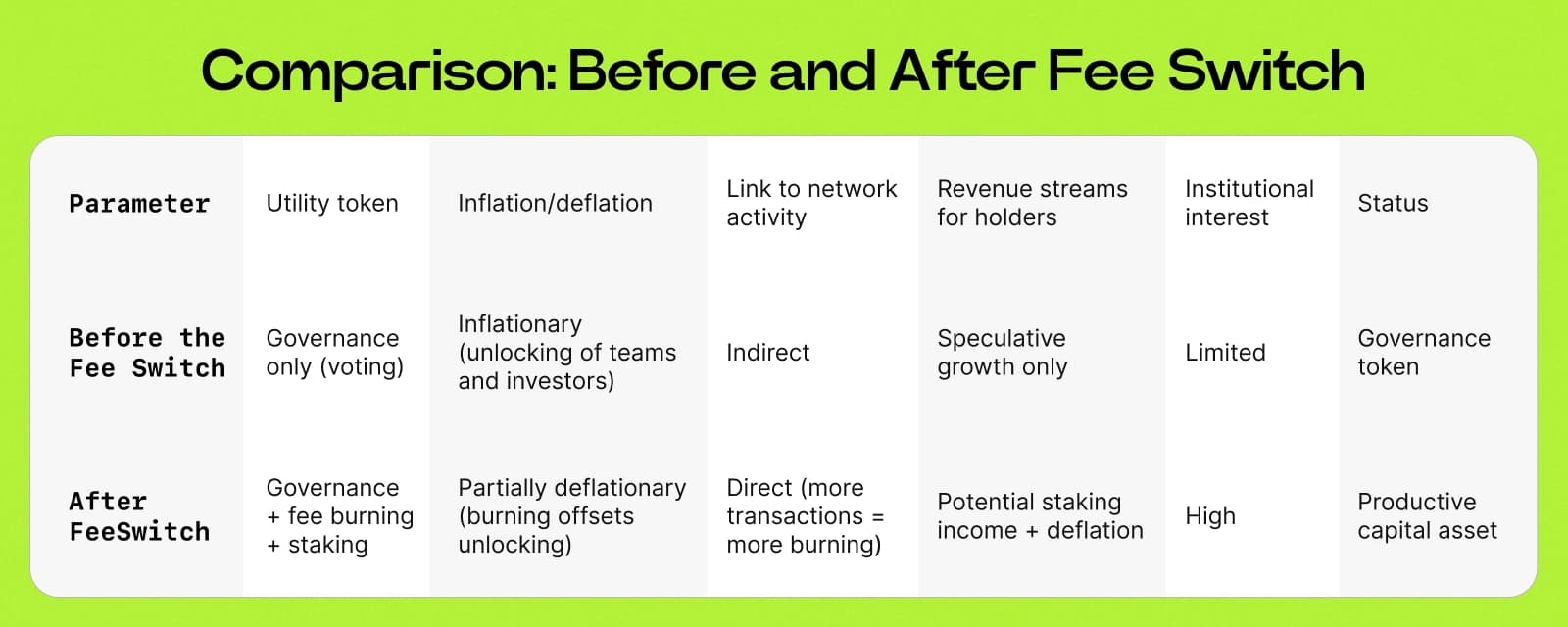
To understand the scale of the changes, let’s compare ZRO’s economics before and after key updates.
| Parameter | Before the Fee Switch | After FeeSwitch |
|---|---|---|
| Utility token | Governance only (voting) | Governance + fee burning + staking |
| Inflation/deflation | Inflationary (unlocking of teams and investors) | Partially deflationary (burning offsets unlocking) |
| Link to network activity | Indirect | Direct (more transactions = more burning) |
| Revenue streams for holders | Speculative growth only | Potential staking income + deflation |
| Institutional interest | Limited | High |
| Status | Governance token | Productive capital asset |
Regional interest and activity
LayerZero demonstrates strong regional diversification:
- Asia. High activity on TRON and Base. The integration with TRON in September 2025 brought in millions of stablecoin users, particularly in Vietnam, Thailand and the Philippines. Many cross-chain applications for gaming and DeFi are being built in Asia.
- USA. Institutional interest via Citadel Securities, ARK, DTCC, ICE. The focus here is on infrastructure for traditional finance – clearing, post-trading, and securities tokenisation. The partnership with Google Cloud is also based in the USA.
- Europe. DeFi protocol developers (AAVE, Curve, Lido) are actively using LayerZero for cross-chain deployment. The ecosystem is particularly strong on Base and Arbitrum.
- The Middle East. Investors from the UAE and Saudi Arabia are entering the market via venture capital funds and family offices. The UAE, with its 0% capital gains tax, is becoming a hub for long-term ZRO holders.
- Latin America. Growing interest via stablecoins on TRON and BSC. Many users in Brazil and Argentina use LayerZero to move funds between networks to circumvent inflation.
Forecasts and outlook until 2030
In November 2025, the Coindataflow analytical platform presented a ZRO price forecast for the next 5 years, considering three scenarios: optimistic, neutral and pessimistic. The ZRO price prediction is available in the table.
| Year | Bearish | Neutral | Bullish |
|---|---|---|---|
| 2027 | $0.62 | $1.21 | $1.81 |
| 2028 | $1.11 | $2.17 | $3.23 |
| 2029 | $2.82 | $7.84 | $12.85 |
| 2030 | $1.96 | $5.47 | $8.98 |
| 2031 | $2.40 | $4.06 | $5.73 |
It is important to understand that this is an analytical model based on current data regarding ecosystem growth, the pace of technology adoption and market trends. The token’s actual value will depend on one key factor: how much demand there is for the LayerZero solution in the real economy. Will developers build cross-chain applications? Will institutional players (DTCC, ICE) start using Zero for their products? Will the protocol be able to compete with Wormhole, Axelar and Chainlink CCIP? Some analytical services predict an increase in the value of the token to $3.5-$5.5.
How to interact with ZRO: for users and developers
Let’s consider the main scenarios:
For token holders
Participation in governance. Half-yearly on-chain votes; you can vote directly or delegate votes to trusted parties. Zero-knowledge proofs are used to ensure voting privacy.
Staking. On the Zero network to secure validators. Staking yields will depend on the total amount of staked tokens and the volume of fees.
Benefiting from deflation. Burning transaction fees reduces the total supply, which, all other things being equal, should support the price.
For developers
Using LayerZero for cross-chain applications. Documentation and SDKs are available on the protocol’s website.
Paying fees in ZRO (or other tokens via abstraction with automatic conversion to ZRO and burning).
Building on Zero – the network is open for smart contract deployment. Supports Solidity and Vyper.
How to buy and store
Where to buy – available on major exchanges – Binance, Coinbase, Kraken, KuCoin, Gate, Bybit, OKX.
Pairs – ZRO/USDT, ZRO/USDC, ZRO/BTC, ZRO/ETH, as well as fiat pairs on Coinbase and Kraken.
Storage – any EVM-compatible wallet (MetaMask, Rabby, Trust Wallet). For large amounts, Ledger or other hardware wallets supporting Ethereum addresses are recommended.
How 0xProcessing relates to the LayerZero ecosystem
0xProcessing closely monitors the development of cross-chain infrastructure. Our platform supports payment acceptance in over 65 cryptocurrencies across 16+ networks, including Ethereum, BSC, Arbitrum, Optimism, TRON, Base and others – all of which are integrated with LayerZero. We are actively exploring cross-chain routing capabilities for our clients to automatically select the optimal network for receiving and withdrawing funds.
If your business operates across multiple blockchains, 0xProcessing will help consolidate payments into a single interface with full control and transparency. Find out about the supported networks and capabilities of 0xProcessing.
Conclusion and takeaways
2026 proved to be a turning point for LayerZero and ZRO. The launch of its own Zero blockchain, the entry of Citadel Securities and ARK Invest, and the confirmation of a unified tokenomics model – all of this has taken the project to a new level. From an abstract protocol for developers, LayerZero is transforming into a real financial infrastructure capable of competing with traditional systems.
Key things to know about ZRO in 2026:
- All fees within the ecosystem are paid in ZRO. Priority fees, tips, MEV, zone fees, message fees – everything is converted into ZRO and burned. This is a powerful deflationary mechanism.
- Institutional investors are on board. Citadel Securities, ARK, Tether, DTCC, ICE – this isn’t just “belief in the project”, but a real infrastructure for global finance. They aren’t buying tokens for speculation – they are building products on them.
- Risks remain. 20 March 2026 – unlocking of about 25.7 million ZRO ($50-55 million at current rates). Competition from Wormhole and Axelar is still very much present. Regulators could still cause problems.
Who is ZRO for? For long-term holders who believe in the growth of the cross-chain economy and the institutional adoption of blockchain. For developers building applications that require compatibility with dozens of networks. For businesses that need a reliable infrastructure for cross-chain payments.
Frequently asked questions about LayerZero and ZRO
What is LayerZero?
LayerZero is an omnichain protocol that enables decentralised applications to exchange data and assets across more than 165 blockchains. It acts as a universal communication layer, eliminating the need for multiple individual bridges.
What is the ZRO token?
ZRO is LayerZero’s native token, used for protocol governance, staking and paying fees. Since February 2026, all fees on the Zero blockchain and the LayerZero protocol have been directed to ZRO and burned.
What has changed with the fee switch?
The fee switch was activated in December 2025 following a community vote, in which 97% of participants supported the change to the model. In February 2026, the team confirmed that all fees (priority fees, tips, MEV, zone fees, message fees) are converted to ZRO and burned, creating a deflationary mechanism.
Has Citadel Securities really invested in ZRO?
Yes. On 10 February 2026, LayerZero announced strategic investments from Citadel Securities, ARK Invest and Tether Investments. Katie Wood of ARK joined the board of directors. DTCC and ICE have also become partners to explore institutional applications.
Will the Zero blockchain have a separate token?
No. On 19-20 February 2026, the CEO of LayerZero confirmed that Zero would not have a separate token. ZRO remains the sole asset for staking and paying gas fees across the entire ecosystem.
How and where can I buy ZRO?
ZRO is available on major exchanges: Binance, Coinbase, Kraken, KuCoin, Gate, Bybit, OKX. Any EVM-compatible wallet (MetaMask, Rabby, Trust Wallet) or a Ledger hardware wallet is suitable for storage.