Litecoin is one of the oldest and most practical coins to use as payment: blocks are confirmed every 2.5 minutes, fees run a fraction of a cent, and it's listed almost everywhere. Here's the whole picture: taking LTC from first setup to fiat in the bank, wiring in a gateway, and a couple of things you won't find in most write-ups, Litecoin's optional privacy layer (MWEB) and the compliance wrinkle it drags along, plus real numbers on what fees and confirmations actually look like.
What is Litecoin, and why does it work for payments?
Charlie Lee forked Bitcoin back in 2011 to build Litecoin, pitched from day one as the silver to Bitcoin's gold. It kept Bitcoin's core design and changed the parts that matter for payments. Where Bitcoin uses SHA-256 and a ten-minute block, Litecoin uses the scrypt algorithm and a 2.5-minute block, four times faster. Transaction fees run at a fraction of a cent under typical conditions, orders of magnitude below card processing fees on small tickets.
Three traits make it a payment coin rather than a store-of-value bet. It's fast enough that customers aren't left waiting at checkout. It's cheap enough that fees don't eat a $5 purchase. And it's liquid. It's listed on just about every exchange, so turning it into fiat or a stablecoin is no trouble at all. Put those together and you see why merchants have kept reaching for Litecoin for more than ten years, long after plenty of noisier coins faded.
How can a business accept Litecoin payments?
Litecoin gives you more ways in than most coins, seven in all, from bare-bones to fully managed.
Direct wallet
Publish your LTC address, receive straight to it. Nothing goes to a processor, but chain-watching, order matching, refunds, and compliance all fall on you. Fine for a hobby project, rough at volume.
Payment button
A "Pay with Litecoin" button at checkout, one snippet, works on most sites.
Payment link
A link carrying a fixed amount, sent over any channel: chat, email, a social post. Suits invoices and one-off sales.
Email invoice
A branded invoice with an LTC amount, due date, and reference ID. Built for B2B and service billing.
CMS plugin
On Shopify, WooCommerce, or similar, plugins from CoinGate and BitPay drop LTC into your existing checkout in under an hour.
API integration
A REST call creates the payment, a webhook confirms it. Full control over checkout logic, the route for custom or headless stores.
Payment processor
Wraps all of the above and adds what a raw wallet can't: AML screening, auto-conversion, fiat settlement, and support. Past hobby scale, the realistic choice.
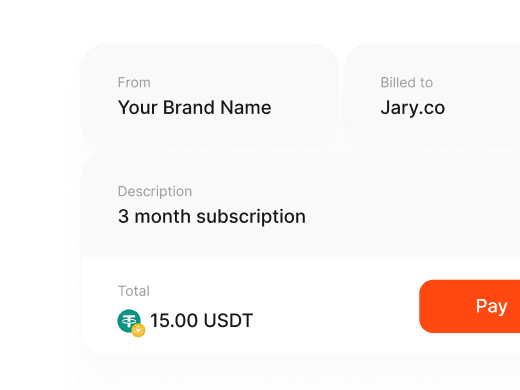
A Litecoin payment gateway handles the chain-watching, conversion, and compliance so you're booking clean revenue rather than managing infrastructure.
How to accept LTC payments: step-by-step integration
Budget about a week, more form-filling than coding.
- Line up a provider. Check it takes LTC, converts automatically, pays out in your fiat (USD, EUR, GBP), and onboards a business like yours.
- Open the account and lock it down. Register, then switch on two-factor authentication before a single coin moves.
- Get through KYB. Company documents and ownership details. Once verified, the processor shoulders AML, screening incoming payments rather than pushing customers through KYC.
- Wire it in. Install the plugin or connect the API, create a payment, catch the webhook, flip the order to paid. Set auto-conversion here, not later.
- Point the money somewhere. Keep LTC as LTC, convert to a stablecoin, or settle to your bank via SWIFT or SEPA. Most convert on arrival.
- Test, then open up. Push one small live payment, watch the webhook land and the status change, then let traffic in.
Why accept Litecoin? The business case
Four payoffs, each backed by a number rather than a slogan.
Lower cost
An LTC transfer costs a fraction of a cent, against a card's 2.9% plus 30 cents. On a $10 order, you claw back essentially the whole fee.
Speed
A 2.5-minute block clears a payment in minutes, not the two days a card takes, or the ten-plus minutes Bitcoin can need.
No chargebacks
On-chain payments can't be reversed, so nobody disputes a charge months after you've shipped. It matters most for digital goods and high-risk niches.
Global reach
LTC crosses borders on nothing but an internet connection, no correspondent banks, no FX spread, no decline over the customer's location.
Ready to accept Litecoin? 0xProcessing supports LTC alongside 85+ coins across 18 blockchains, with auto-conversion to stablecoins at the moment of payment and 0% processor withdrawal fees.
Want to accept crypto payments on your website?
LTC vs BTC vs BCH for payments: an honest comparison
All three are Bitcoin-lineage payment coins. They differ where it counts for a merchant.
| Litecoin (LTC) | Bitcoin (BTC) | Bitcoin Cash (BCH) | |
|---|---|---|---|
| Block time | 2.5 min | 10 min | 10 min |
| Typical fee | Fraction of a cent | $0.50–3+ (varies) | ~$0.01 |
| Confirmation | Minutes | 10–60 min | Minutes |
| Optional privacy | Yes (MWEB) | No | No |
| Liquidity | Very high | Highest | Moderate |
| Brand recognition | High | Highest | Moderate |
| Best for | Everyday payments, micro-tickets | High-value, store-of-value | Low-fee payments |
A quick read. Bitcoin has the name and the deepest liquidity, but its fees and slower confirmations make it awkward for small, quick payments; it's happier settling big amounts. Bitcoin Cash keeps fees low, like LTC, though it lags in liquidity and in its widespread use. Litecoin lands where payments actually live, fast and cheap, liquid, and carrying an optional privacy layer the other two just don't have. Running lots of small transactions? LTC is usually your answer. Settling the occasional large sum? Bitcoin's recognition might tip it.
How many confirmations does a Litecoin payment need?
Operational detail most guides skip, and the first thing a real merchant asks.
A Litecoin block is mined every 2.5 minutes, and the number of confirmations you should wait scales with the value at risk. Rough working guidance:
Small payments (under $100)
1 confirmation, about 2.5 minutes, is generally enough. The cost of a reversal is low.
Mid-value ($100–1,000)
2–3 confirmations (roughly 5–8 minutes); balance speed against safety.
High-value (above ~$1,000)
6 confirmations, about 15 minutes, is the long-standing convention for settling significant sums. One caveat worth noting: in April 2026, an MWEB-related exploit triggered a rare 13-block reorg on Litecoin, deeper than the usual 6-confirmation assumption. It was an isolated incident, patched in Litecoin Core 0.21.5.4. Still, for genuinely large settlements it's an argument for waiting longer than six, or letting your processor carry that risk instead of you.
A good processor sets these thresholds for you and only fires the "paid" webhook once the confirmation count you've configured is met, so you're not shipping against an unconfirmed transaction. Median network fees run around 0.00001 LTC, a fraction of a cent, paid by the sender.
Litecoin's MimbleWimble (MWEB): optional privacy, and what it means for a merchant
Here's the part almost no competitor explains, and it's where Litecoin gets genuinely interesting for payments.
Litecoin enabled MWEB (MimbleWimble Extension Blocks) in May 2022, a privacy layer that runs alongside the main chain and only kicks in when you ask for it. Opt in, and it hides the amount through Confidential Transactions, muddies the sender with CoinJoin-style mixing, and cloaks the recipient behind a stealth address (those ltcmweb1 ones). The keyword there is opt in. Leave it alone, and your Litecoin payments stay as transparent as they've always been. Unlike Monero, where every transaction is private, standard Litecoin transactions remain fully transparent, and a user must deliberately peg funds to MWEB to use privacy.
What does that give a business? For your customers, it means a privacy-minded buyer, someone paying for a subscription, a personal item, or a donation they'd rather keep quiet, can choose confidentiality without ever leaving Litecoin. Think of handing over a $5 bill for a $4 coffee: the person behind you sees the $5 and the $1 back, not what's left in your wallet. If your audience cares about discretion, that's something the transparent-by-default coins simply can't match.
The compliance nuance nobody mentions
Now the honest part. Because MWEB conceals transaction data, it collided with AML rules in some jurisdictions. Once MWEB went live, some exchanges pulled back. Five major South Korean platforms, Upbit, Bithumb, Coinone, Korbit, and Gopax, delisted LTC in June 2022; Thailand's SEC blocked assets that can obscure transaction data, and Binance stopped processing MWEB-specific deposits and withdrawals. But it pays to be exact about what actually got hit here. The action targeted MWEB privacy transactions, not Litecoin itself, and LTC remains listed on the overwhelming majority of exchanges worldwide, unlike Monero, which faces far broader delisting.
For a merchant, this raises a fair question: does accepting LTC expose me to that compliance risk? With the right setup, no, and this is exactly where a custodial processor earns its place. A licensed processor with real-time AML screening accepts standard transparent LTC transactions and runs KYT checks on every incoming payment against blacklist and sanctions data. You get Litecoin's speed and low fees without holding the compliance burden yourself. Because incoming funds are screened and can auto-convert to a stablecoin on arrival, MWEB's privacy on the payer's side never becomes your regulatory problem. Privacy remains optional for customers who want it; compliance is handled for you.
The 2026 MWEB security incident
Being straight about this matters, because MWEB is the reason to pick Litecoin and also its newest risk. In March 2026, a validation bug in MWEB allowed an attacker to peg out roughly 85,034 LTC from an input of 1 to 2 coins. Miners coordinated to contain it, and the attacker returned about 84,184 LTC. A follow-up attempt on April 25 caused a denial-of-service condition that stalled upgraded mining nodes while unupgraded ones extended an invalid chain, and the network resolved it with a 13-block reorg. Third-party services took the real damage: NEAR Intents reported roughly $600,000 of exposure. Litecoin published a full
postmortem and shipped fixes in Core 0.21.5.4.
What should a merchant take from it? Two things. Extension-block privacy adds attack surface that plain transactions don't have, so the feature isn't free. And the practical defence is exactly what a processor does anyway: wait for enough confirmations before you treat a payment as final, and convert on arrival so you're not sitting on the asset when something goes wrong on-chain.
Is accepting Litecoin legal in the EU? MiCA and VASP licensing
Accepting LTC is legal across the EU. The regulatory weight falls on the crypto-asset service provider that processes your payments, not on you as the merchant receiving them.
What MiCA changes
MiCA is now in full force across the bloc, and it licenses the providers rather than restricting which coins a business may take. For an EU-facing merchant, that means one practical question: is your processor authorised as a CASP (crypto-asset service provider) in an EU member state, or operating under an equivalent regime? A licensed processor passports across the EEA under a single authorisation, which is why CoinGate's Lithuanian MiCA licence, for instance, matters to European sellers.
Litecoin itself sits outside MiCA's stablecoin rules. It isn't an e-money token or an asset-referenced token, so it carries none of the issuer obligations that apply to USDT or USDC. Nothing in MiCA prohibits a merchant from accepting it.
Where MWEB complicates things
The privacy layer is the wrinkle. Because MWEB can obscure transaction data, some jurisdictions treated it as a concealment feature, which is what drove the South Korean and Thai restrictions. Within the EU, AML rules push service providers toward transaction traceability, so a CASP processing LTC will screen standard transparent transactions and generally won't handle MWEB peg-outs. For you, that's the setup you want anyway: transparent inbound payments, screened on arrival, with the privacy option left to customers who choose it on their own side.
What to check in your processor
Ask which licences it holds and in which jurisdictions, whether it runs real-time AML/KYT on incoming payments, and whether it verifies only the business (KYB) or puts your customers through KYC as well. Your own obligations come down to tax reporting and record-keeping, which vary by member state, so confirm the specifics with an advisor in the member state where you operate.
LTC isn't a stablecoin: handling volatility
Litecoin's price moves, so a payment held unconverted is an open position. It's less volatile than a meme coin, but a double-digit weekly swing is ordinary, and that's enough to turn a month of LTC revenue into a P&L line that drifts from what you actually sold.
The fix is conversion at the moment of payment. 0xProcessing runs this through VRCS (Volatility Risk Control System), which locks the dollar value the instant a transaction confirms and settles to a stablecoin at no extra fee. A customer pays $80 in LTC; you receive $80 in USDT regardless of what Litecoin does an hour later. From there, you hold the stablecoin or off-ramp to fiat. For a merchant, that turns a volatile asset into predictable revenue without you ever having to time the market.
Which industries fit Litecoin payments?
LTC's low fees and fast block times suit specific business models better than others.
E-commerce
Cross-border orders where card FX markups and declines bite. LTC clears globally in minutes, and low fees preserve margin on smaller baskets.
SaaS
Recurring subscriptions billed in LTC avoid card-expiry churn, and the low per-transaction cost fits monthly billing at scale.
Gaming and iGaming
High-frequency deposits and payouts, an audience already holding crypto, and no chargebacks. LTC's speed suits the deposit-to-play loop.
Travel
High-ticket, international bookings where cross-border card fees are steep, and chargeback risk is real. LTC settles fast and final.
Digital goods and content
Instant delivery plus no chargebacks means the disputes that drain content businesses don't happen. Optional MWEB privacy also appeals to discretion-minded buyers.
Refunds and accounting when payments are irreversible
Two operational things to settle before your first LTC sale.
Refunds
Nothing on-chain can be undone, so a refund is a fresh transaction you send the customer, not a reversal. Two calls to make up front. Do you return the same number of LTC or the same dollar value? Litecoin's price drifts between purchase and refund, and the two cost you differently. And get the return address right; one wrong character and the funds are gone. Log both transactions with their hashes for reconciliation.
Accounting and tax
LTC you take in counts as income at its fiat value the day it arrived, same as any payment. Convert it immediately, and the tax side stays quiet; you held it for seconds, nothing meaningful to gain or lose. Sit on it and any price move before you convert becomes a reportable gain or loss. Log each payment's date, LTC amount, and fiat value. This isn't tax advice, and rules vary by country, so confirm with an advisor in the country where you operate.
Conclusion
Litecoin has quietly done the payment job for over a decade, and not for flashy reasons. Blocks every 2.5 minutes, has fees under a cent, deep liquidity, and it's accepted almost everywhere. What really separates it from its Bitcoin cousins is MWEB, optional privacy none of the transparent coins can offer, with a compliance wrinkle that a licensed, AML-screening processor irons out for you. Take LTC through a gateway that auto-converts it to a stablecoin, and you keep the speed and low cost while dropping both volatility and privacy-compliance worries. Set confirmation thresholds based on how much is at stake, write your refund policy before the first sale, and Litecoin does what Charlie Lee built it to do: move money fast, cheaply, and for good.
Want to start taking Litecoin? 0xProcessing handles LTC among 85+ coins across 18 blockchains, VRCS pins the dollar value the moment a payment confirms, withdrawals carry no processor fee, and you can settle in crypto or cash out to a bank over SWIFT/SEPA. Custodial, with regular external security audits and real-time AML/KYT on every payment.
Get startedFrequently asked questions
How do I accept Litecoin payments on my website?
Pick a Litecoin payment gateway, sign up and clear KYB, connect it through a CMS plugin or the API, switch on auto-conversion, then run one small live payment to check everything fires. Most businesses are taking payments within a week.
How fast are Litecoin payments?
A new block lands every 2.5 minutes, so a payment usually confirms in a few minutes, about four times quicker than Bitcoin. Small amounts often clear on a single confirmation; larger ones may take up to six confirmations.
What are the fees to accept LTC?
Network fees are a fraction of a cent in typical conditions, usually paid by the sender. Your gateway adds a processor fee, plus possible conversion and withdrawal fees; ask about each separately.
Is Litecoin private? What is MWEB?
Litecoin is transparent by default. MWEB (MimbleWimble Extension Blocks) is an optional privacy layer a user can opt into, hiding amounts and addresses. Because it's opt-in, standard LTC payments remain fully visible on-chain.
Did MWEB get Litecoin delisted?
Some exchanges (in South Korea and Thailand) restricted MWEB privacy transactions over AML rules, and Binance limited MWEB deposits/withdrawals. But LTC itself remains listed on most global exchanges, and a licensed processor with AML screening handles the compliance side for merchants.
How do I avoid Litecoin's price volatility?
Auto-convert at the moment of payment. A processor like 0xProcessing converts incoming LTC to a stablecoin via VRCS the instant it confirms, so you receive a locked dollar value regardless of later price moves.
Can I settle Litecoin payments to my bank in fiat?
Yes. A gateway with a fiat off-ramp converts incoming LTC and settles to your bank in USD, EUR, or GBP via SWIFT or SEPA. 0xProcessing supports this alongside stablecoin settlement.