Capgemini's World Payments Report 2026 reports 60% of paytech firms adopting generative AI across their operations (compared to 41% at banks), with payment orchestration deployment specifically reaching higher concentrations, and
Gr4vy's 2026 industry data reports early adopters of AI-driven routing seeing 3 to 8 percentage point lifts in authorization rates on card networks. Crypto-specific implementations report larger gains because crypto carries an additional failure mode that card flows don't have: the buyer's wallet may not hold funds on the default chain at all. Production deployments routinely show 30 to 40% reductions in effective network fees and settlement times, collapsing from minutes to seconds.
This guide covers what AI crypto payment routing actually does at the transaction level, how it differs from traditional payment orchestration, why static routing fails for crypto specifically, the machine learning model families in production today, what AI does for security and antifraud, where agent-driven payments fit in, where the gains land in real merchant scenarios, and how businesses should approach implementation.
What AI crypto payment routing actually does
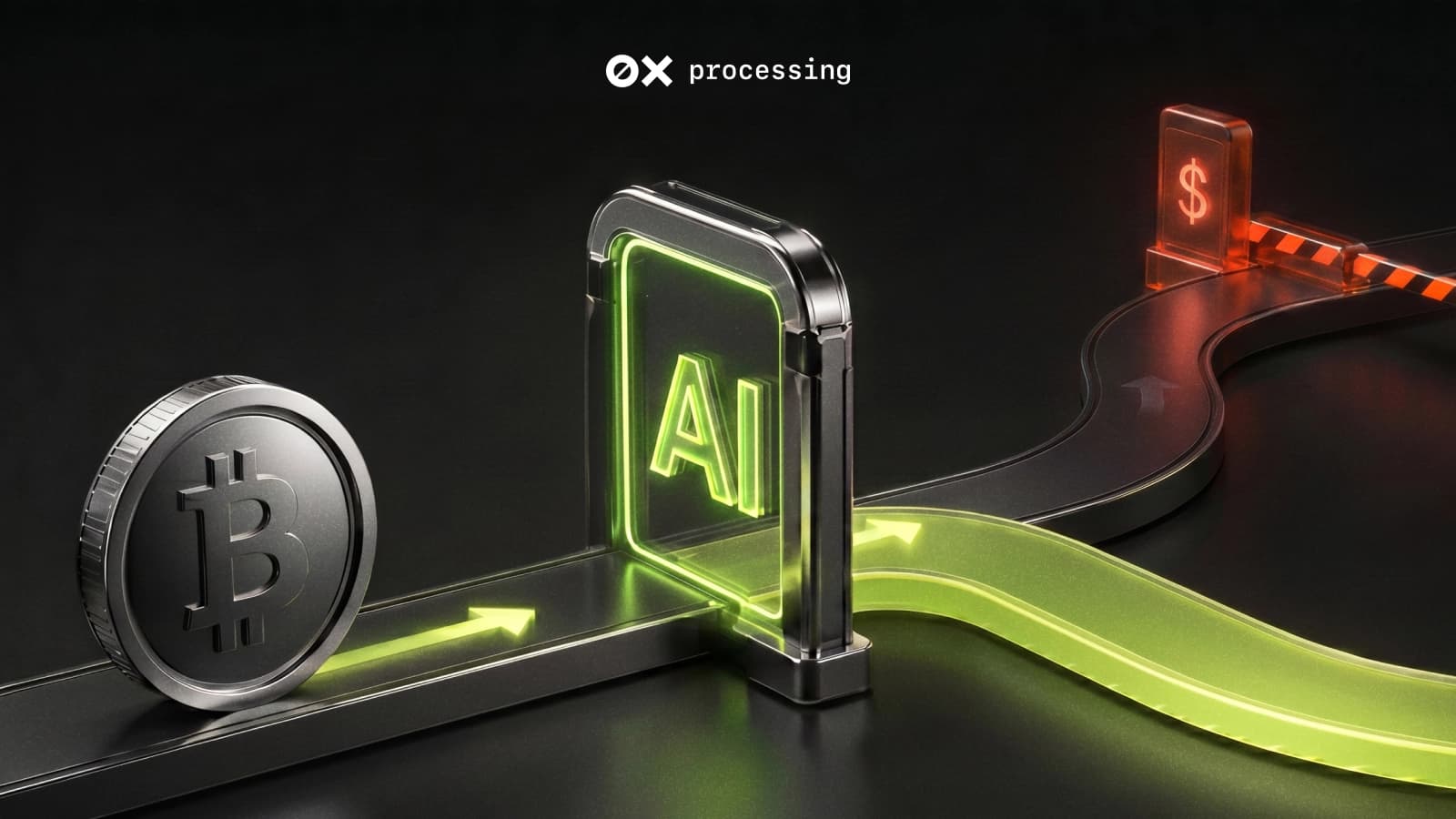
A crypto payment routing system makes three decisions per transaction: which blockchain to use, which liquidity source to draw from if conversion is needed, and how to handle gas and confirmation timing. A static router applies fixed rules ("if USDT then use Tron"). An AI router uses a model that reweights those decisions per transaction based on live conditions.
What the model takes as input
- Current mempool depth and block utilization on each candidate chain
- Network fee in the previous N blocks
- Historical success rate for similar transactions on each chain
- The buyer's wallet history (which chains they've used before, what worked)
- Merchant preferences (cost-prioritized, speed-prioritized, finality-prioritized)
- AML and regulatory constraints (sanctioned wallets, jurisdictional rules)
- Liquidity depth on connected DEXs if conversion is needed
Output: a routing decision in under 100ms, applied before the buyer sees the payment form. According to a published analysis of smart-routing architectures, production systems typically combine a static filter module (logistic regression for gateway downtime prediction) with a dynamic module (random forests or gradient boosting on real-time features). A static filter removes unavailable terminals; a dynamic filter ranks the remaining options by success probability.
Why static routing fails for crypto
Network fees can swing meaningfully within hours. Ethereum mainnet ERC-20 transfers typically run $0.10–0.50 in normal conditions, with rare spikes to $1–3 during heavy congestion. The $30 peaks of 2021–2022 are now exceptions after Dencun and Pectra upgrades, but relative variability remains – static "use chain X" logic can't follow even smaller swings. Models monitor congestion in real time and automatically route around expensive windows.
Wallet fragmentation matters as much as fee volatility. A buyer holding USDT on Tron, USDC on Base, and ETH on Arbitrum has zero interest in being told: "We only accept Polygon." Intelligent payment routing crypto uses the chain the buyer actually holds, which is the largest single factor in checkout completion.
Success rates also vary by chain and time of day. Bitcoin transactions during congestion peaks see meaningful drops in confirmation within typical timeout windows. Solana typically maintains high success rates at sub-cent fees during normal operation. However, historical peak-congestion episodes have produced elevated rates of failed transactions – something routing models account for when sizing confidence intervals.
How ML models make routing decisions
Three model families dominate production deployments in 2026.
Cost-prediction models. Typically, gradient-boosted decision trees or lightweight neural networks. Forecast the network fee for each candidate chain over the next 1 to 10 minutes. Inputs: mempool data, historical fee curves, time-of-day patterns. Output: per-chain expected fee with confidence interval.
Conversion-likelihood models. Predict whether a buyer will complete a payment if offered chain A versus chain B. Usually, logistic regression or shallow neural nets trained on millions of historical checkouts. Inputs: wallet history, transaction amount, chain availability, and current congestion. Output: per-route completion probability.
Multi-objective optimizers. Reinforcement learning or constrained optimization. Combine cost and conversion predictions with merchant priorities into a single routing decision. A merchant who configured "prioritize speed" gets a different decision than one who configured "prioritize cost," even for the same buyer.
Models retrain continuously, typically on a 24-hour lookback for fee data and a 7-day window for conversion data. Online learning lets the system adapt to anomalies (such as a chain outage or a new L2 launch) within minutes rather than weeks.
Where smart routing pays off in crypto
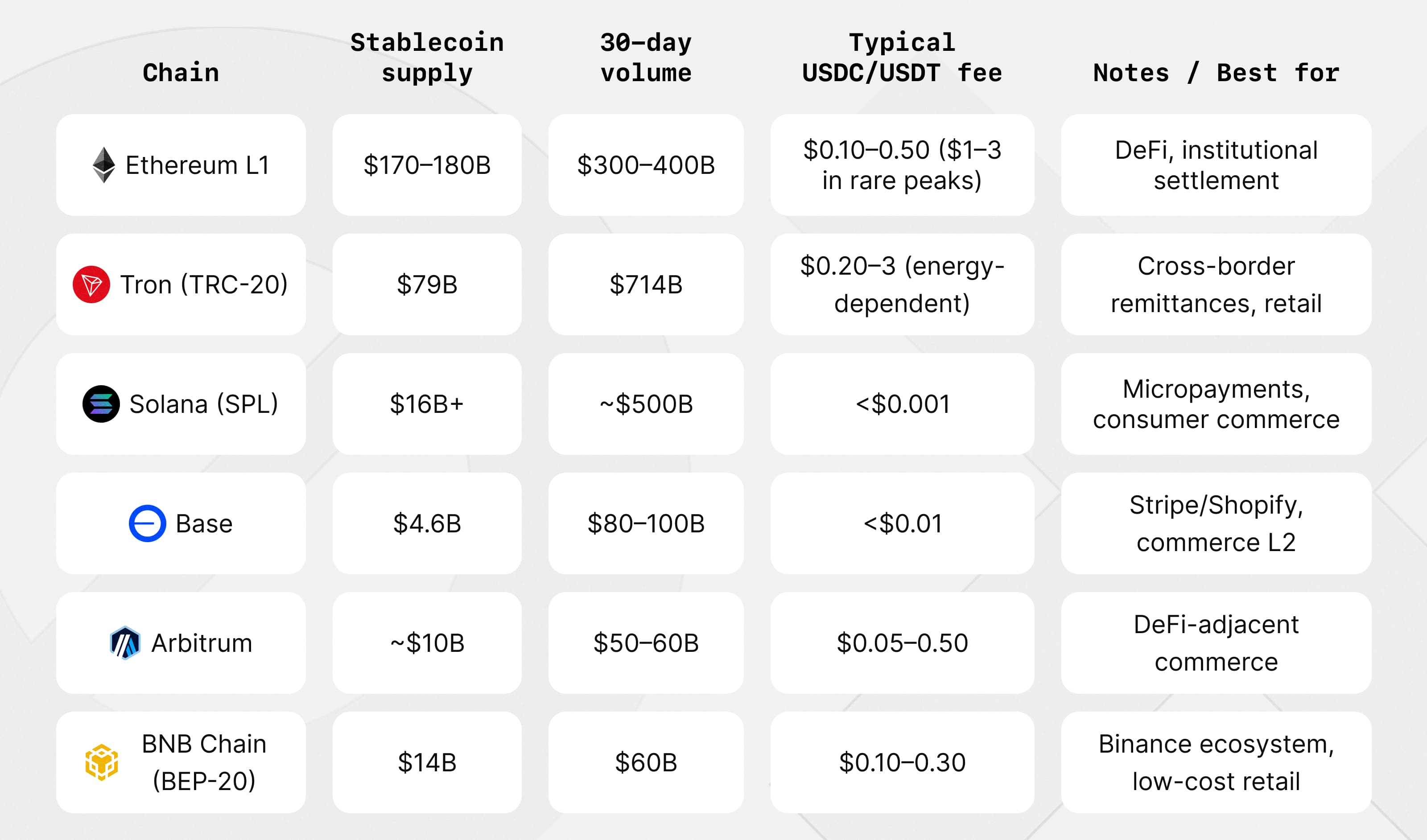
Stablecoin volumes by chain define the routing surface in 2026.
Want to accept crypto payments on your website?
| Chain | Stablecoin supply | 30-day volume | Typical USDC/USDT fee | Notes / Best for |
|---|---|---|---|---|
| Ethereum L1 | $170–180B | $300–400B | $0.10–0.50 ($1–3 in rare peaks) | DeFi, institutional settlement |
| Tron (TRC-20) | $79B | $714B | $0.20–3 (energy-dependent) | Cross-border remittances, retail |
| Solana (SPL) | $16B+ | ~$500B | <$0.001 | Micropayments, consumer commerce |
| Base | $4.6B | $80–100B | <$0.01 | Stripe/Shopify, commerce L2 |
| Arbitrum | ~$10B | $50–60B | $0.05–0.50 | DeFi-adjacent commerce |
| BNB Chain (BEP-20) | $14B | $60B | $0.10–0.30 | Binance ecosystem, low-cost retail |
Sources: Token Terminal (March 2026), Alchemy stablecoin landscape (October 2025), Eco USDT TRC-20 fee guide (May 2026), DefiLlama (Q2 2026).
Four scenarios where smart routing blockchain payments deliver measurable wins
Multi-stablecoin checkout. A merchant accepting USDC and USDT across five or more chains routes the buyer onto the cheapest path the buyer can actually pay from. For a $50K monthly volume store, the typical savings versus default "Ethereum mainnet" routing are $400 to $800 per month.
iGaming and high-volume deposits. Players want to deposit immediately. AI routing selects the chain with the lowest confirmation time at that moment (often Solana or Tron rather than Ethereum), which increases deposit completion rates by 10 percentage points or more compared to static routing.
Mass payouts to affiliates. A network paying 500 affiliates monthly can batch payouts on whichever chain has the lowest gas at the scheduled payout time. Gas optimization combined with a 0% withdrawal fee structure cuts total payout costs by 40–60% compared to traditional rails.
Cross-border B2B invoices. For invoices above $10K, the routing model accounts for off-ramp speed at the destination (SEPA, SWIFT, or stablecoin treasury). The best route depends on whether the receiver wants fiat in 24 hours or USDC immediately.
Want intelligent routing across 18 blockchains baked into your checkout? 0xProcessing's payment engine selects the optimal chain per transaction across 85+ cryptocurrencies and 31 stablecoins, with VRCS auto-conversion to stablecoins included and a 99.9% acceptance rate.
Get a demoMeasured results from production deployments
Composite picture from production data across multi-chain processors and orchestrators in 2025 to 2026:
- 30 to 40% reduction in effective network fees through dynamic chain selection, primarily by routing high-fee Ethereum mainnet traffic to L2s or Solana when fees spike
- Authorization improvements of 3 to 8 percentage points on card flows per Gr4vy, with crypto-specific implementations reporting larger lifts (10+ percentage points) due to the additional wallet-funding factor
- Settlement time reduced from 8 to 12 minutes (Ethereum default) to under 30 seconds when transactions route to fast L2s or Solana
- 5 to 7% drop in checkout abandonment when buyers see the chain they actually hold funds on
As an illustrative merchant example based on aggregated 2026 deployment data: a $100K per month subscription business running smart routing across USDC on Base, Polygon, Solana, and Ethereum mainnet would typically see effective network costs drop from roughly $480 per month under static "Ethereum default" routing to around $140 per month after 60 days of model training – exact figures vary by traffic mix and merchant configuration. Raising the authorization rate from 91% to 96.5% recovers approximately $5,500 per month in previously lost revenue.
AI routing vs traditional payment orchestration
Payment orchestration as a category exists in traditional payments – platforms like Gr4vy, Yuno, Spreedly, and Primer route card transactions across multiple PSPs to lift authorization rates. The payment orchestration market is projected to grow
from $3.5B today to $18B by 2031, with AI-driven providers reporting 2- to 8-percentage-point lifts in authorization rates over rule-based routing.
AI crypto payment routing shares the conceptual architecture but solves a
different problem space. The differences matter when choosing infrastructure.
| Dimension | Traditional payment orchestration | AI crypto payment routing |
|---|---|---|
| Routes between | Multiple PSPs and acquirers (Stripe, Adyen, Checkout, regional acquirers) | Multiple blockchains and chains (Ethereum, Solana, Tron, L2s) |
| Primary failure mode | PSP downtime, card decline, 3DS friction | Wallet not funded on the default chain, gas spike, chain congestion |
| Cost variability | Interchange and PSP markup (stable for months) | Gas fees (can swing 10x within hours, larger across days historically) |
| Time horizon for decisions | Static rules update weekly or monthly | Real-time, sub-100ms decisions per transaction |
| Key optimization inputs | Card BIN, country, historical PSP success rate, fraud score | Mempool depth, wallet history, chain congestion, stablecoin liquidity |
| Compliance layer | PCI DSS, 3D Secure, network tokenization | AML/KYT screening, sanctions, chain analysis |
| Authorization lift reported | 2 to 3 percentage points (rule-based) to 8% (AI-native, per Yuno data) | 8 to 15 percentage points typical (larger gap because of wallet-funding mismatch) |
| Settlement finality | T+1 or T+2 batch settlement | Seconds to minutes on-chain |
| Network outage handling | Failover to alternate PSP | Failover to alternate chain |
| Market maturity | Mature category; most enterprise merchants run multiple PSPs | Emerging; most crypto processors still use hardcoded chain rules |
The core insight: AI crypto routing isn't just "payment orchestration for crypto." The decision surface is different, the variables move faster, and the failure modes are crypto-native. A processor that copies card-flow orchestration logic into a crypto context overlooks structural differences and ships routing logic that underperforms even basic crypto-native heuristics. Yuno's analysis of the 2026 orchestration market makes the same point about agent-driven architecture – the platforms that win in 2026 ship intelligent decisioning, not just plumbing.
Implementation paths for business
Three paths exist depending on existing infrastructure.
Use a processor with built-in routing. Multi-chain natives (0xProcessing, BVNK, Triple-A) include routing intelligence in their APIs. The merchant integrates a single endpoint; routing happens server-side. Time to value: hours to days.
Build a custom router on top of a single-chain processor. Possible but expensive. The merchant ingests chain data feeds (Etherscan, Tronscan, Solana RPC), trains models on their own transaction history, and applies routing logic at the application layer before calling the processor. Time to value: 3 to 6 months. Justified only for very large merchants ($10M+ per month).
Use a routing-as-a-service layer. Specialized providers (Conduit, Squid, LI.FI for cross-chain) offer smart routing APIs that sit between the merchant and any underlying processor. Useful when the merchant wants to keep their existing processor but add intelligence. Time to value: 2 to 4 weeks.
For most merchants with less than $5M in monthly volume, the first path delivers 80 to 90% of the available benefit at a fraction of the engineering cost.
AI for security and anti-fraud in crypto payments
Routing decisions are only one application of ML in crypto payment infrastructure. Real-time security and antifraud screening are the other major surface, and in 2026, it's a regulatory requirement, not a feature.
Four ML-driven security functions running in production at multi-chain processors.
Real-time AML/KYT screening. Every incoming and outgoing transaction gets screened against blockchain analytics databases (Chainalysis, TRM Labs, Elliptic) before settlement clears. The ML layer evaluates source-of-funds risk, exposure to sanctioned wallets, mixer/tumblers, and darknet market exposure across multiple hops. Processors with mature AML/KYT typically score transactions in 80–200ms, fast enough to block before the merchant sees the payment.
Behavioral pattern anomaly detection. Models learn each merchant's typical transaction profile (amount distribution, time-of-day patterns, geographic dispersion, and wallet age distribution of buyers) and flag deviations. A merchant that normally processes $50–500 retail payments and suddenly sees an incoming $50,000 wire from a new wallet gets an automatic risk flag for manual review, even if the source wallet itself passes basic AML screening.
Sanctions and watchlist enforcement. Beyond static lists (OFAC, EU sanctions, UN designations), modern systems use ML to identify wallets behaviorally associated with sanctioned actors – clusters that share funding patterns with known bad addresses, wallets that interact predominantly with high-risk DeFi protocols, addresses tied to mixers. This is where pure rules-based screening misses meaningful risk, per industry estimates from analytics vendors.
Wallet reputation scoring. Each wallet that interacts with the processor accumulates a reputation score based on transaction history, chain analysis, time on chain, and KYT outcomes. Models score new wallets against this database in real time. For high-risk verticals (iGaming, forex), a new buyer wallet with low reputation might trigger an additional KYC step before the payment clears; an established wallet with a clean 12-month history clears immediately.
The compounding effect of AI routing matters. A processor that does both routing AND security in ML – not as separate systems but as a unified decision layer – can route a transaction to a specific chain, not just for cost or speed, but for the AML/KYT capabilities of the chain itself. Some chains have better analytics tooling and faster sanctions enforcement than others. A risk-aware routing layer factors in.
Agentic payments and the routing layer
The fastest-growing buyer segment in 2026 isn't human checkout – it's autonomous AI agents paying on behalf of users or other systems. x402 alone
processed 165 million transactions across 69,000 active agents by late April 2026, and Juniper Research projects the agentic commerce market at $8B in 2026, reaching $1.5T by 2030 and $3.5T by 2031.
This creates new requirements for the routing layer.
Machine-to-machine flows have different patterns from human checkout. Agents pay in micropayments ($0.30 average size on x402), at high frequency (multiple per session), and with sub-second latency requirements. Routing models trained on human-checkout data perform poorly on agent traffic without retraining. Mature processors maintain separate routing optimization for agent flows vs human flows.
Protocol awareness becomes a routing constraint. A buyer-agent using x402 needs the processor to support HTTP 402 responses, EIP-3009 gasless USDC transfers, and chain-specific facilitator endpoints. Routing must check protocol support before chain cost. A theoretically cheaper chain that doesn't support the agent's protocol stack is functionally unavailable.
Identity verification through ERC-8004. Agents authenticating via ERC-8004
(launched in January 2026) need the routing layer to verify on-chain identity registration before authorizing the transaction. This adds a verification step before the proper routing decision, but it removes the need for traditional KYC for every agent interaction. ERC-8004 lives on Ethereum, Base, Polygon, and Arbitrum, making these chains preferred for agent-heavy traffic.
AP2 authorization mandates. Google's Agent Payments Protocol (AP2) attaches cryptographically signed mandates to each agent transaction, confirming the agent acts within the authorized scope. Processors integrating AP2 can route higher-trust transactions (authorized via signed mandate) on cost-optimized paths, while routing unauthorized or anomalous agent attempts through stricter verification flows.
The strategic implication: a payment processor without awareness of x402, AP2, and ERC-8004 in 2026 is locked out of the fastest-growing transaction segment. Processors with full agent-protocol support route human and machine traffic through different optimization profiles in the same routing engine.
Bottom line
AI payment optimization moved from experimental to standard infrastructure during 2025 and 2026. The difference between paying $480 and $140 per month at the same volume isn't theoretical anymore; it's measured across thousands of merchant deployments. The gap is between processors that were built around multi-chain intelligence from day one and processors that bolted chain support onto an originally Bitcoin-first or US-card architecture.
The useful question for a business choosing a processor in 2026 isn't "Do you support routing?" Everyone says yes. The real question is: can the merchant see routing decisions in real time and override them when treasury policy or audit requirements demand it? If both answers are yes, the routing is real. If not, what's marketed as AI routing is usually just a few hardcoded if-statements with a machine-learning label attached.
Want a routing layer that picks the right chain on every transaction? 0xProcessing natively handles intelligent routing across 18 blockchains and 31 stablecoins. Four external audits since 2022, including VRCS auto-conversion; mass payouts at 0% fee.
Talk to our teamFAQ
What is AI crypto payment routing, and why does it matter?
A system using machine learning payment routing models to pick the optimal blockchain, gas timing, and liquidity source for every transaction in real time. It matters because, based on multi-chain processor benchmarks reported in 2025–2026 production deployments, static routing typically wastes 30-40% of effective network spend and degrades approval rates by 10+ percentage points compared to intelligent alternatives.
Does intelligent payment routing crypto require building ML models from scratch?
Not anymore. Major multi-chain crypto payment processors ship routing intelligence as part of their API. Building from scratch is only justified for very high-volume merchants with requirements that off-the-shelf processors can't meet.
How accurate are these models in practice?
Cost-prediction models achieve 85-92% accuracy on next-block fees in production benchmarks. Conversion-likelihood models achieve 75-85% accuracy in predicting buyer completion. Both improve with more transaction data, so the second month at a processor typically delivers better results than the first.
Can smart routing handle iGaming or forex specifically?
Yes, and the gains are typically larger in these verticals because deposit speed directly affects player conversion. AI routing picking Solana or Tron over Ethereum during congestion lifts deposit completion by 10 percentage points or more.
What's the trade-off with AI routing?
Reduced merchant control over which specific chain gets used. If a merchant has a regulatory or operational reason to prefer one chain (audit, accounting, treasury policy), they need to lock that as a constraint. Processors with mature implementations expose this as a per-transaction or per-merchant flag.
How long until I see savings from machine learning payment routing?
Cost savings appear immediately for high-fee chains (Ethereum mainnet routes deprioritized day one). Authorization lifts typically appear within 30 to 60 days as the model accumulates buyer-side data.