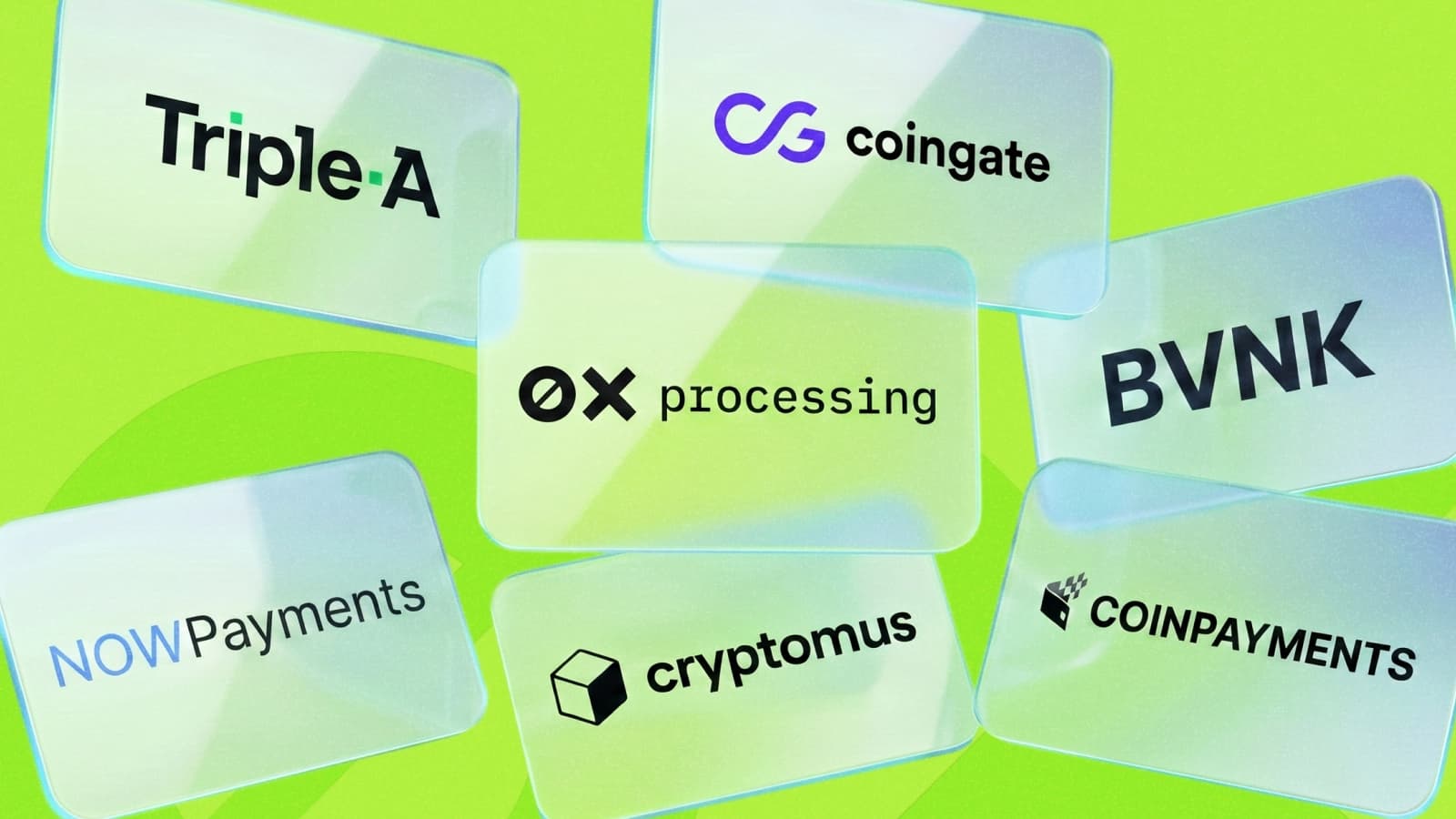
The best BitPay alternative depends on what pushed you away from BitPay in the first place. If it's fees and volatility protection, 0xProcessing leads in cost and stablecoin auto-conversion. If it's EU compliance, CoinGate holds an MiCA license. If it's a coin variety, NOWPayments supports 350+ assets. For the enterprise stablecoin treasury, BVNK. For Asia-Pacific licensing, Triple-A. Below is the full comparison table, followed by a detailed breakdown of each option, the real reasons merchants migrate, and a step-by-step switching guide.
The crypto payment gateway market is crowded in 2026, and BitPay is no longer the only serious name. Per Plisio's 2026 field guide, over 25 million merchants worldwide now accept some form of cryptocurrency, and stablecoin transaction volume hit roughly $33 trillion in 2025. With that much money moving, the gaps in any single provider's offering matter more than they used to.
Comparison table: 7 BitPay alternatives at a glance
Here's how the seven strongest BitPay alternatives stack up on the metrics merchants actually weigh. Figures are pulled from each provider's public pricing pages and documentation as of May 2026.
| Gateway | Headline fee | Custody | Supported coins | Fiat settlement | KYC | Best for |
|---|---|---|---|---|---|---|
| 0xProcessing | Custom (volume-based) | Custodial + VRCS | 85+ across 18 chains | SWIFT, SEPA | KYB | iGaming, forex, high-volume B2B |
| CoinGate | 1% | Custodial, non-custodial flow | 70+ | EUR, USD, GBP next day | Full KYC | EU merchants needing MiCA |
| NOWPayments | 0.5% (1% auto-convert) | Custodial + non-custodial mode | 350+ | Via a third-party partner | Light, optional below thresholds | Altcoin variety, no-KYC |
| Triple-A | ~0.8% | Custodial | Stablecoins + majors | Next-day, 30+ local currencies | Full KYC | Asia-Pacific, licensed compliance |
| BVNK | Custom | Custodial (enterprise) | Stablecoins | SWIFT, SEPA near-instant | Full KYB | B2B treasury, $500k+/mo |
| CoinPayments | 0.5% | Custodial | 2,300+ | Via conversion | KYC | Widest coin coverage |
| Cryptomus | From 0.4% | Custodial | 100+ | P2P fiat | No-KYC option | Emerging markets, low fees |
| BitPay (reference) | 1–2% tiered + 25¢ | Custodial | 15 | USD/EUR/GBP T+2 | Strict KYC | US enterprise |
Two patterns jump out. First, BitPay's headline fee sits at the high end of the field, and the per-transaction 25¢ adds up on low-ticket volume. Second, BitPay supports only 15 settlement cryptocurrencies (per BitPay's settlement docs), while several alternatives handle 70 to 2,300+.
Why merchants look for BitPay alternatives in 2026
Before getting into each option, it's worth being precise about what actually frustrates BitPay merchants. These are documented facts from BitPay's own published materials, not opinions.
Settlement minimums and timing. Per BitPay's settlement documentation, USD settlement to US banks via ACH takes two business days, with a $20 minimum. The bigger issue sits outside the US: USD settlements to banks outside the United States are delivered via wire, with a minimum settlement of $10,000. For a smaller international merchant, that threshold can lock up funds.
Country-specific restrictions. BitPay's docs list a patchwork of regional rules. Japanese merchants can't take settlement in any foreign-backed stablecoin (USDC, EUROC, DAI, GUSD, USDP/PAX). Merchants registered in New York may only settle in USD, BTC, BCH, ETH, or USDC. Gibraltar EUR merchants face a €2,000 settlement minimum.
Want to accept crypto payments on your website?
Mandatory branding. Per BitPay's merchant requirements page, a merchant must display the "BitPay Accepted" payment mark in the checkout and footer to be certified for launch. For businesses that want a white-label checkout under their own brand, that's a hard constraint.
The network cost line item. Per BitPay's fee documentation, when BitPay consolidates customer payments (a UTXO sweep) and sends them to exchanges, it calculates a network cost using Bitcoin Core's 2-block fee estimate. If that exceeds $0.01 or 0.05% of the invoice, it's charged to the purchaser as a separate line item that fluctuates with blockchain congestion.
None of these makes BitPay a bad processor. It's a US-regulated, established player trusted by names like Microsoft. But each is a real reason a specific merchant might outgrow it.
The hidden-fee problem: comparing true all-in cost
Headline fees lie. The real number is the all-in cost: processing fee + network/miner cost + conversion spread + settlement/withdrawal fee + any FX margin. A 1% gateway can cost more than a 0.5% gateway once you add the layers.
Here's a worked example for a merchant processing $10,000/month in crypto, based on published pricing:
| Gateway | Headline | Per-tx fee | Conversion to fiat | Approx. monthly all-in |
|---|---|---|---|---|
| 0xProcessing | Volume-based | None | Included via VRCS | Negotiated, typically below 1% |
| NOWPayments | 0.5% | None | +0.5% if converting | ~$50–100 |
| CoinGate | 1% | None | Included | ~$100 |
| Cryptomus | 0.4% | None | Spread on P2P | ~$40+ |
| BitPay | 1% | $0.25/tx | Locked-in rate spread | ~$100+ plus per-tx |
The takeaway: for sub-$500k monthly volume, the public sticker is the real cost, and providers in the 0.4–0.5% band (Cryptomus, NOWPayments same-coin) win on raw price. Above $500k, enterprise desks at BitPay, BVNK, and Triple-A negotiate below sticker, so the comparison shifts.
Want a transparent quote with no per-transaction surcharge? 0xProcessing prices on volume with stablecoin conversion through VRCS included, no monthly fees, and 0% payout fees.
Get a custom quoteThe 7 best BitPay alternatives reviewed
1. 0xProcessing – lowest-fee alternative for high-volume and high-risk merchants
0xProcessing is the strongest pick for businesses that BitPay's pricing or vertical restrictions don't serve well, especially iGaming, forex, and B2B operators. It runs on proprietary blockchain infrastructure with no third-party aggregators, supports 85+ cryptocurrencies across 18 chains, and integrates with 16+ Web3 wallets.
The standout against BitPay is the Volatility Risk Control System (VRCS), which auto-converts incoming crypto into USDT or USDC at settlement, so the merchant receives the exact invoiced value. BitPay charges a per-transaction 25¢ and a fluctuating network cost, 0xProcessing prices purely on volume, with 0% payout fees. It also carries no mandatory checkout branding, so white-label is genuinely white-label. Recognition includes "Best Crypto Payment Solution 2026" at SiGMA Dubai and a 4.9/5 rating across 200+ reviews.
Pros: No per-tx fee, no forced branding, VRCS volatility protection, supports high-risk verticals, BitPay declines.
Cons: Guided onboarding (3–7 days) rather than instant signup; pricing not publicly listed.
2. CoinGate – best EU-compliant alternative
CoinGate is the cleanest legal path for European merchants. It's Lithuania-based, MiCA-licensed, and settles in EUR, USD, or GBP via SEPA the next business day. Per CoinGate's documentation, it supports 70+ cryptocurrencies at a flat 1% fee with Lightning Network support for fast Bitcoin payments.
The MiCA passport covers all EEA countries under one framework, which is its real advantage over BitPay's US-centric registration. The trade-off, per an iGaming Payment Solutions review, is that verification can take time, and there's no native Shopify App Store integration.
Pros: MiCA-licensed, EU fiat settlement, Lightning support, transparent 1%, regulated under Bank of Lithuania oversight.
Cons: Verification can be lengthy; the regulatory advantage applies mainly inside the EEA.
3. NOWPayments – best non-custodial, widest-coin alternative
NOWPayments leads in flexibility. It supports 350+ cryptocurrencies, charges 0.5% for same-coin payments (plus 0.5% if auto-converting), and offers a non-custodial mode where funds route directly to the merchant wallet. Per multiple 2026 reviews, KYC is optional below certain thresholds, which has made it a default for gaming, adult, and other verticals that mainstream processors reject.
It also ships useful extras: Mass Payouts for affiliate networks and a donation widget. The main trade-off is no native fiat off-ramp; conversion to USD or EUR runs through a third-party partner, which adds steps.
Pros: 350+ coins, 0.5% fee, non-custodial option, light KYC.
Cons: No native fiat settlement; custodial mode holds funds during conversion.
4. Triple-A – best for Asia-Pacific and licensed compliance
Triple-A is the answer for merchants who need licensing breadth across regions. It's Singapore-based with MAS licensing, plus ACPR, AMF, and FinCEN coverage, and handles 30+ local currency payouts. Per the Ventureburn comparison, it folds conversion into treasury and payout products and runs around 0.8%.
For a merchant who needs US, EU, and APAC coverage under a single contract, Triple-A is the strongest single-vendor option, an angle BitPay doesn't match outside North America.
Pros: Multi-region licensing (MAS, ACPR, AMF, FinCEN), white-label, strong APAC coverage.
Cons: Smaller coin list; strict verification.
5. BVNK – best for enterprise stablecoin treasury
BVNK isn't a checkout button; it's closer to a financial operating system. Per the MEXC review, it processes over $25 billion a year in stablecoin volume for clients like Deel and Worldpay, is ISO 27001 certified, and settles stablecoins into bank accounts via SEPA or SWIFT almost instantly. Visa Ventures invested in 2025.
IT's built for businesses moving at least $500,000 a month, with bespoke pricing and dedicated account managers. For high-value B2B flows, it outclasses BitPay; for a small retail shop, it's overkill.
Pros: Enterprise-grade compliance, near-instant SEPA/SWIFT settlement, embedded multi-currency wallets.
Cons: Not for small retail; limited altcoin support; high minimum volume.
6. CoinPayments – broadest coin coverage
If your customers pay in long-tail altcoins, CoinPayments supports 2,300+ assets, far beyond BitPay's 15 settlement coins. Fees run around 0.5%. It's the practical choice for merchants whose audience holds obscure tokens.
Pros: Largest coin selection on the market, low fee, established player.
Cons: Custodial; interface and compliance depth trail enterprise rivals.
7. Cryptomus – best low-fee option for emerging markets
Cryptomus starts at 0.4%, one of the lowest published rates, supports 100+ coins, and offers a no-KYC path plus P2P fiat conversion. It's popular in emerging markets and with privacy-focused merchants. Features include auto-convert, payment links, QR codes, staking, and a personal manager.
Pros: Lowest headline fee, no-KYC option, P2P fiat, broad tooling.
Cons: Fiat settlement is P2P rather than direct bank; less brand recognition.
Which alternative fits which industry?
The right BitPay alternative depends heavily on your vertical. Here's the practical mapping.
iGaming and high-risk. 0xProcessing and CoinsPaid are built for this. BitPay's strict KYC and US focus make it awkward for operators in gray-area jurisdictions. 0xProcessing handles forex and iGaming verticals directly, with VRCS protecting against the volatility that high-deposit-volume operators face. NOWPayments works too, given its light KYC.
SaaS and subscriptions. NOWPayments and 0xProcessing both support recurring billing. The decision comes down to whether you want non-custodial (NOWPayments) or stablecoin auto-conversion with fiat off-ramp (0xProcessing).
EU e-commerce. CoinGate's MiCA license is the safe default for merchants who want lower fees and don't need the EU regulatory wrapper, 0xProcessing, or Cryptomus undercut it on cost.
B2B and cross-border treasury. BVNK and Triple-A. Both fold crypto-to-fiat conversion into enterprise treasury rails with SWIFT/SEPA. BVNK for pure stablecoin volume, Triple-A for multi-region licensing.
Global retail with altcoin customers. CoinPayments for sheer coin count, NOWPayments for a balance of coins and usability.
How to migrate from BitPay: a step-by-step guide
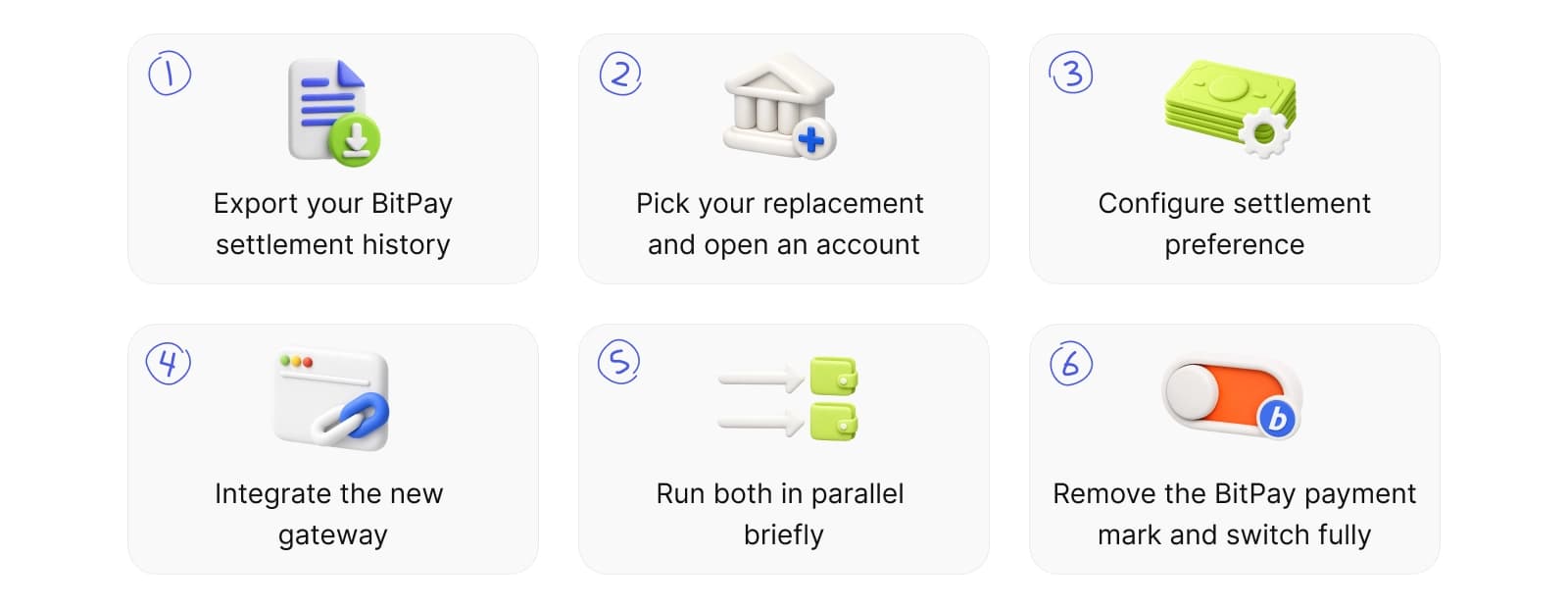
Switching processors sounds disruptive. In practice, for most merchants, it's a half-day job. Here's the sequence.
- Export your BitPay settlement history. Pull your transaction and settlement records from the BitPay dashboard for accounting continuity and tax records (1099-DA) in the US.
- Pick your replacement and open an account. Match the provider to your vertical using the mapping above. Submit KYB documents. For 0xProcessing, a dedicated manager runs onboarding in 3–7 days.
- Configure settlement preference. Decide whether to hold crypto, auto-convert to stablecoins, or off-ramp to fiat. This is where alternatives with VRCS-style conversion remove the volatility exposure that BitPay's locked-in rate only partially addresses.
- Integrate the new gateway. Most alternatives offer REST APIs, payment links, and plugins. Test in the sandbox before touching production funds. Migrate webhook handlers so order reconciliation continues uninterrupted.
- Run both in parallel briefly. Keep BitPay live on a fraction of traffic while you confirm the new gateway's webhooks, settlement, and reconciliation behave as expected.
Remove the BitPay payment mark and switch fully. Once confirmed, update your checkout, remove the mandatory BitPay branding, and route all crypto traffic to the new provider.
Ready to move off BitPay? 0xProcessing handles migration with a dedicated manager, free integration support, and API-first setup, so your crypto checkout keeps running while you switch. Start the switch →
FAQ
What is the best alternative to BitPay in 2026?
It depends on your priority. For low fees and volatility protection on high volume, 0xProcessing. For EU MiCA compliance, CoinGate. For coin variety, NOWPayments (350+) or CoinPayments (2,300+). For the enterprise stablecoin treasury, BVNK. There's no single winner, only the best fit per use case.
Why do merchants leave BitPay?
Common documented reasons include the $10,000 minimum for non-US bank wire settlements, country-specific stablecoin restrictions (per BitPay's settlement docs), mandatory BitPay checkout branding, and a per-transaction 25¢ fee plus a fluctuating network cost line item.
Are BitPay alternatives cheaper?
Often, yes, at the headline level. Cryptomus (0.4%) and NOWPayments (0.5% same-coin) sit below BitPay's 1–2% tiered fee. But "cheapest headline" isn't always "lowest all-in cost" once conversion and settlement fees are included, so compare the full stack.
Can I keep accepting the same coins if I switch from BitPay?
Almost certainly. BitPay settles in 15 cryptocurrencies. Most alternatives cover those plus far more. 0xProcessing handles 85+, NOWPayments 350+, CoinPayments 2,300+.
Is it hard to migrate from BitPay to another gateway?
No. For most merchants, it's a half-day task: export records, open the new account, configure settlement, integrate via API or plugin, test in sandbox, then switch. Running both in parallel briefly removes the risk.
Which BitPay alternative is best for iGaming?
0xProcessing and CoinsPaid are purpose-built for iGaming and high-risk verticals. BitPay's strict KYC and US regulatory focus make it a poor fit for many operators, while 0xProcessing supports the vertical directly with stablecoin auto-conversion.
Bottom line
BitPay built the category and still suits US enterprises that need NYDFS-grade compliance and direct fiat settlement. But it's no longer the obvious default. The friction points, high non-US settlement minimums, regional stablecoin restrictions, mandatory branding, and per-transaction fees are exactly what the newer field solves.
For most merchants moving in 2026, the decision narrows fast: 0xProcessing for low-fee, high-volume, and high-risk verticals; CoinGate for EU compliance; NOWPayments for coins and no-KYC; BVNK or Triple-A for enterprise and multi-region treasury. Match the provider to your vertical, compare the all-in cost rather than the headline rate, and run a brief parallel period before switching fully.