
If you're a finance lead paying contractors or vendors across borders, here's the short answer: stablecoin mass payouts cut your per-payment cost from the typical $25–50 of a SWIFT wire (plus hidden intermediary fees) down to $0.10–$3 all-in on efficient chains like Tron or Solana, and settlement drops from 1–5
business days to under a minute.
For a company running a few hundred international payments a month, that's the difference between thousands in fees and almost nothing, plus your contractors actually get paid the same day.
This guide covers why finance teams are moving to crypto payouts, how bulk crypto payouts work in practice, how they stack up against SWIFT and SEPA, which tools handle them, and how to stay compliant and tax-ready.
Why automate vendor payments in crypto?
SWIFT was designed in 1973 for the occasional big bank-to-bank transfer. It was never meant for a marketplace cutting 400 payments to freelancers across 40 countries every month, and at that volume, the costs get silly.
The numbers tell the story. Industry analyses in 2026 put a typical cross-border wire at $25 to $50 once you account for everything, with funds in transit for 1 to 5 days. Move the same payment as a stablecoin, and you're often under a dollar, landing in under a minute on a chain like Solana or Tron. That's not a marginal saving, it's one to two orders of magnitude.
What does that actually change for a finance team:
Those stacked bank fees go away. A cross-border wire rarely goes straight; it usually passes through a couple of correspondent banks, and each takes a cut along the way. The result your finance team knows well: a vendor invoices $1,000, the bank credits maybe $970, and someone has to reconcile the gap as a fee with no clear line item. On-chain, the number you send is the number that arrives.
Payment lands the same day. There's no 5 PM cutoff, and nothing freezes over the weekend; transfers confirm in seconds, any day.
And contractors in tough currency markets come out ahead, provided they have access to a decent off-ramp. Pay someone in Argentina, Turkey, Nigeria, or the Philippines in stablecoins, and they can end up with noticeably more local-currency value than a SWIFT wire converted at the official bank rate. Where the gap between the official and parallel exchange rate is wide, or remittance fees are steep, that edge is real, though the exact size depends entirely on the corridor and how they cash out.
For recurring cross-border payments, the math is decisive. Per Transfi's 2026
analysis, traditional cross-border payments run 2–7% all-in, while stablecoin payouts come in at 0.1–0.5%, a saving of roughly 70–90% on most corridors.
How bulk crypto payouts work
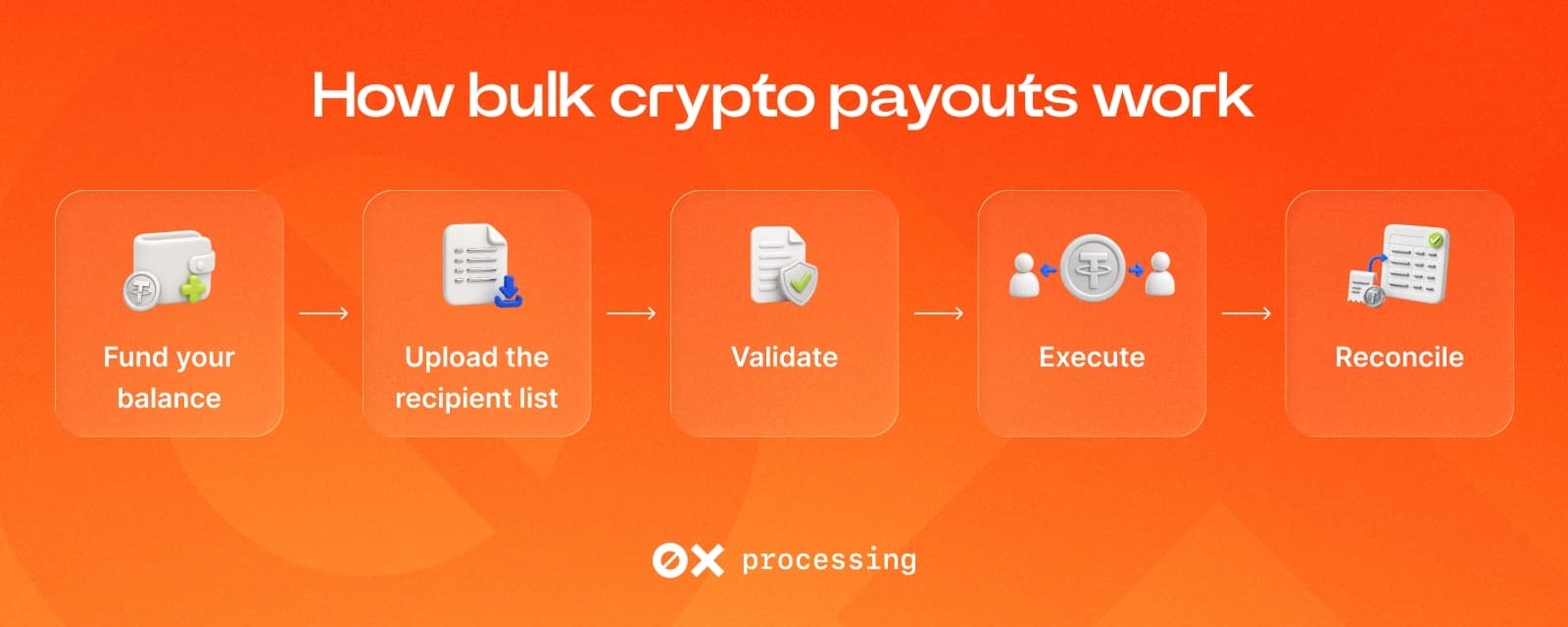
The mechanics are simpler than most finance teams expect. A mass payout (sometimes called a batch payout) lets you send funds to multiple recipients in a single operation instead of initiating each transfer manually.
The typical flow:
- Fund your balance. Top up the payout account in stablecoins (USDT,
USDC) or convert incoming fiat or crypto to a stablecoin to hold value steady. - Upload the recipient list. A CSV or API call with each recipient's wallet address, amount, and network. A few hundred or a few thousand rows in one batch.
- Validate. The platform checks addresses, networks, and balances, and flags errors before anything is sent.
- Execute. One confirmation triggers the whole batch. Each recipient gets paid directly on-chain.
- Reconcile. Every transfer returns a transaction hash, amount, and timestamp via a webhook or export, so your books match automatically.
The difference from traditional payroll runs is that there's no per-payment friction. Sending to 1,000 freelancers costs roughly the network fee times 1,000, not a $25 wire fee times 1,000.
Want to accept crypto payments on your website?
How freelancers cash out crypto payouts
A fair question from any contractor: "Great, I got paid in USDC, now how do I pay rent?" Worth knowing the options, because the easier you make this for your contractors, the more attractive you are as a payer.
- Local crypto exchanges. In most countries, there's a regulated exchange (Binance, Coinbase, Bitso in LATAM, Luno in Africa) where a contractor sells stablecoins for local currency and withdraws to a bank account. Usually, the cheapest route is available.
- P2P marketplaces. In regions where access to crypto via banks is limited, peer-to-peer desks (Binance P2P, local Telegram-based markets) allow contractors to sell directly to buyers, often at the parallel rate, which is frequently better than the official one.
- Crypto debit cards. Cards from providers like Wirex or the major exchanges let a contractor spend stablecoins directly, converting at the point of sale, no bank withdrawal needed.
- Off-ramp platforms. Services like MoonPay, Transak, or built-in processor off-ramps convert crypto to fiat and push it to a card or bank account in one step.
- Self-custody vs exchange wallets. Holding funds in a personal wallet (MetaMask, Trust Wallet, or a hardware wallet) means the contractor controls the keys and the responsibility. Leaving funds on an exchange is easier, but it trusts the exchange.
- Hardware wallets for larger balances. Anyone holding meaningful value should move it off a phone or browser extension to a hardware device (Ledger, Trezor). Keys never touch the internet.
- Seed phrase hygiene. The recovery phrase is the key. Written down, offline, never typed into a website or shared. Most losses come from phishing for this phrase, not from chain-level hacks.
- Verify the address every time. Crypto transactions are final. An incorrect address means lost funds with no recourse, so contractors should double-check the receiving address and, on the payer side, validate addresses before a batch goes out.
- Worker classification. Classify contractors correctly. A crypto payment doesn't change whether someone is a contractor or an employee, and misclassification carries the same penalties as it does with fiat.
- Tax documentation. The crypto received is treated as income at fair market value on the day it's received. In the US, the 1099-DA reporting regime now applies to digital asset transactions, and you'll need clean per-payment records. (See our guide on crypto tax reporting for
merchants for the full breakdown.) - KYB and AML. A compliant payout platform runs KYB on your business and AML screening on transactions. This matters more than it sounds: paying out to a sanctioned or flagged address creates real liability. A processor that screens outgoing payments protects you here.
- Stablecoin choice. Stablecoin payouts in USDC or USDT remove the volatility question for both you and the recipient; the amount paid is the amount received in dollar terms, which also simplifies your books versus paying in a volatile asset.
The practical takeaway for a payer: contractors in well-served markets cash out in minutes. In thinner markets, P2P and cards fill the gap. Either way, paying in a widely-supported stablecoin (USDC, USDT) on a common chain matters more than the exact amount, because it determines how easily they can actually use the money.
Keeping crypto payouts secure
If your contractors are new to holding crypto, a few basics can help protect everyone and reduce "I lost access to my funds" support tickets.
Convert what you don't want to hold. A contractor who needs the money for bills shouldn't sit on a volatile token. Holding in a stablecoin until cash-out removes the price risk entirely.
Crypto payouts vs traditional systems: a comparison
| Factor | SWIFT wire | SEPA | Stablecoin payout |
|---|---|---|---|
| Cost per payment | $25–50 | €0.20–1 (EU only) | network fee |
| Settlement time | 1–5 business days | Same/next day (EU) | Seconds to minutes |
| Availability | Banking hours | Banking hours | 24/7, including weekends |
| Geographic reach | 200 countries via banks | EU/EEA only | Anywhere with internet |
| Transparency | Limited (GPI tracker) | Limited | Full on-chain visibility |
| FX spread | Retail bank rate | N/A in-zone | Minimal, near-market |
| Reversibility | Hard to reverse | Hard to reverse | Final and irreversible |
The honest caveat: SWIFT still makes sense for very large one-off institutional transfers, where banks may waive fees and where the recipient has no crypto off-ramp. For recurring, high-volume, smaller-ticket payments – the freelancer and vendor case – stablecoins win clearly.
Tools and platforms for automated crypto payments
Several categories of tooling handle this, depending on whether you want a
crypto payment processor, a dedicated payroll platform, or your own API integration.
Crypto payment processors with mass payout features. Platforms like 0xProcessing, CoinsPaid, and NOWPayments offer batch payout tools alongside payment acceptance. You fund a balance, upload recipients, and execute. 0xProcessing runs Mass Payouts with 0% payout fees and stablecoin auto-conversion through its VRCS system, so you can hold value in USDT or USDC and pay out without exposure to volatility.
Dedicated crypto payroll platforms. Services like Rise focus specifically on contractor payroll, bundling KYC, tax documentation, and payouts into a single workflow, with recipients choosing from 100+ cryptocurrencies or local currency.
Direct API integration. If you run a marketplace or SaaS platform paying out at scale, you'll likely want to wire payouts directly into your system. A processor with a clean payout API lets you trigger batches programmatically, when a freelancer hits a payout threshold, when a vendor invoice clears, or on a fixed schedule.
For most finance teams, a processor that offers both acceptance and mass payout in a single dashboard is the practical choice. You collect revenue in crypto and pay out in crypto from the same balance, avoiding a round-trip to fiat.
Compliance and tax for crypto payroll and payouts
This is where finance leads should slow down, because getting it wrong is expensive. Paying contractors in crypto is legal in most jurisdictions in 2026, but it's treated as taxable compensation, just like a fiat payment.
The essentials:
The reconciliation advantage is real, too. Every on-chain payout carries a transaction hash, so matching payments to invoices is far cleaner than chasing a SWIFT wire that arrived $30 short with no remittance detail.
Always consult local tax legislation – in many jurisdictions, crypto payments to contractors must be reported at fair market value on the date of receipt.
Industry use cases
Where automated crypto payments deliver the most depends on the shape of the business.
Marketplaces and gig platforms. A platform paying thousands of sellers or drivers across borders is the textbook case. Per-payment fees that are trivial at a small scale become a major cost line at 10,000 payouts a month. Batch stablecoin payouts to reduce costs, and let the platform pay daily instead of weekly.
SaaS and creator platforms. Revenue-share payouts to creators, affiliates, and partners in dozens of countries. Crypto payroll for freelancers and contributors means a creator in Lagos and one in Lisbon get paid the same way, same day, at the same cost.
Agencies and remote teams. A US or EU agency with contractors worldwide. Instead of a finance person spending a day a month initiating wires, a single batch handles the whole team, with stablecoin payouts protecting everyone from FX surprises.
E-commerce and dropshipping. Paying overseas suppliers and vendors. The supplier gets paid in full, same day, which strengthens supplier relationships and can earn better terms.
The common thread: high payment count, cross-border, smaller individual amounts. That's exactly the profile SWIFT handles worst, and stablecoin mass payouts handle best.
Bottom line
For finance teams paying vendors and freelancers internationally, automated crypto payouts aren't a speculative bet in 2026; they're a cost-cutting, speed-up upgrade with hard numbers to back them up. These savings (roughly 70–90% on cross-border fees), combined with dramatically faster settlement and global reach, make a compelling case for finance teams.
The practical path: hold your payout balance in a stablecoin to eliminate volatility, use a platform with a real mass payout feature and clean reconciliation, properly classify and document contractors for tax, and ensure the platform screens outgoing payments for AML. Start with a small batch to validate the savings against your current SWIFT costs, then scale once the numbers prove out.
Ready to cut your international payout costs? 0xProcessing offers Mass Payouts across 85+ cryptocurrencies and 18 chains, with stablecoin settlement, 0% payout fees, real-time AML screening, and full transaction logs.
Get startedFAQ
What are crypto mass payouts?
Sending cryptocurrency to many recipients, vendors, freelancers, and affiliates in a single batch operation rather than one transfer at a time. You upload a list of wallet addresses and amounts, validate it, and execute the entire batch with a single confirmation.
How much cheaper are stablecoin payouts than SWIFT?
Per Transfi's 2026 analysis, all-in costs on a $10,000 international transfer drop from the typical $200–700 (2–7%) via traditional rails to roughly $10–50 (0.1–0.5%) using stablecoins, a 70–90% saving, with settlement in minutes instead of 1–5 business days.
How does a freelancer convert crypto payouts to local currency?
Several ways, depending on the country. The most common is selling stablecoins on a local, regulated exchange (Coinbase, Binance, Bitso, Luno) and withdrawing the proceeds to a bank account. Where banking access is limited, P2P marketplaces let them sell directly, often at a better-than-official rate. Crypto debit cards (Wirex, exchange-issued cards) let them spend directly, and off-ramp services like MoonPay or Transak convert to fiat in one step. Paying in a widely supported stablecoin on a common chain makes all of these easier.
Is it legal to pay freelancers in crypto?
Yes, in most jurisdictions in 2026. Crypto and stablecoin payments are treated as taxable compensation under existing law, provided you classify the worker correctly, issue proper tax documentation, and follow KYC and AML rules.
Which stablecoin is best for payouts?
USDC and USDT are the most widely used for stablecoin payouts, both dollar-pegged and liquid across major chains. US-regulated businesses often prefer USDC for its transparency; USDT dominates in emerging markets. Choose based on where your recipients can most easily off-ramp.
How do I automate vendor payments in crypto via API?
Use a processor with a payout API. You trigger a batch programmatically, on a schedule, at a payout threshold, or when an invoice clears, passing recipient addresses and amounts. The API returns transaction hashes for reconciliation. This is how marketplaces and SaaS platforms handle payouts at scale.
Do crypto payouts help with chargebacks?
Yes. Blockchain transactions are final, so there's no chargeback risk on payouts. On the acceptance side, this eliminates chargeback fraud that can cost high-risk merchants a meaningful share of annual profit.
