2026 changed the game for merchants who take crypto. The IRS now gets Form 1099-DA straight from every US-registered exchange, and starting with 2026 transactions, brokers have to report cost basis – not just gross proceeds. This merchant crypto tax guide breaks down the new rules, walks through the tools worth using, and lays out what to do step by step. One thing upfront: track each transaction as it happens, run it through automation software, and match your numbers to the 1099-DA well before filing day. May is too late to start.
What changed in 2026: the 1099-DA era
Form 1099-DA is the IRS's new reporting form for digital asset transactions. Think of it as the crypto version of the 1099-B that stock brokers have sent for decades. The IRS phased it in under Treasury Decision 10000 (July 2024). For 2025 activity, brokers report gross proceeds only.
Here is the timeline, based on IRS final regulations (Treasury Decision 10000, July 2024):
2025 transactions (filed in 2026): Brokers report gross proceeds only. Cost basis reporting is optional. The IRS sees what you sold, but not what you paid for it.
2026 transactions (filed in 2027): Brokers must report both gross proceeds and cost basis for covered securities. This is when crypto tax reporting for merchants starts to look like traditional securities reporting.
The practical consequence: if you accept crypto as a business payment method and your reported numbers do not match what the exchange sent to the IRS, you will receive a CP2000 notice – an automated letter flagging the mismatch. According to CryptoTaxAudit, these notices typically arrive 12–18 months after filing.
Why merchants face unique challenges
Individual traders worry about tracking buys and sells. Merchants face a different set of problems.
Every incoming payment is a taxable event. Say a customer pays you $500 in BTC. That $500, measured at fair market value on the day you receive it, counts as gross income. If you later sell or convert that BTC, the difference between what it was worth when it hit your wallet and what you got when you disposed of it becomes a capital gain – or a loss.
Volume creates complexity. A merchant processing 200 crypto transactions per month has 2,400 taxable events per year – each with its own cost basis, timestamp, and fair market value. Manual tracking is not realistic at this scale.
Multi-asset, multi-chain exposure. If you accept BTC, ETH, USDT, SOL, and a dozen other tokens, each one generates its own cost basis record. If you use auto-conversion to stablecoins (like VRCS), that conversion is itself a taxable event – you are disposing of the original asset and receiving the stablecoin.
Want to accept crypto payments on your website?

Cross-platform movement breaks cost basis tracking. If you receive crypto on one platform and withdraw it to another before selling, the selling platform may not know your original cost basis. The 1099-DA will show the sale amount, but the cost basis field may be blank. The IRS sees a large number and no offset – and assumes you owe tax on the full amount unless you document otherwise (H&R Block).
How to handle tax accounting for crypto payments: a practical workflow
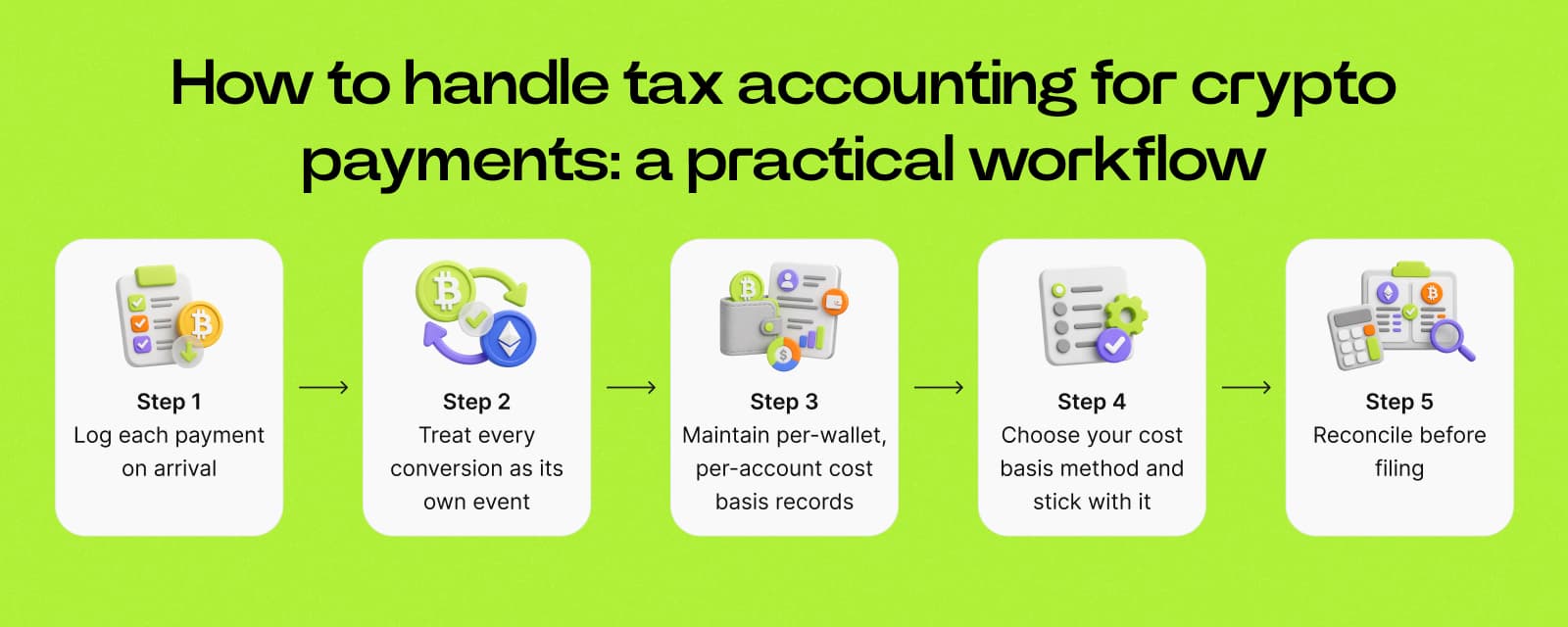
Tax accounting for crypto payments gets messy when you try to piece everything together retroactively. The solution is to capture data the moment money comes in.
Step 1: Log each payment on arrival. Your gateway should spit out a record for every transaction – date, crypto type, amount, USD value at that moment, tx hash, and the invoice or customer reference. Gateways with webhook callbacks (0xProcessing is the one) can push this directly into your accounting stack without manual entry.
Step 2: Treat every conversion as its own event. Auto-converting BTC to USDT? That counts as a disposal. You need to log the conversion date, the amount of crypto you gave up, its USD value at the time, the stablecoins you received, and any fees. Miss this, and your books will be short.
Step 3: Maintain per-wallet, per-account cost basis records. Under the IRS's new rules (Rev. Proc. 2024-28), you can no longer treat the same asset across multiple wallets as one combined pool. Each wallet or account must maintain its own cost basis ledger. According to MetaMask's 2026 tax guide, this per-wallet requirement is one of the biggest changes merchants need to adapt to.
Step 4: Choose your cost basis method and stick with it. The IRS allows FIFO (first in, first out), LIFO (last in, first out), and specific identification. FIFO is the default if you do not elect otherwise. For merchants who convert incoming crypto quickly, the method matters less – your holding period is short, and gains are minimal. For those who hold, the choice can significantly affect your tax bill.
Step 5: Reconcile before filing. Compare your internal records against the 1099-DA you receive from your exchange or payment processor. Flag any mismatches – missing cost basis, incorrect amounts, or transactions that appear on one record but not the other. Fix these before filing.
Automation tools that reduce the burden
Manual crypto tax accounting at merchant scale is not practical. Here are the categories of software that help, with examples:
| Tool type | What it does | Examples |
|---|---|---|
| Crypto tax software | Connects to exchanges and wallets, categorizes transactions, calculates gains/losses, generates IRS-ready reports | CoinTracker, Koinly, CryptoTaxCalculator, TokenTax |
| Payment gateway reporting | Exports transaction logs with timestamps, amounts, and FMV at the time of receipt | 0xProcessing dashboard, BitPay, Coinbase Commerce |
| Accounting integrations | Syncs crypto transaction data with traditional accounting software | QuickBooks integrations via Koinly, Xero via CoinTracker |
| On-chain reconciliation | Pulls transaction history directly from blockchain explorers for wallets not connected to exchanges | Zerion, DeBank, Etherscan (manual export) |
The most efficient setup for merchants: connect your payment gateway's export to a crypto tax tool, which in turn feeds your accounting platform. This creates a single pipeline from payment received to gain/loss calculation to report generation.
Looking for a gateway that keeps clean records from the start?
0xProcessing logs every transaction with timestamps, amounts, and fair market value – exportable from your merchant dashboard. When tax season arrives, your data is already structured for compliance. Get started →
The cost basis gap: what to do when 1099-DA is incomplete
For the 2025 tax year (the filing season happening right now), most 1099-DA forms show only gross proceeds. Cost basis is missing in many cases, especially when assets were transferred between platforms.
This is not an excuse to skip reporting. It is a documentation problem. According to Camuso CPA, a firm specializing in crypto tax compliance, in the first year of reporting, brokers generally report gross proceeds, while cost basis may be missing when assets move between wallets or platforms outside broker visibility.
What to do:
Do not copy a $0 cost basis from your 1099-DA into your tax return. If the exchange does not know your cost basis, it may report zero, which overstates your gain. Calculate it yourself from your original purchase records.
Keep a paper trail. The IRS expects documentation: purchase confirmations, exchange records, wallet transaction history, and any records of transfers between platforms.
Use the specific identification method if it benefits you. This lets you choose which units you are selling, potentially reducing your gain by selecting higher-cost units first. But you need records to back this up.
Penalties and how to avoid them
The IRS has several enforcement tools for crypto non-compliance:
CP2000 notices are the most common outcome. They arrive when the amount you reported does not match what the exchange reported. The IRS proposes an additional tax based on the mismatch. You can respond with documentation, but the burden of proof is on you.
Late filing and underpayment penalties apply if you owe tax and do not file by April 15 (or October 15 with extension). The penalty is typically 0.5% of unpaid tax per month, up to 25%.
Accuracy-related penalties of 20% apply if the IRS determines your understatement of income was due to negligence or disregard of rules.
The simplest way to avoid all three: file on time, report every taxable event, and reconcile your records against third-party reports before submitting.
International merchants: what about non-US businesses?
The 1099-DA rules apply specifically to US-registered brokers and US taxpayers. But if you operate outside the US:
EU: The DAC8 directive (effective 2026) requires crypto service providers in the EU to report transaction data to tax authorities. Merchants should expect similar automated matching as in the US.
UK: HMRC treats crypto received as business income at fair market value. Capital gains apply on disposal. No equivalent of 1099-DA yet, but self-reporting requirements are strict.
Global trend: Tax authorities worldwide are moving toward automated information exchange for crypto. The OECD's Crypto-Asset Reporting Framework (CARF) is being adopted by over 50 countries, with the first exchanges of information expected in 2027.
For merchants processing cross-border crypto payments, the safest approach is to treat every incoming payment as taxable income at the time of receipt and record the fair market value in your local currency.
FAQ
What is Form 1099-DA?
It is the IRS form that reports digital asset transactions – sales, exchanges, and certain transfers. Starting with 2025 transactions, US-registered exchanges send this form to both you and the IRS. It functions like the 1099-B for stocks.
Do I owe tax when I receive crypto as payment?
Yes. The fair market value of the crypto at the time of receipt is treated as gross income. If you later sell or convert it, any difference in value creates a capital gain or loss.
What if my 1099-DA shows no cost basis?
Calculate it yourself from your purchase records. Do not report a $0 basis – this overstates your gain and may trigger a larger tax bill than necessary.
Does converting crypto to stablecoins create a taxable event?
Yes. Converting BTC to USDT, for example, is a disposal of BTC. You realize a gain or loss based on the difference between your cost basis and the fair market value at the time of conversion.
What tools can help automate tax reporting on crypto transactions?
CoinTracker, Koinly, CryptoTaxCalculator, and TokenTax all connect to exchanges and wallets, categorize transactions, and generate IRS-ready reports. Pair them with your payment gateway's transaction export for the cleanest workflow.
Can I use the wash sale rule to harvest losses?
As of 2026, the wash sale rule does not apply to crypto. You can sell at a loss and immediately rebuy the same asset without losing the deduction. This is one of the most valuable tax optimization tools for active crypto merchants (Phemex).
Bottom line
Tax compliance for crypto-accepting businesses does not have to be painful, but it does require a system. Capture transaction data at the point of receipt. Use software to calculate gains and losses. Reconcile against your 1099-DA. File on time.
The merchants who struggle are the ones who try to reconstruct a year's worth of transactions in April. The ones who simplify crypto compliance do it from day one.
Need a payment gateway that keeps your records clean from the start?
0xProcessing provides real-time transaction logs, exportable reports, and support for 85+ cryptocurrencies across 18 blockchains. When it's time to file, your data is already where it needs to be. Start accepting crypto →