Machine learning fraud models are trained on millions of tagged transactions, then score each new transaction in real-time against known patterns of legitimate and illicit behavior. To wire AI fraud detection into a payment business, three pieces need to be running: a transaction monitoring engine connected to your gateway, a behavioral analytics layer that tracks individual user patterns, and a feedback loop that feeds confirmed outcomes back into training. The rest of this article covers the loss numbers driving urgency in 2026, how the models actually work under the hood, what production deployments are producing, and a readiness checklist for merchants.
2025 was a rough year for crypto fraud. Chainalysis put total scam losses at $17 billion, with $14 billion confirmed on-chain and the rest projected based on historical revision patterns. The part that doesn't show up in headline numbers: AI-enabled scams ran 4.5 times more profitable than traditional methods, and impersonation scams – criminals posing as executives, officials, or well-known crypto figures – were up 1,400% year-over-year. The defense side had catching up to do.
What is AI fraud detection in crypto payments?
It is a system that uses machine learning to flag suspicious transactions before they settle. Three things make it different from rule-based monitoring:
It learns from data, not from a rulebook. A traditional system has rules like "flag any transaction over $10,000 from a new address." AI systems learn that the address matters less than how the address has behaved over the last six months, who it has interacted with, and whether the timing fits the user's normal pattern.
It scores in real-time. A modern model assigns a risk score to each transaction in milliseconds. The merchant gets an answer before the funds settle, not three days later.
It updates itself. Each confirmed case (real fraud or a false positive) is fed back into the training data. The model gets sharper without manual rule changes.
How AI prevents crypto fraud at the transaction level
The mechanics break down into four working parts:
Pattern recognition. Models train on labeled datasets of past transactions. The Elliptic++ dataset, widely used in academic research, contains over 822,000 Bitcoin wallet addresses labeled as licit or illicit, along with 1.27 million temporal interactions. MIT and IBM released a dataset of over 200 million tagged crypto transactions specifically for training fraud detection models.
Behavioral profiles. The model builds a profile for each user (or wallet, or merchant) and monitors for deviations. A wallet that suddenly transacts at 10x its historical volume with new counterparties across jurisdictions is a different risk profile than a wallet making a single large transfer to a known exchange. Elliptic's behavioral detection currently identifies 21 distinct fraud typologies, including patterns like "pig butchering" (small initial transfer → bait → larger second transfer).
Want to accept crypto payments on your website?

Cross-chain tracing. Modern models follow funds as they move between blockchains through bridges, mixers, and DEX swaps. This matters because criminals rarely keep funds on one chain. Chainalysis's Reactor and similar tools handle multi-chain analysis as a default capability.
Real-time scoring and escalation. Alerts are triaged by severity. Elliptic users currently resolve 99% of alerts in under five minutes, and report 50% reduction in alert escalation time.
Why crypto fraud AI matters for businesses in 2026
The case is not theoretical. Three numbers from 2025–2026 tell the story:
- $17 billion. Total estimated losses to crypto scams in 2025.
- +1,400%. Year-over-year growth in impersonation scams, including AI-deepfake video impersonations of executives and officials.
- +300%. Improvement in detection rates, Mastercard reported after embedding generative AI across its fraud detection systems in 2025.
For a business that processes crypto payments, the math is straightforward. Manual review costs money and time, takes hours per case, and 44% of North American financial institutions still rely on it primarily. Each manual hour is an hour the merchant is exposed. AI-driven systems compress that into milliseconds.
There's a second dimension that matters in competitive verticals: false positives. Card payment data shows that legitimate transactions declined by overcautious systems are a bigger revenue drain than actual fraud in many cases. AI models meaningfully reduce false positives because they consider the full behavioral picture rather than single-flag rules.
Real deployments: who's running this in 2026
The infrastructure is no longer experimental. A few production systems worth knowing:
Chainalysis blockchain intelligence agents. Launched March 2026. AI agents that compress hours of investigation work into prompts. An investigator types, "Where did this money come from? Is it suspicious?" and the system assembles the answer. 150+ government agencies currently use Reactor.
Elliptic Lens. Configurable across 10M+ risk-permutation combinations. Behavioral detection covers 21 fraud typologies. Risk-based approach matches FATF guidance.
TRM Labs. 75% reduction in time to detect illicit activity using AI-driven blockchain intelligence.
CipherTrace Armada. Real-time AML compliance monitoring is used by 68% of top-tier crypto exchanges.
Mastercard generative AI fraud stack. 300% improvement in detection and a significant reduction in false declines after the 2025 rollout.
Build a fraud-resistant payment stack with 0xProcessing. Real-time AML monitoring on every transaction, behavioral risk scoring per merchant and per agent, and integration with leading blockchain analytics providers.
Submit a request →
How to reduce losses on crypto payments with AI: a practical framework
For a merchant or platform integrating fraud prevention, the work breaks into four steps.
Step 1: Pick the right transaction monitoring layer
Whatever runs in your gateway, the monitoring layer needs at least three things: real-time scoring (under 500ms per decision), a behavioral baseline per user, and integration with at least one blockchain analytics vendor (Chainalysis, Elliptic, TRM Labs, CipherTrace).
Step 2: Define risk thresholds you can actually defend
A common mistake is treating "fraud detection" as a single dial. Real systems use multi-tier scoring: auto-clear, soft review, hard review, and block. The thresholds depend on your business model and tolerance. iGaming platforms typically have tighter thresholds than B2B SaaS because their chargeback exposure profiles differ.
Step 3: Build feedback loops
The model only improves if confirmed outcomes flow back into it. Every chargeback, every refund, and every confirmed legitimate transaction needs to be labeled and fed back. Without feedback loops, the system fossilizes, and false positives climb over the course of six months.
Step 4: Pair AI with human compliance review for edge cases
The best deployments don't replace humans. They prioritize what humans look at. The system handles 95–99% of decisions automatically, surfaces the rest with full context, and saves the compliance team for cases where judgment actually matters.
Risks and limitations: what these systems don't solve
A clean picture of the technology has to include the parts that don't work yet.
Adversarial AI is real. Fraudsters use generative AI to craft synthetic identities, deepfake video calls, and large-scale impersonation campaigns. The same tools that defenders use are available to attackers, and the gap between offense and defense narrows fast. The Chainalysis 2026 report explicitly identifies this: AI is now an attacker's tool, too.
Models drift. A model trained on 2024 fraud patterns degrades as fraud patterns shift. Without active retraining, accuracy drops 10–20% over a single year in production environments.
False positives still happen. Even the best systems flag legitimate transactions. The question is the rate, not the existence. A 1% false-positive rate on $100M in monthly volume results in 10,000 customers being declined. Models need ongoing tuning to keep that number low.
Checklist: AI fraud prevention readiness for crypto merchants
- Transaction monitoring with real-time scoring (sub-500ms per decision)
- Integration with at least one blockchain analytics vendor (Chainalysis, Elliptic, TRM Labs, CipherTrace)
- Multi-tier risk scoring (auto-clear / soft review / hard review/block)
- Cross-chain tracing capability for funds moving through bridges and mixers
- A feedback loop that captures confirmed fraud and false positives back into training
- Human compliance review tier for edge cases
Real metrics: what these systems deliver
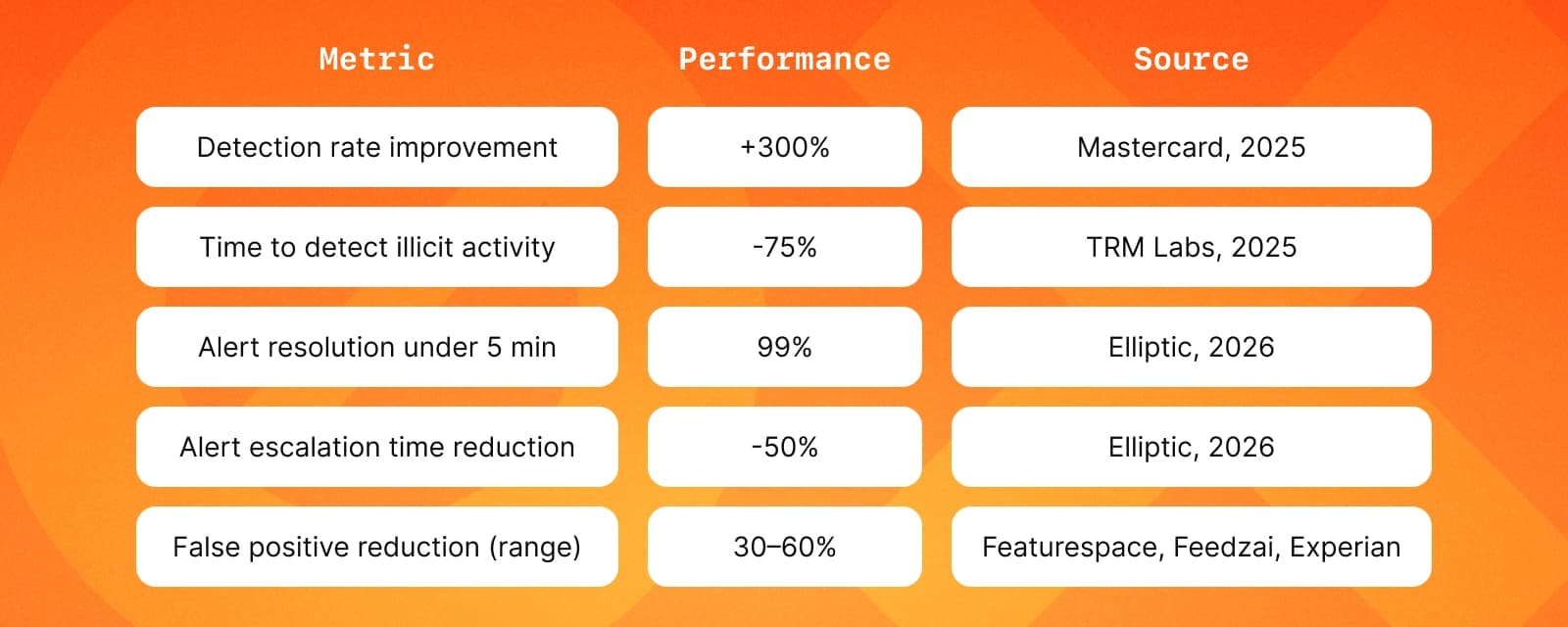
Concrete results from 2025–2026 deployments:
| Metric | Performance | Source |
|---|---|---|
| Detection rate improvement | +300% | Mastercard, 2025 |
| Time to detect illicit activity | -75% | TRM Labs, 2025 |
| Alert resolution under 5 min | 99% | Elliptic, 2026 |
| Alert escalation time reduction | -50% | Elliptic, 2026 |
| False positive reduction (range) | 30–60% | Featurespace, Feedzai, Experian |
These numbers don't apply uniformly. A small e-commerce store sees different gains than a high-volume exchange. But the direction is clear: AI fraud systems consistently outperform pure rule-based monitoring in real production deployments.
Reduce fraud losses on every transaction. 0xProcessing combines AI-driven AML monitoring, behavioral risk scoring, and integration with major blockchain analytics platforms. Every transaction is screened in real-time, with full audit logs and per-merchant configurable thresholds. Talk to our team →
Conclusion
The fraud landscape changed in 2025. AI-enabled scams turned out to be 4.5x more profitable than traditional methods; impersonation grew by 1,400%; and total losses surpassed $17 billion. Defenders responded with AI of their own, and by mid-2026, the gap between manual review and machine learning detection had become impossible to ignore for any business processing crypto at scale.
The right approach for merchants is not to chase every new fraud detection vendor that surfaces. It's to build a layered stack: blockchain analytics for tracing, behavioral models for scoring, real-time monitoring for speed, and human compliance for edge cases. Plug those four together, set the thresholds correctly for your business, and feed the outcomes back into training. The merchants who do this in 2026 walk into 2027 with materially lower fraud losses and materially higher approval rates than those still running rule-based systems.
FAQ
What is this technology in simple terms?
Software that watches transactions as they happen and flags the ones that don't look right, based on patterns learned from millions of past cases. It runs faster than humans, learns over time, and looks at behavior instead of just rules.
What businesses benefit most from crypto fraud AI?
High-volume merchants in verticals with elevated chargeback risk: iGaming, forex, e-commerce in regulated markets, exchanges, and platforms with global customer bases. Anyone processing crypto payments at scale benefits from real-time AML and behavioral monitoring.
Can these systems reduce losses on crypto payments?
Yes. Production deployments show 75% reduction in detection time, 300% improvement in detection rates (Mastercard), and 50% faster alert escalation. The combination results in fewer fraud losses and fewer legitimate transactions wrongly declined.
Does this technology eliminate the need for human compliance review?
No, and serious vendors don't claim it does. AI handles 95–99% of decisions automatically and surfaces edge cases for human review with full context. The human role shifts from screening every transaction to investigating the difficult ones.
How does 0xProcessing handle AI fraud prevention?
Every transaction passes through real-time AML and behavioral monitoring. We integrate with major blockchain analytics providers, score risk for each agent and merchant, and produce auditable logs for compliance teams. Configurable thresholds let merchants tune the balance between fraud blocking and conversion.