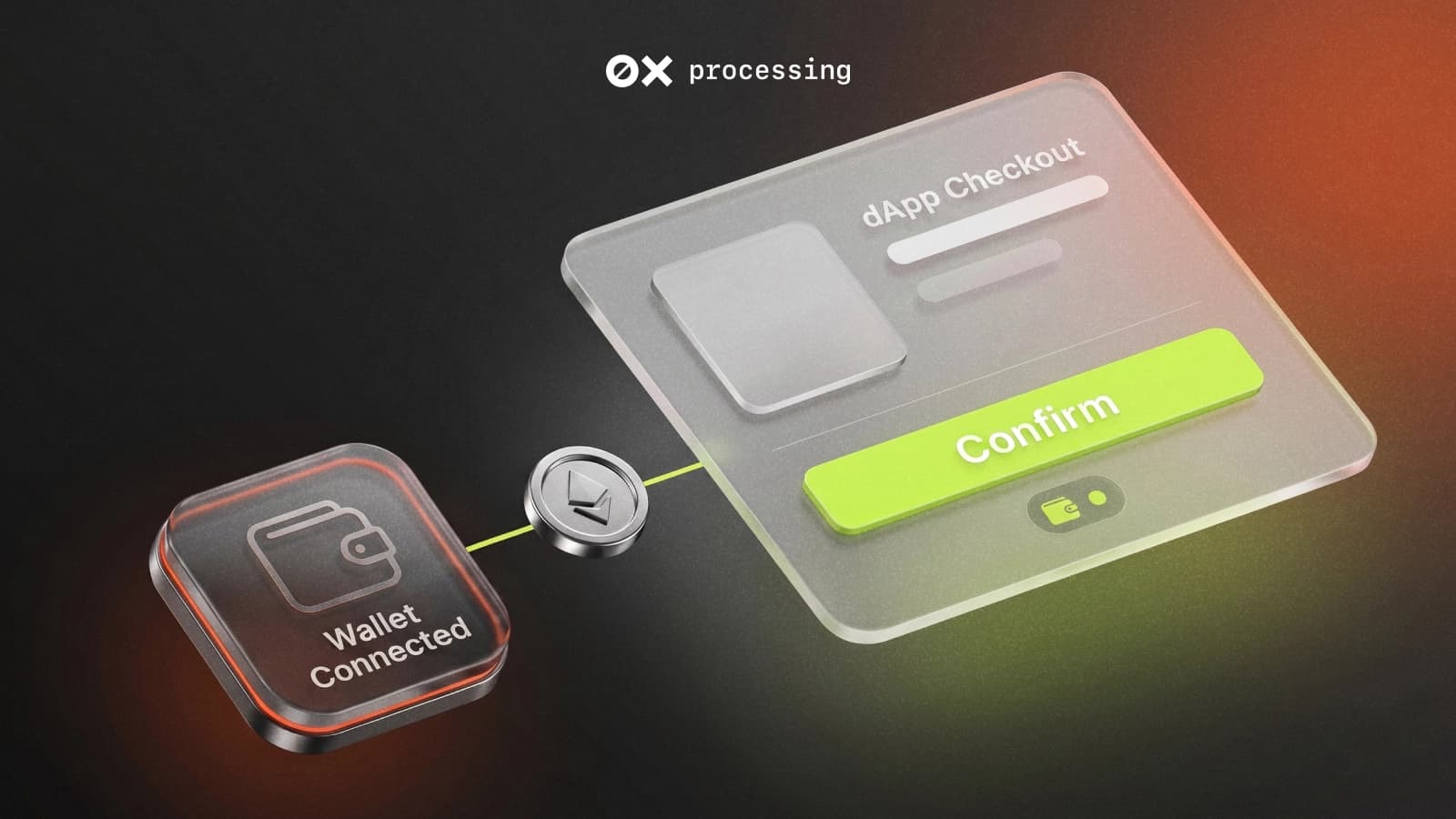
A truly Web3 payment gateway hands the buyer a one-click wallet-connect checkout, supports multiple stablecoin chains without switching networks, and settles on-chain through standards like x402, AP2, or ERC-8004 – not just a custodial checkout with a MetaMask button glued on.
The cleanest non-custodial options in 2026 are BTCPay Server (Bitcoin and Lightning, self-hosted), Helio (Solana-native, MoonPay-owned), and partial-non-custodial flows at NOWPayments. For merchants who want a Web3-grade checkout experience but prefer custodial settlement (the usual choice in iGaming, forex, and SaaS), 0xProcessing's 16+ wallet support and x402-ready architecture deliver the same UX without forcing self-custody onto the operator. BVNK and Triple-A serve the enterprise stablecoin-rail end of the market. This article explains the difference and ranks the seven processors that actually qualify.
What is a Web3 payment gateway?
Web3 payment processor must let the buyer pay from a non-custodial wallet (MetaMask, WalletConnect, Phantom, Trust, Rabby) with a single signature, support direct on-chain settlement without forcing routing through a centralized custodian, and integrate with the emerging machine-payment standards (x402, AP2, ERC-8004) that now govern agent-to-agent commerce.
x402 specifically handles micropayments and machine-to-machine API calls – by late April 2026, 165 million transactions across 69,000 active agents, averaging $0.30 per transaction, totaling ~$50M cumulative volume and $600M+ annualized. The broader agentic commerce market – which includes higher-value agent transactions through other rails – reached $8B in 2026 per Juniper's analysis, projected to $1.5T by 2030 and $3.5T by 2031.
Web3 checkout vs custodial settlement: the spectrum
Most processors marketed as "Web3" sit somewhere on a spectrum, not at the extreme.
Fully non-custodial, self-hosted. The merchant runs the software, holds the keys, and signs every settlement. BTCPay Server is the canonical case: zero counterparty risk, maximum operational burden.
Non-custodial, hosted. The processor operates as a company but never controls the funds. Funds are routed from the buyer's wallet straight to the merchant's wallet. Helio sits here for Solana. NOWPayments offers a non-custodial option alongside its custodial product.
Custodial with Web3-grade checkout. Funds settle through the processor's custody for AML, KYT, and stablecoin conversion. But the checkout itself is Web3: one-click wallet connect, multi-chain selection, on-chain payment confirmation. 0xProcessing, Cryptomus, and BVNK fall here.
Custodial with Web3 features bolted on. The default flow is still hosted-form checkout, with a wallet-connect button added recently. BitPay and Coinbase Commerce sit here. Functional, but the architecture wasn't built around Web3-first interactions.
The relevant question isn't which model is "better" in the abstract. It's the one that matches the merchant's operational reality.
Checklist: what a Web3 crypto payment processor needs
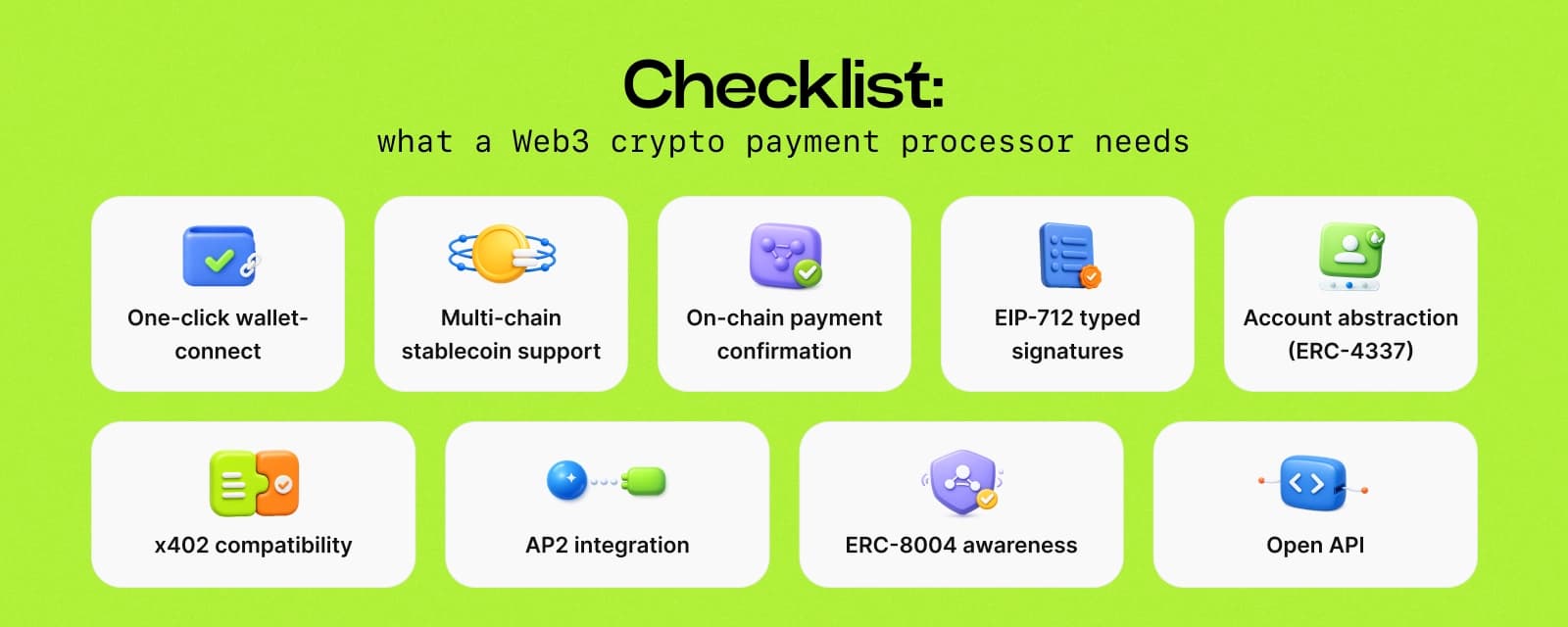
Nine criteria worth checking before integration. The first six are about the merchant experience; the last three cover machine-payment readiness.
- One-click wallet-connect for MetaMask, WalletConnect, and Phantom at a minimum
- Multi-chain stablecoin support without forcing the buyer to switch networks (USDC on Base, Ethereum, Solana, Polygon, Arbitrum at a minimum)
- On-chain payment confirmation visible to the buyer (block explorer link, not just a green checkmark)
- EIP-712 typed signatures for transaction approval (standardized format for cryptographic message signing that makes intent human-readable to the buyer)
- Account abstraction (ERC-4337) for gasless or sponsored transactions, with transparent disclosure of who pays gas (buyer, merchant, or sponsor)
- x402 compatibility for HTTP-402 micropayments from AI agents
- AP2 (Google Agent Payments Protocol) integration or roadmap
- ERC-8004 awareness for agent identity verification
- Open API and webhook architecture, not a closed embed-only flow
On-chain vs off-chain settlement: what changes
Two architectures live under the same "Web3 payment" label.
On-chain settlement means funds move from the buyer's wallet to the merchant's wallet via a single transaction on a single blockchain. Settlement finality is immediate (sub-second on Solana, ~12 seconds on Ethereum L1, near-instant on most L2s). The cost is the network fee. The benefit is no counterparty risk and full transparency.
Off-chain settlement means the processor batches payments and settles with the merchant at periodic intervals (hourly, daily, or on demand). The buyer's payment is on-chain; the merchant's receipt is off-chain accounting until withdrawal. This is how most custodial processors work, including 0xProcessing, BitPay, and CoinGate. The trade-off is between operational efficiency (one withdrawal vs. hundreds of small ones) and custody risk during the holding window.
For high-frequency low-value flows (Lightning, micropayments, agent commerce), on-chain settlement wins because batching adds latency. For high-value or merchant-side fee optimization, off-chain settlement wins because consolidated withdrawals reduce gas exposure.
Want to accept crypto payments on your website?
x402, AP2, and ERC-8004: the AI agent payment stack
Three protocols that became the de facto standards for machine-to-machine commerce in 2026.
x402: HTTP-402 micropayments
Launched by Coinbase and Cloudflare in May 2025, x402 revives the HTTP 402 "Payment Required" status code that has been reserved since the 1990s but never standardized. When an agent hits a paywalled endpoint, the server returns a 402 status code with payment instructions; the agent pays in stablecoin (typically USDC) and then retries. According to the latest data from Coinbase, by the end of April 2026, x402 had processed over 165 million transactions across networks (119M on Base, 35M on Solana), with 69,000 active agents, ~$50M cumulative volume, and roughly $600M+ in annualized volume – per Coinbase's reporting.
Co-founded by Coinbase and Cloudflare, with 22 launch members including Adyen, AWS, American Express, Base, Circle, Fiserv Merchant Solutions, Google, KakaoPay, Mastercard, Microsoft, Polygon Labs, PPRO, Shopify, Solana Foundation, Stripe, thirdweb, Visa, and others.
AP2: Google's Agent Payments Protocol
Google announced AP2 in September 2025 – an open protocol with 60+ partners, including PayPal, Mastercard, and American Express. AP2 lets AI agents make payments using cryptographically signed digital contracts called Mandates. It treats stablecoin rails as first-class citizens, with x402 serving as an extension specifically for crypto payments. AP2 sets economic behavior boundaries – spending limits, approval workflows, audit trails – making the entire agent payment stack enterprise-deployable.
ERC-8004: agent identity registry
Launched January 29, 2026, co-authored by contributors from MetaMask (Marco De Rossi), Ethereum Foundation (Davide Crapis), Google (Jordan Ellis), and Coinbase (Erik Reppel) – not «by Ethereum Foundation» as an institution. ERC-8004 is the cryptographic passport for the agentic web: a lightweight on-chain registry that lets AI agents be discovered, evaluated, and trusted across organizations. Over 45,000 AI agents had registered across multiple blockchains by the end of February 2026 (per 8004scan tracking; 22,900 in the first three days, 21,000+ by early February, 45,000+ by the end of February).
Together, these three protocols define how machines pay machines. A payment processor without at least x402 compatibility in 2026 is functionally locked out of the agentic commerce segment.
Comparison: 7 Web3 payment processors in 2026
The custody column shows where merchant funds are held before withdrawal.
| Processor | Custody model | Web3 wallets | Multi-chain stablecoin | x402 / AP2 ready | Best fit |
|---|---|---|---|---|---|
| 0xProcessing | Custodial, Web3-grade checkout | 16+ (MetaMask, WC, Phantom, Trust, Coinbase, Rabby, etc.) | USDC/USDT on 18 chains, 31 stablecoins | x402 architecture in production | iGaming, forex, SaaS |
| BTCPay Server | Self-hosted non-custodial | Any (merchant-controlled) | Bitcoin + Lightning core; altcoins via plugins | Limited (Bitcoin-first) | Bitcoin-native, sovereignty-first |
| BVNK | Custodial, stablecoin-focused | MetaMask, WC, enterprise tooling | Strong stablecoin rail coverage | Stablecoin rails, partial | Enterprise B2B stablecoin |
| ⚠️ Cryptomus* | Custodial with Web3 connect | MetaMask, WC, Trust, Phantom | 100+ coins, multiple chains | No native x402 | CIS, P2P fiat, Web3 UX |
| Helio | Non-custodial, hosted | Phantom, Solflare, WC | Solana-native (USDC, USDT, SOL) | Solana ecosystem ready | Solana-first commerce |
| NOWPayments | Custodial; non-custodial option available | MetaMask, WC, Trust | 350+ coins, multi-chain | Partial AI-agent readiness | Altcoin breadth, low fee |
| Triple-A | Custodial, MAS-licensed | MetaMask, WC | 30+ coins, key stablecoins | No native x402 | APAC regulated |
* Compliance risk: subject to the largest AML penalty in FINTRAC history (Oct 2025); business continuity risk elevated
Need Web3-grade checkout without self-custody overhead? 0xProcessing supports 16+ Web3 wallets, USDC/USDT across 18 blockchains, one-click wallet-connect, and x402-ready architecture – with licensed custodial settlement so your treasury isn't exposed to operational key management.
Get a demoThe seven processors compared in depth
0xProcessing
Custodial settlement with Web3-grade checkout architecture. 16+ Web3 wallets at the payment form, 18 blockchains supported, 31 stablecoins, one-click wallet-connect through MetaMask, WalletConnect, Phantom, Trust, Coinbase Wallet, Rabby, and others. Web3 endpoint at web30.0xprocessing.com handles direct dApp integration.
Pros:
- Widest Web3 wallet coverage of any custodial processor (16+ wallets)
- USDC and USDT across all major chains, plus 29 other stablecoins
- x402-compatible architecture in production (rare among custodial processors)
- VRCS auto-conversion to stablecoins included, no extra fee
- Mass payouts at 0% withdrawal for affiliate-heavy models
- Three external audits since 2022, real-time AML/KYT, 99.9% acceptance rate
Cons:
- Custodial by design – funds settle through the processor before withdrawal (intentional trade-off for AML/KYT)
- No off-the-shelf CMS plugins (API-first integration)
- Pricing not publicly listed; turnover-based after onboarding (3–7 days)
BTCPay Server
The reference non-custodial Bitcoin payment processor. Self-hosted, open-source, runs on the merchant's VPS. Lightning Network is enabled by default. Plugins support altcoins, but the project remains Bitcoin-first in its design philosophy.
Pros:
- True self-custody: funds never touch a third-party operator
- Zero platform fees, only network costs
- Lightning Network for sub-second settlement on small tickets
- Open-source, auditable, no vendor lock-in
Cons:
- Full operational burden on merchant (VPS, node maintenance, security patching)
- Limited beyond Bitcoin (altcoin support via community plugins varies in quality)
- No AML/KYT layer – compliance becomes the merchant's job entirely
BVNK
Enterprise stablecoin payments and B2B treasury rails. Handles $25–30B in annual volume as reported by BVNK. Mastercard agreed to acquire BVNK for up to $1.8B (announced 17.03.2026; includes a $300M earnout; closing by the end of 2026 – not yet completed). 25+ licenses, ISO 27001.
Pros:
- Strongest enterprise stablecoin rail coverage
- Regulatory footprint across 25+ jurisdictions
- Mastercard's pending acquisition signals long-term Web3 alignment
Cons:
- Enterprise entry tier: $500K monthly minimum and six months of operating history, typical
- Less consumer-checkout focused than other processors
- Custom integration timelines (weeks, not days)
Cryptomus
Custodial processor with one-click Web3 connect and P2P fiat rails. Popular in CIS markets. Took on the FINTRAC penalty (CAD 177M, October 2025) and shifted to mandatory KYC – worth weighing if business continuity matters for your stack.
Pros:
- One of only two custodial processors with native Web3 connect at checkout (alongside 0xProcessing)
- 100+ coins and P2P fiat off-ramp in the CIS region
- From 0.4% base fee at low volumes
Cons:
- Public enforcement history with FINTRAC raises continuity questions
- Mandatory KYC since February 2025
- No native x402 or AP2 integration
Helio
Solana-native payment processor. Acquired by MoonPay in 2024, embedded into MoonPay's broader Web3 stack. Non-custodial by default – the merchant's Solana wallet receives funds directly. Strong fit for stores selling NFTs, SaaS, or digital goods to Solana audiences.
Pros:
- True non-custodial on Solana (funds go directly to merchant wallet)
- Sub-second settlement, fees under $0.001
- Native integration with Phantom, Solflare, and the broader Solana ecosystem
- MoonPay's parent provides fiat on-ramp coverage
Cons:
- Solana-only as the primary chain (limited cross-chain coverage)
- Less suitable for merchants with Ethereum-heavy buyer bases
- No mass payout feature for affiliate-heavy models
NOWPayments
Custodial processor with a non-custodial mode toggle. Founded in 2019, part of the ChangeNOW group. 350+ cryptocurrencies. Lowest base fee in the comparison at 0.5% + 0.5% convert.
Pros:
- Genuine non-custodial mode available alongside custodial
- 350+ coins, including most stablecoin networks
- HMAC-SHA512 webhook signatures (sorted JSON)
- Lowest base fee among major Web3-capable processors
Cons:
- The exchange engine depends on ChangeNOW (third-party dependency)
- No MiCA, PI, or EMI license at the time of writing
- Partial x402 / AP2 readiness, not full production integration
Triple-A
Singapore-based, MAS-licensed, ACPR/AMF/FinCEN registered. 30+ cryptocurrencies. ~0.8% base fee – strong APAC regulatory footprint.
Pros:
- Strongest regulatory posture among Web3-capable processors (MAS, ACPR, AMF, FinCEN)
- Clean fiat off-ramp in APAC and EU
- Reliable enterprise SLA for high-volume merchants
Cons:
- 30+ coins is narrower than the peer-set median
- No native x402 or AP2 integration
- Lower Web3 wallet coverage than Web3-first processors
How to choose between self-hosted and managed Web3 processors
The custody question dominates everything else. Three filters that usually settle it.
Technical capacity. Running BTCPay Server means running a Lightning node, a Postgres database, regular security patches, and being your own AML officer. For an SMB without an in-house DevOps team, this is 5–10 hours per month at a minimum. For a Bitcoin-only merchant who values sovereignty over time, that's a fair trade. For everyone else, it isn't.
Volume profile. Below $50K monthly, BTCPay Server's zero platform fee is mostly cancelled by the operational overhead. Above $500K monthly, the savings start to dominate the operational cost. The crossover sits roughly where 10 monthly hours of technical work equals the platform fee saving on volume.
Compliance footprint. Self-hosted = self-compliance. The merchant runs KYC, KYT, sanction screening, and FATF Travel Rule reporting where applicable. For regulated verticals (iGaming, forex, regulated SaaS), this is a deal-breaker – managed processors with licensed custody bring the compliance infrastructure as part of the package. For unregulated digital goods or Bitcoin-native communities, self-hosted works.
The middle path – managed non-custodial – is what Helio offers on Solana. Funds route directly from buyer to merchant, but the integration is hosted and maintained by the processor. For Solana-native commerce, this is usually the cleanest fit.
Real Web3 transaction examples in production
Three concrete flows running in 2026 that illustrate the architectural differences.
A SaaS API with x402 micropayments. A weather data API charges $0.001 per call. AI agents access it directly without sign-up: the server returns HTTP 402 with USDC payment requirements, the agent signs and submits via EIP-3009 (gasless USDC transfer), and the API returns the data within 800ms. No account, no API key, no monthly billing. This is the pattern x402 was designed for.
An NFT marketplace with Helio A digital art store accepts SOL and USDC on Solana, with funds going directly to the artist's Phantom wallet – no marketplace custody layer. Settlement is sub-second; fees are under $0.001 per sale. The marketplace operator never touches the funds, removing both regulatory exposure and operational risk during platform downtimes.
An iGaming operator with 0xProcessing A licensed sportsbook accepts deposits across 18 blockchains and 31 stablecoins via one-click wallet-connect (MetaMask, WalletConnect, Phantom, Trust, Coinbase Wallet, Rabby). VRCS auto-converts crypto to stablecoin at the moment of deposit – no FX exposure between deposit and withdrawal. Mass payouts to affiliates and winning players go out via 0% withdrawal, batched on whichever chain has the lowest gas at payout time. Compliance, AML/KYT, and SWIFT/SEPA off-ramp are handled inside the processor – operator-side overhead stays near zero.
Bottom line
The best web3 payment gateway is the one that matches the merchant's tolerance for self-custody. For sovereignty-first Bitcoin merchants, BTCPay Server is the unambiguous choice. For Solana-native commerce, Helio. For altcoin breadth, choose the lowest base fee with a non-custodial option: NOWPayments. For enterprise stablecoin B2B, BVNK. For APAC regulatory comfort, Triple-A.
For iGaming, forex, SaaS, and any merchant who wants the Web3 checkout experience (16+ wallets, multi-chain stablecoins, x402 readiness) without the operational burden of self-custody, 0xProcessing's custodial-with-Web3-grade-checkout architecture is the practical fit. The trade-off is intentional: licensed custody offers real-time AML/KYC, mass payouts at 0%, and an SWIFT/SEPA off-ramp that pure non-custodial setups can't match.
The agentic commerce shift is the wildcard. With x402, AP2, and ERC-8004 now defining how machines pay machines, processors that miss the integration window in 2026 will struggle to catch up by 2028. The lead question for any web3 crypto payment processing decision today: does this provider have a working x402 path, or is it still on the roadmap?
Want Web3-grade checkout with licensed settlement? 0xProcessing supports 16+ Web3 wallets, 31 stablecoins across 18 blockchains, x402-ready architecture, and one-click wallet-connect with MetaMask, WalletConnect, Phantom, Trust, Coinbase Wallet, and Rabby. Mass payouts at 0%, VRCS auto-conversion included, three audits since 2022.
Talk to our teamFAQ
What is the best web3 payment gateway in 2026?
Depends on custody preference. BTCPay Server for self-hosted Bitcoin sovereignty; Helio for Solana-native non-custodial; NOWPayments' non-custodial mode for altcoin breadth; 0xProcessing for Web3-grade checkout with licensed custodial settlement; BVNK for enterprise stablecoin rails.
Can a web3 crypto payment gateway be custodial?
Some practitioners argue that non–strict Web3 implies non-custodial by definition. In practice, most merchants need AML/KYT, mass payouts, and SWIFT/SEPA off-ramp that pure non-custodial setups don't provide. The pragmatic answer: a custodial processor with Web3-grade checkout (one-click wallet connect, multi-chain stablecoins, x402 readiness) delivers most of the Web3 buyer experience without the operational burden of self-custody.
Why does x402 matter for web3 crypto payment processing?
x402 is becoming the de facto standard for AI agent payments. Over 165 million x402 transactions had been processed by April–May 2026 (with Base alone exceeding 100 million by Q1 and total ecosystem figures continuing to grow rapidly). The agentic commerce market is projected at $3.5T by 2031. A processor without x402 compatibility will be locked out of the fastest-growing buyer segment within the next 12–18 months.
What's the difference between WalletConnect and a Web3 wallet?
WalletConnect is an open protocol, not a wallet. It lets a payment page connect to any compatible wallet (mobile or browser) via QR code or deep link, with end-to-end encryption and TLS. The wallet (MetaMask, Phantom, Trust, etc.) signs the transaction; WalletConnect carries the communication.
Do AI agent payments through x402 require a separate web3 crypto payment processor?
They require a processor that can receive HTTP-402 responses, validate EIP-712 signatures, and settle in stablecoins (typically USDC) within seconds. Most Web2-style processors can't do this without a dedicated x402 module. 0xProcessing's x402 architecture in production handles this natively; most competitors are still implementing.