You won't buy a Ferrari with Tether at the dealership. Flights, VPN subscriptions, gift cards for just about any high-street brand, a freelance invoice – all payable in USDT right now. Acceptance runs deeper than most people assume. It also rarely looks like the headlines claim.
This guide maps out the companies accepting Tether in 2026, broken down by industry and region, the practical routes for spending it where direct acceptance hasn't arrived yet, and how to get your own business onto the list.
How widely is USDT accepted in 2026?
Widely, but mostly through gateways rather than native checkout. As of June 2026, USDT's market cap is around $186 billion, roughly 59% of the total market cap of all stablecoins in circulation.
And stablecoins stopped being a side rail a while ago. On-chain volume across all stablecoins reached about $33 trillion in 2025 – up 72% on the year, enough to rival what Visa and Mastercard clear together. USDT accounted for roughly $13.3 trillion of that, the largest share. Real-world payments volume specifically – not trading – roughly doubled to around $400 billion, with the majority in B2B settlement.
What that means in practice is that direct "pay with USDT" buttons are still concentrated in crypto-native and privacy-focused businesses. Everywhere else, acceptance runs through a processor like BitPay or Binance Pay, a dedicated gateway, or an indirect route such as gift cards.
The reach is broad. The mechanism varies, and knowing which mechanism applies is half the battle when you're trying to spend or accept Tether.
Which companies accept Tether by industry?
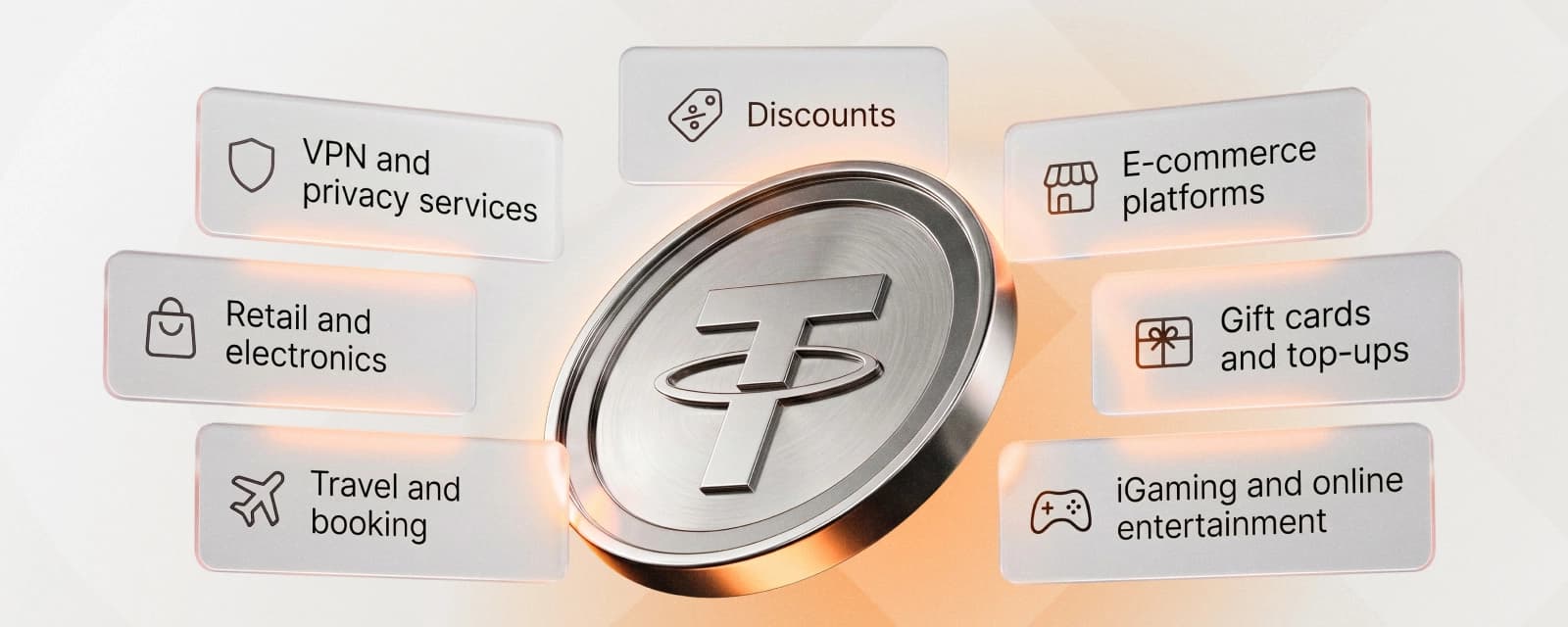
Here's the verified landscape, grouped by sector. Where a company accepts USDT through a processor rather than directly, it's noted – because that distinction changes how you actually pay.
VPN and privacy services
This is the most reliable category. Privacy tools and crypto payments are a natural fit, and most major providers have accepted Tether for years. Paying for a VPN with crypto removes the need to hand over card details linked to your identity, which is the whole point of the product.
- NordVPN accepts crypto, including USDT, at checkout after plan selection.
- Surfshark supports USDT among several cryptocurrencies.
- ExpressVPN confirms USDT payments via compatible wallets such as Coinbase or Kraken.
- Proton VPN accepts BTC, ETH, USDT, and more, in line with its privacy-first positioning.
Travel and booking
Travel was one of the earliest mainstream adopters, largely because crypto sidesteps the high bank fees and currency-exchange friction that plague cross-border bookings.
- Travala – the leader in crypto travel, with millions of listings across 230+ countries and a dedicated USDT checkout.
- Alternative Airlines – flights from hundreds of airlines payable in USDT through integrated providers.
- CheapAir – an early crypto adopter, flights and hotels payable in USDT via crypto processors.
Retail and electronics
Direct native USDT in mainstream retail is rare. The practical route is almost always a processor.
Want to accept crypto payments on your website?

- Newegg, the electronics retailer, accepts USDT via BitPay at checkout, making it a popular destination for buying hardware and software with crypto.
- AMC Theatres – movie tickets are payable via BitPay, which supports stablecoins including USDT (available chains vary by merchant).
Hosting and SaaS
Infrastructure providers tend to be crypto-friendly because their customers are often technical and value privacy.
- Snel.com – hosting from shared plans to dedicated servers, accepts Tether among several assets.
- is*hosting – VPS and dedicated server offerings with USDT support.
E-commerce platforms
Platforms enable merchants to accept USDT rather than accepting it on their own balance sheet.
- Shopify – merchants can enable crypto payments, including USDT, via gateway integrations, reaching crypto-paying customers without rebuilding checkout.
- WooCommerce – stores add USDT via a crypto payment plugin or a processor connection.
Gift cards and top-ups
The universal workaround and arguably the most useful category for everyday spending. If a brand doesn't accept crypto directly, you buy a gift card with USDT and spend it as usual.
- Bitrefill – gift cards, eSIMs, and mobile top-ups for thousands of brands across 180+ countries, USDT accepted on multiple networks.
- Coinsbee – thousands of brands and 200+ supported coins, including USDT. Covers Amazon, Zalando, and other retailers that never directly touch crypto.
- CryptoRefills – similar model, USDT supported across multiple chains, strong on regional brands.
iGaming and online entertainment
The vertical where stablecoins genuinely dominate. Crypto casinos and betting platforms have largely standardized on USDT for instant deposits, fast payouts, and predictable balances – a single $26 billion in digital-currency betting moved through Q1 2025 alone, with stablecoins as the primary medium.
NFT games and metaverse projects use USDT as a base currency for in-game assets, land, and operations. For a high-risk, high-volume vertical, the chargeback-free finality of on-chain settlement is the decisive feature.
How can a customer pay a company in USDT?
From the buyer's side, the flow is simpler than it looks. You need a wallet that holds USDT – MetaMask, Trust Wallet, Phantom, or an exchange account – and you pick the network the merchant supports.
At a crypto-native checkout, you select USDT; the site shows a unique address and amount (often as a QR code); you send from your wallet; and the payment confirms in seconds to minutes, depending on the chain.
The single most common mistake is sending on the wrong network – TRC-20 USDT to an ERC-20 address, for example. Always match the network the merchant displays. When in doubt, TRC-20 (Tron) is the cheapest and most widely supported for consumer payments.
How can you spend USDT in 2026?
Five practical routes, from most to least direct.
Direct checkout. On crypto-native sites like Travala or NordVPN, you pay USDT straight from your wallet. Pick the network the merchant supports, usually TRC-20 for low fees.
Crypto debit cards. A Binance Card, Crypto.com Card, or BitPay Card links to your crypto balance and converts USDT to fiat at the point of sale, working anywhere Visa or Mastercard is accepted. The Crypto.com card adds cashback in crypto; the BitPay card converts at the moment of payment.
Binance Pay. Merchants accept Tether via QR code in-store or online, supporting 300+ cryptos. It's worth checking when you're looking for acceptance outside crypto-native shops, since merchant tools include both online buttons and point-of-sale codes.
PayPal "Pay with Crypto." Rolling out to US merchants, it includes USDT among 100+ supported assets and settles to PYUSD for the merchant. This is the closest stablecoins have come to mainstream checkout, and a strong signal of where adoption is heading.
Gift cards. Convert USDT to brand credit via Bitrefill or Coinsbee, then shop as usual at retailers that don't accept crypto directly. This is the route that unlocks Amazon, app stores, food delivery, and most high-street names.
Where is USDT accepted by region?
Acceptance and the rules around it vary by jurisdiction, and the regulatory picture in 2026 is clearer than it's ever been.
United States
The widest set of direct routes. PayPal's Pay with Crypto, BitPay-enabled retailers like Newegg and AMC, and crypto cards all work. The GENIUS Act, signed in 2025, regulates stablecoin issuers rather than merchants, so accepting USDT is legal and unambiguous.
EU / Germany
USDT is usable, but MiCA has narrowed how licensed venues offer it – some processors restrict USDT-to-fiat conversion for EU merchants ahead of the July 2026 authorization deadline. Self-custody, gift cards, and direct acceptance remain unaffected.
UK
Crypto-friendly merchants and processors operate normally; the FCA is finalizing an issuer-level regime under the Financial Services and Markets Act 2023.
Singapore
A clear MAS framework and high merchant adoption make it one of the friendlier markets for stablecoin payments, with reserve and redemption rules that give businesses legal certainty.
India
The lack of a dedicated stablecoin framework and heavy crypto taxation limit direct acceptance. Gift cards and peer-to-peer routes are the common workarounds.
Why are more businesses accepting Tether?
Because the math is hard to argue with, card acquiring runs 2.9% + $0.30 plus 1–3% cross-border, landing at 4–6% all-in for international payments. USDT on Tron or Solana costs cents in network fees. For a business with thin margins or heavy cross-border flow, that gap is the difference between a payment method and a cost center.
Three drivers stand out. No chargebacks. Blockchain transfers are final, which matters enormously for digital goods and high-risk verticals where friendly fraud is rampant. Dollar stability. A $1 USDT invoice settles as $1, unlike volatile crypto, so accepting it doesn't expose your books to price swings. Global reach. Customers in markets where the dollar is scarce or banking is unreliable can pay without friction, which opens revenue you simply couldn't capture on card rails.
The adoption curve backs this up. Real-world stablecoin payment volume doubled in 2025, and roughly 60% of that was B2B – a strong signal that businesses, not just traders, are settling in stablecoins.
For the deeper trade-offs between Tether and Circle's coin when you're choosing what to accept, see our USDT vs USDC comparison.
Comparison table: who accepts USDT and how
| Industry | Example companies | How do they accept USDT |
|---|---|---|
| VPN / privacy | NordVPN, Surfshark, ExpressVPN, Proton VPN | Direct checkout |
| Travel | Travala, Alternative Airlines, CheapAir | Direct/integrated providers |
| Retail/electronics | Newegg, AMC Theatres | Via BitPay |
| Hosting | Snel.com, is*hosting | Direct checkout |
| E-commerce platforms | Shopify, WooCommerce | Merchant gateway integration |
| Gift cards | Bitrefill, Coinsbee, CryptoRefills | Convert USDT to brand credit |
| iGaming | Crypto casinos, betting platforms | Direct via processors |
How do you join the list and accept USDT in your business?
If you want your company in the next version of this list, the setup is more administrative than technical. You register with a crypto payment gateway, pass business verification (KYB), pick which USDT networks to accept – TRC-20 for cheap consumer payments, ERC-20 for institutional flows – integrate via API or a payment link, and go live. Most merchants are processing within a week.
The thing most businesses get wrong is treating acceptance as a plugin install.
The cleaner route is a processor that handles settlement, AML screening, and auto-conversion, so you're not babysitting a wallet, reconciling transactions by hand, or worrying about volatility and freeze risk.
A gateway generates a unique address per invoice, watches the blockchain, confirms the amount, and pushes the funds to your balance – then converts to a stablecoin or fiat if you want it.
Want to be on this list? 0xProcessing lets you accept USDT across TRC-20, ERC-20, BEP-20, Solana, and 18 blockchains total, with auto-conversion to stablecoins and 0% withdrawal fees. iGaming, forex, and high-risk verticals welcome.
Start accepting USDTVPN operators in particular fit this profile well – privacy-focused, global, and chargeback-averse.
Bottom line
USDT acceptance in 2026 is real but uneven. Crypto-native businesses – VPNs, travel platforms, hosting, iGaming – take it directly. Mainstream retail mostly works through processors like BitPay or the gift-card workaround.
The trajectory is clear, though: with stablecoin payment volume doubling year over year and rails like PayPal's Pay with Crypto reaching ordinary merchants, the gap between "crypto-native" and "everywhere" keeps closing.
For a business deciding whether to accept Tether, the question isn't whether customers want to pay in it. In a growing number of markets, they already do – and the cost savings over cards land straight on the bottom line.
FAQ
Who accepts Tether (USDT) as payment in 2026?
VPN providers (NordVPN, Surfshark, ExpressVPN), travel platforms (Travala, Alternative Airlines, CheapAir), electronics retailers via BitPay (Newegg, AMC), hosting providers, and thousands of brands indirectly through gift-card services like Bitrefill and Coinsbee.
Can I buy from Amazon with USDT?
Not directly – Amazon doesn't accept crypto. The workaround is to buy an Amazon gift card with USDT on Coinsbee or Bitrefill, then redeem it normally at checkout.
Does PayPal accept USDT?
PayPal's "Pay with Crypto" is rolling out to US merchants and accepts USDT among 100+ assets, settling to PYUSD for the merchant. You can also buy PayPal gift cards with USDT via Bitrefill.
Which USDT network do most companies accept?
TRC-20 (Tron) is the most common for consumer payments because fees run under a dollar. ERC-20 (Ethereum) is widely recognized for institutional flows. Many processors also support Solana and BNB Chain.
Is it legal for a business to accept USDT?
In most major markets, yes. The US GENIUS Act, EU MiCA, UK FCA rules, and Singapore's MAS framework regulate stablecoin issuers, not merchants that accept them.
How do I start accepting Tether for my own business?
Register with a crypto payment gateway, pass KYB, choose your networks, and integrate via API or payment link. A processor handles AML screening and auto-conversion so you avoid manual wallet management.