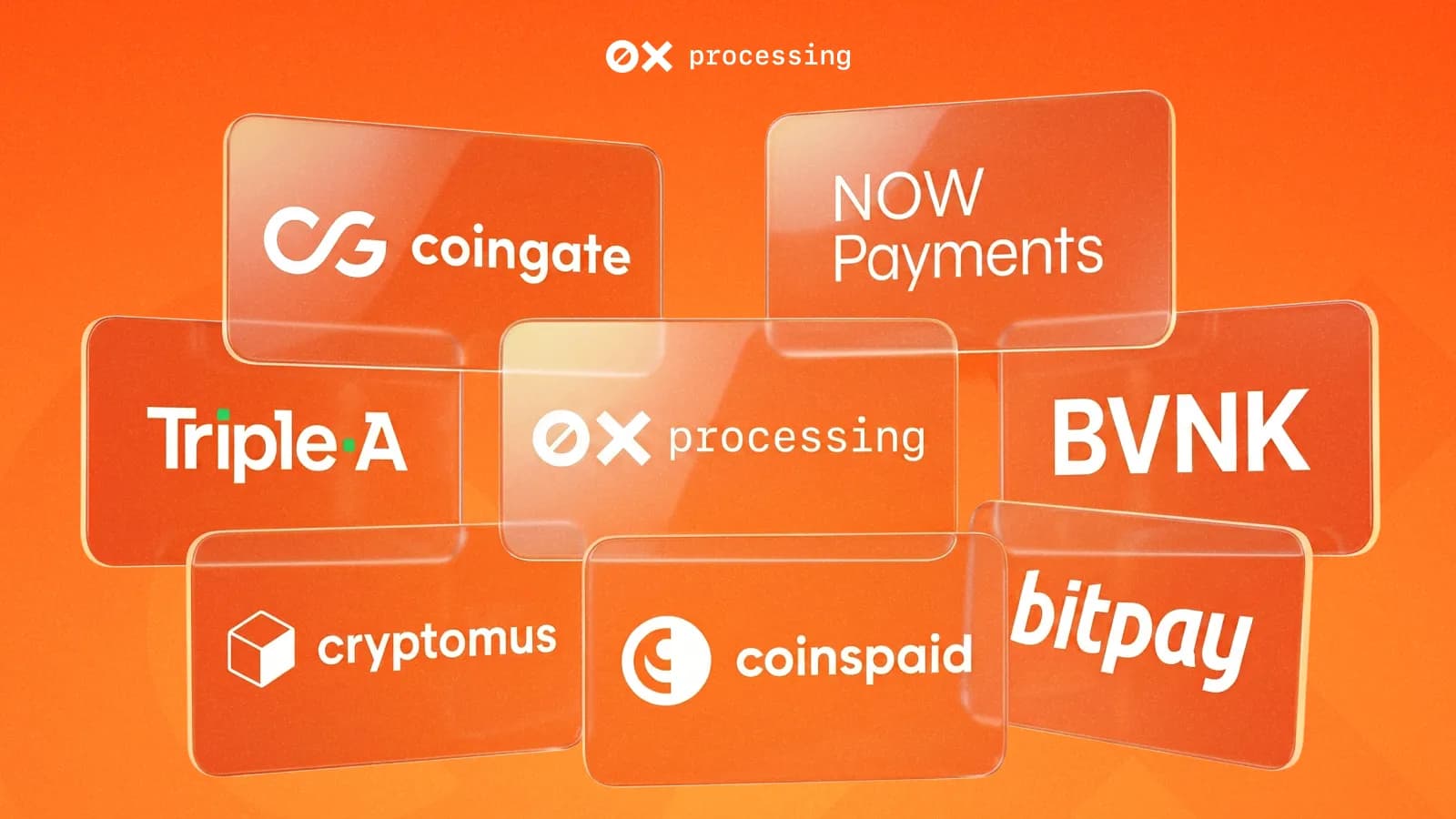
No single crypto payment processor wins for everyone.What's right for you comes down to a few things: how much fee you'll stomach, your vertical, where you operate, and whether you want fiat in the bank or stablecoins in treasury. We scored eight processors against nine criteria. The short version: 0xProcessing wins for high-volume and high-risk merchants. CoinGate, if you need EU compliance. NOWPayments has the widest coin list and the lightest KYC. BVNK owns an enterprise stablecoin treasury, Triple-A, and the Asia-Pacific licensing angle. CoinsPaid handles iGaming volume, BitPay covers US enterprise, and Cryptomus comes in cheapest for emerging markets.
What follows: the scoring method, a side-by-side table, then a full write-up on each one, with real volume figures wherever the provider actually publishes them.
This matters more than it did a year ago. Stablecoin transfer volume hit roughly $33 trillion in 2025, edging past Visa and Mastercard's combined payment volume for the year. Even on the narrower "real economic" measure that strips out bots,
Chainalysis put it at around $28 trillion. The money pulled in the big names fast. In March 2026, Mastercard agreed to acquire BVNK for up to $1.8 billion (including $300 million in contingent payments), with the deal expected to close by year-end pending regulatory approval. Stripe expanded USDC settlement across its platform, reaching merchants in dozens of countries. So the processor you pick is a real infrastructure call now, not a box you tick at checkout.
What is a crypto payment processor?
A crypto payment processor is a service that lets a business accept cryptocurrency from customers and receive either crypto or fiat in return. On the surface, it works like a card processor. Underneath, it's quite different: instead of routing through banks and card networks, it watches a blockchain for incoming payments and settles them to your balance.
How crypto payment processors work
The flow has three parts. A customer reaches checkout and picks a coin. The processor generates a unique invoice, usually a QR code and a time-limited wallet address. The customer sends the payment, the processor confirms it on-chain, and then either forwards the crypto to your wallet or converts it to stablecoins or fiat and settles it to your account. Most processors fire a webhook upon confirmation, so your system automatically marks the order as paid.
Gateway vs processor: what's the difference?
Strictly, a payment gateway is the front-end layer that presents the checkout and captures the payment. A payment processor is the back-end that handles settlement, conversion, and the move to your bank. Most providers in this guide do both: they give you the checkout and run the settlement behind it. When you see "crypto payment gateway" and "crypto payment processor" used for the same product, that's why.
How we ranked
Every processor was evaluated against the same nine criteria. Nobody paid to be here, and nothing is a sponsored slot.
- Headline fee. The rate they publish.
- All-in cost. What you actually pay once conversion, settlement, and per-transaction charges stack up.
- Custody model – custodial, non-custodial, or somewhere in between.
- Coins and chains. How many assets, across how many networks?
- Fiat settlement – can it put real money in your bank, and how fast?
- Regulatory posture. MiCA, MAS, FinCEN, whatever licensing they hold.
- Developer experience – API, SDKs, webhooks, a sandbox that works.
- Vertical fit. Whether it handles iGaming, Forex, SaaS, B2B, or retail.
- Volatility protection – does it auto-convert to stablecoins when the payment lands?
Each review below runs against that list. Where a provider actually publishes volume or transaction numbers, we've cited them straight.
Comparison table
Figures pulled from each provider's public pricing pages and documentation as of May 2026.
| Processor | Headline fee | Custody | Coins | Fiat settlement | Regulation | Best for |
|---|---|---|---|---|---|---|
| 0xProcessing | Custom (volume) | Custodial + VRCS | 85+ / 18 chains | SWIFT, SEPA | Crypto payment license, KYB | High-volume, high-risk, iGaming |
| CoinGate | 1% | Custodial | 70+ | EUR/USD/GBP next day | MiCA (Lithuania) | EU e-commerce |
| NOWPayments | 0.5% (+0.5% convert) | Non-custodial + custodial | 350+ | Third-party partner | Light KYC | Altcoins, no-KYC |
| BVNK | Custom | Custodial (enterprise) | Stablecoins | SWIFT/SEPA near-instant | 25+ licenses, ISO 27001 | Enterprise treasury |
| Triple-A | ~0.8% | Custodial | Stablecoins + majors | 30+ local currencies | MAS, ACPR, AMF, FinCEN | Asia-Pacific |
| CoinsPaid | ~0.8% | Custodial | 20+ | Instant, deep liquidity | Estonia-licensed | iGaming, Forex volume |
| BitPay | 1–2% + 25¢ | Custodial | 15 settle | USD/EUR/GBP T+2 | US MSB, NYDFS | US enterprise |
| Cryptomus | From 0.4% | Custodial | 100+ | P2P | No-KYC option | Emerging markets |
Want to accept crypto payments on your website?
A couple of patterns. Most headline fees sit between 0.4% and 1%, though BitPay's 25¢-per-transaction fee quietly pushes its real rate up on small tickets. And licensing now splits the field as much as price does, which counts for more since MiCA fully kicked in.
The 8 processors reviewed
1. 0xProcessing – best for high-volume and high-risk merchants
0xProcessing is built for verticals that mainstream processors hesitate to serve: iGaming, Forex, gaming, and high-volume B2B. It runs its own blockchain infrastructure, has no third-party aggregators in the chain, covers 85+ cryptocurrencies across 18 networks, and plugs into 16+ Web3 wallets. That last part is rare; barely a handful of processors do it.
Its signature feature is the Volatility Risk Control System (VRCS), which automatically converts incoming crypto to USDT or USDC at settlement, at no extra cost. Pricing is volume-based with 0% payout fees and no mandatory checkout branding. Recognition includes the "Best Crypto Payment Solution 2026" award at SiGMA Dubai and a 4.9/5 rating based on 200+ reviews.
Pros: Free VRCS volatility protection, 0% payouts, supports high-risk verticals, own infrastructure, white-label.
Cons: Guided onboarding (3–7 days) rather than instant signup; pricing not publicly listed.
2. CoinGate – best for EU compliance
CoinGate is the cleanest legal path for European merchants. Lithuania-based and MiCA-licensed, it settles in EUR, USD, or GBP via SEPA the next business day, supports 70+ coins at a flat 1%, and offers Lightning Network support. The MiCA passport covers all EEA countries under one framework.
Pros: MiCA-licensed, EU fiat settlement, Lightning support, transparent flat fee. Cons: Verification can be lengthy; no native Shopify App Store integration.
3. NOWPayments – best for coin variety and no-KYC
NOWPayments supports 350+ cryptocurrencies, charges 0.5% for same-coin payments (plus 0.5% if auto-converting), and offers a non-custodial mode that routes funds directly to the merchant wallet. KYC is light and optional below certain thresholds. You also get Mass Payouts and a donation widget. Catch is, there's no native fiat off-ramp, so converting to cash means routing through a third-party partner.
Pros: 350+ coins, low fee, non-custodial option, light KYC.
Cons: No native fiat settlement; depends on a third-party exchange partner for conversion.
4. BVNK – best for enterprise stablecoin treasury
BVNK is the enterprise heavyweight. Per the eco.com 2026 processor comparison, it reported $10 billion in annualized volume at its Series B. Per Plisio's field guide, it now processes roughly $25–30 billion a year in stablecoin volume for clients like Deel and Worldpay (figures vary by source). It holds 25+ licenses, an ISO 27001 certification, and enables stablecoin settlements via SWIFT or SEPA almost instantly. Mastercard's agreement to acquire BVNK for up to $1.8 billion (announced March 17, 2026) tells you where institutional money thinks this is heading. The deal is expected to close by the end of 2026, pending regulatory sign-off.
It's built for businesses moving at least $500,000 a month, with bespoke pricing and dedicated managers.
Pros: Enterprise compliance, $25B+ annual volume, near-instant bank settlement, Mastercard-backed.
Cons: Not for small retail; limited altcoin support; high minimum volume.
5. Triple-A – best for Asia-Pacific
Triple-A is the answer for multi-region licensing. Singapore-based with MAS licensing, plus ACPR, AMF, and FinCEN coverage, it handles 30+ local currency payouts at around 0.8% and folds conversion into treasury and payout products. For a merchant needing US, EU, and APAC coverage under one contract, it's the strongest single-vendor option.
Pros: Multi-region licensing, white-label, strong APAC coverage, next-day settlement.
Cons: Smaller coin list; strict verification.
6. CoinsPaid – best for iGaming and high-frequency volume
CoinsPaid is an Estonia-licensed processor founded in 2014, specializing in transaction-intensive verticals. It serves over 800 merchants, processes approximately €1 billion in monthly volume, and handles roughly 0.8% of global Bitcoin activity, with strong gaming partnerships including SoftSwiss. It handles thousands of transactions per minute with deep liquidity that prevents slippage.
Pros: Built for iGaming/Forex volume, deep liquidity, EU-licensed, high-frequency capable.
Cons: High barrier to entry for small merchants; complex integration for non-developers.
7. BitPay – best for US enterprise
BitPay built the category and remains the trusted choice for US enterprises needing NYDFS-grade compliance and direct bank settlement. Names like Microsoft use it. Per BitPay's settlement docs, it settles in 15 cryptocurrencies and supports direct bank deposits in 37+ countries. Fees run 1–2% tiered plus a 25¢ per-transaction charge.
The constraints: per BitPay's documentation, non-US bank wire settlements have a $10,000 minimum, and merchants must display the BitPay payment mark at checkout.
Pros: US-regulated, established brand, direct fiat settlement, enterprise trust.
Cons: High fees with per-tx surcharge; $10K non-US settlement minimum; mandatory branding.
8. Cryptomus – best for low fees and emerging markets
Cryptomus starts at 0.4%, among the lowest published rates, supports 100+ coins, and offers P2P fiat conversion. For small transactions and P2P payments, you can often get by with minimal verification. Full no-KYC access isn’t available for all features (the platform still complies with AML regulations), but they offer a simplified process that’s particularly popular among privacy-oriented merchants. Popular in emerging markets and with privacy-focused merchants, it ships auto-convert, payment links, QR codes, staking, and a personal manager.
Pros: Lowest headline fee, no-KYC option, P2P fiat, broad tooling.
Cons: Fiat settlement is P2P rather than a direct bank transfer; lower brand recognition.
Best processor by use case
Rankings are only useful if they map to your situation. Here's the segmented breakdown.
Best for iGaming and Forex: 0xProcessing and CoinsPaid. Both handle high-frequency, high-risk flows. 0xProcessing adds free VRCS volatility protection; CoinsPaid brings €1B monthly throughput and SoftSwiss integration.
Best for EU e-commerce: CoinGate,for the MiCA license and SEPA settlement. 0xProcessing or Cryptomus undercut it on fees if you don't need the EU regulatory wrapper.
Best for enterprise B2B treasury: BVNK, now Mastercard-owned, for pure stablecoin volume above $500k/month. Triple-A for multi-region licensing under one contract.
Best for US enterprise: BitPay,for NYDFS-grade compliance and brand recognition.
Best for altcoin-heavy stores: NOWPayments (350+ coins), Cryptomus (100+) or 0xProcessing (85+).
Best for lowest fees: Cryptomus (0.4%) and NOWPayments (0.5% same-coin) at the headline level, though always compare all-in cost.
Best for developers: processors with REST APIs, webhooks, and sandboxes, 0xProcessing, NOWPayments, and BVNK all score well here.
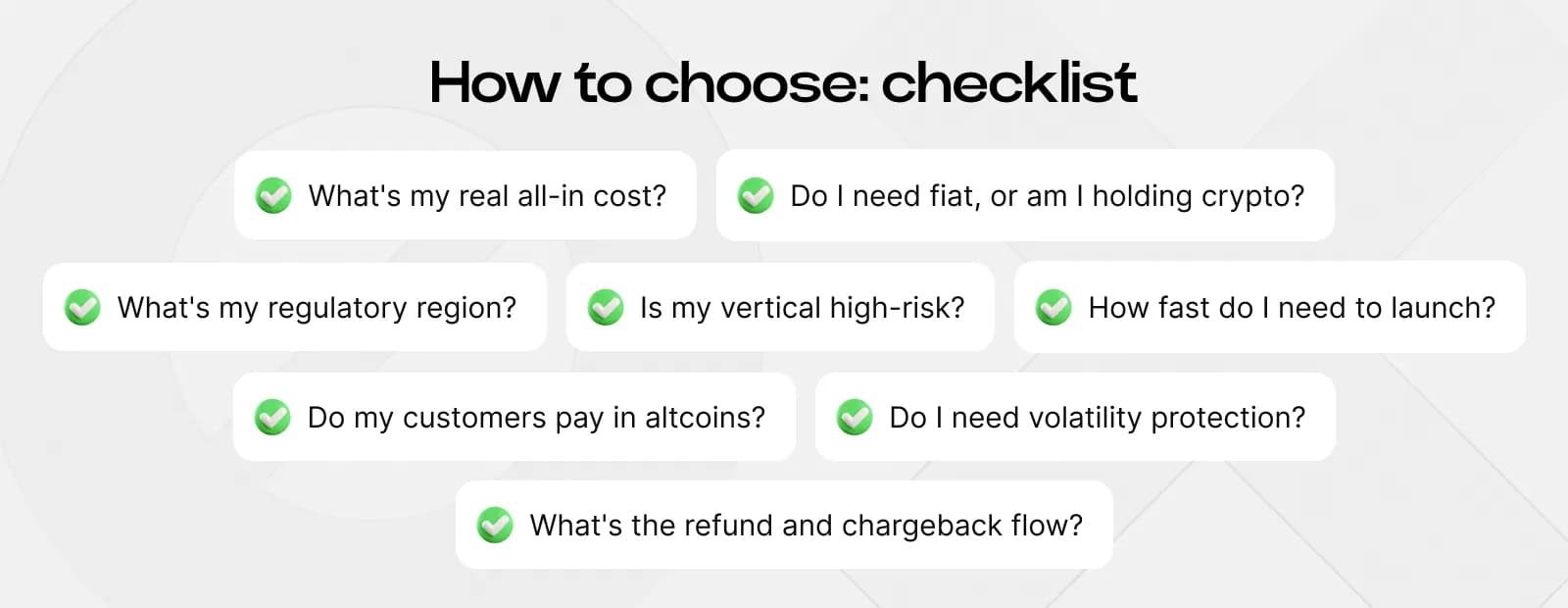
How to choose: checklist
Run through these before committing. Each is a question, not a feature box.
- What's my real all-in cost? Add processing fee + conversion spread + settlement/withdrawal fee + per-transaction charges, not just the headline rate.
- Do I need fiat, or am I holding crypto? Fiat settlement points to BitPay, CoinGate, and BVNK. Holding stablecoins points to non-custodial NOWPayments or VRCS (Volatility Risk Control System) by 0xProcessing.
- What's my regulatory region? EU → MiCA (CoinGate). APAC → MAS (Triple-A). US → MSB (BitPay).
- Is my vertical high-risk? iGaming, Forex, adult → 0xProcessing or CoinsPaid. Most mainstream processors decline these.
- How fast do I need to launch? Non-custodial light-KYC options activate in hours; licensed processors take days.
- Do my customers pay in altcoins? If yes, 0xProcessing, NOWPayments or Cryptomus. If they pay in BTC/ETH/stablecoins, almost any processor works.
- Do I need volatility protection? If you can't hold volatile crypto, confirm the processor auto-converts to stablecoins, and at what cost. For example, 0xProcessing has a free VRCS system that converts cryptocurrency into stablecoins.
- What's the refund and chargeback flow? Blockchain payments are final; refunds require a separate outbound transaction. Confirm how the processor handles it.
Crypto vs card fees
Card processing runs about 1.5–3.5% per transaction, plus chargeback exposure. The crypto processors in this guide cluster between 0.4% and 1%. On a $100,000 monthly volume, the gap between a 2.9% card rate and a 0.5% crypto rate is roughly $2,400 a month, before you count chargebacks. The catch is the network fee: a customer paying USDT on Ethereum during congestion can incur several dollars in gas fees, while the same payment on Tron or Solana costs a fraction of a cent. Chain choice matters as much as the processor's headline rate.
How processors handle refunds and chargebacks
This is where crypto flips the card model on its head. Blockchain payments are final; there's no issuer to reverse a charge, so chargeback fraud essentially disappears. That's a real saving for high-risk verticals. The trade-off: refunds aren't built in either. A refund is a separate outbound transaction that the merchant initiates manually or via the processor's API, returning crypto to the customer's address. Before committing to a processor, confirm how its refund flow works and whether the API supports partial refunds, because your accounting has to treat each one as a new transaction, not a reversal.
Bottom line
The crypto payment processor market matured quickly in 2026. With stablecoin volume surpassing Visa and Mastercard combined and Mastercard buying BVNK for $1.8 billion, stablecoins are now core financial infrastructure, not an experiment.
The advice is the same as it always was. The top-ranked name isn't automatically your name; the right fit is. Run your shortlist through all-in cost, your region's rules, your vertical, and how you want to get paid. If you're high-volume or high-risk, 0xProcessing is the one to beat on cost and volatility cover. Past that, the use-case breakdown above is your starting point.
FAQ
What is the best crypto payment processor in 2026?
There isn't one. 0xProcessing if you're high-volume or high-risk, CoinGate for EU compliance, NOWPayments when you want the most coins, BVNK for enterprise stablecoin treasury. It comes down to your vertical, your region, and what fees you'll accept.
How much do crypto payment processors charge?
Headline fees run from 0.4% (Cryptomus) to 1–2% (BitPay), with most clustering around 0.5–1%. Watch for hidden costs: conversion spreads, settlement minimums, and per-transaction fees such as BitPay's 25¢ fee.
Which crypto payment processors support fiat settlement?
BitPay, CoinGate, BVNK, Triple-A, and 0xProcessing all offer fiat off-ramp via SWIFT, SEPA, or local rails. NOWPayments requires a third-party partner. Cryptomus uses P2P conversion.
What's the best crypto payment processor for iGaming?
0xProcessing and CoinsPaid are purpose-built for iGaming and high-frequency, high-risk processing. Both handle the transaction volume and volatility that gaming operators face.
Are crypto payment processors regulated?
Increasingly, yes. CoinGate holds a MiCA license, Triple-A has MAS/ACPR/AMF/FinCEN coverage, BitPay is a US-registered MSB, and BVNK carries 25+ licenses. Regulatory posture is now a primary selection criterion.
Which processor has the most supported coins?
Among this list, NOWPayments leads with 350+, followed by Cryptomus (100+) and 0xProcessing (85+). For extreme long-tail coverage, CoinPayments (not ranked here) supports 2,300+.