If you already know you want to accept Tether and you're stuck on which gateway and which chain. Pick the chain based on who's paying you: Tron (TRC-20) for cheap, high-volume consumer payments; Ethereum (ERC-20) for institutional and DeFi flows; Solana or BNB Chain for fast, low-cost retail. Then pick the gateway based on your vertical and how you want to settle. The full comparison table and chain-by-chain fee breakdown sit below.
Most guides skip this: USDT is issued by a central company, Tether Limited, which can freeze tokens. That's not a reason to avoid it. But it shapes how you should set up processing, and we cover it in more detail further down.
USDT is the backbone of crypto payments. Tether's market cap sat near $189 billion in May 2026, with USDT holding roughly 60% of the entire stablecoin market. USDT accounts for roughly 70% of stablecoin transfer volume, so if dollars are moving on a blockchain, odds are it's Tether. For a merchant, that means accepting Tether isn't a nice-to-have; it's where most stablecoin volume already lives.
Which chains should you accept USDT on in 2026?

USDT runs natively on 10+ blockchains, with bridged versions across 80+ networks. But supply, and therefore liquidity, concentrates on a handful. Here's where it actually sits and what each chain costs.
| Chain | Share of USDT supply | Typical transfer fee | Confirmation | Best for |
|---|---|---|---|---|
| Tron (TRC-20) | ~45–52% | $0.0003 native; $1–5 for users without staked energy | ~3 seconds | High-volume consumer payments, remittances, and emerging markets |
| Ethereum (ERC-20) | ~40% | Cents to several dollars under load | ~12 seconds+ | Institutional settlement, DeFi collateral, exchange float |
| Solana (SPL) | ~6% | Under $0.001 | ~400ms | Fast retail, micropayments, consumer apps |
| BNB Chain (BEP-20) | Smaller | ~$0.10–0.30 | ~3 seconds | Binance-ecosystem users, low-cost retail |
The numbers come from CoinLaw, Eco, and VentureBurn's 2026 Tron analysis. Two takeaways for a merchant.
First, Tron dominates payments for a reason. It confirms in about three seconds, and the native fee is a fraction of a cent. The catch is the energy model: users who haven't staked TRX can pay $1 to $5 in burned TRX per transfer, which surprises many first-time payers. As a merchant, you don't carry that cost, but your customers might feel it.
Second, if your customers are paying small amounts, Ethereum is the wrong default. A $4 payment with a $2 gas fee makes no sense. Push those customers to Tron or Solana.
For most merchants, the answer isn't one chain. It's accepting USDT on Tron and Ethereum at minimum, and adding Solana or BNB Chain if your audience skews retail. A good Tether payment gateway handles all of them from a single dashboard, so you don't have to run separate setups.
How accepting USDT actually works
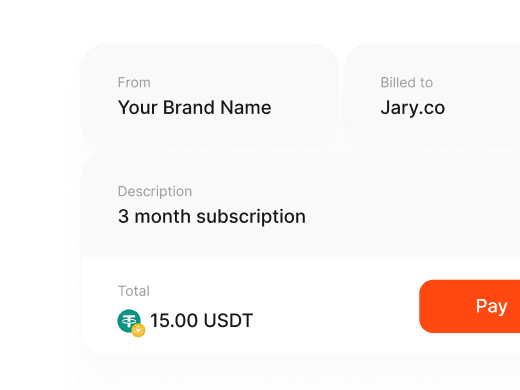
The flow is the same across processors. A customer reaches the checkout and picks USDT and a network. The gateway generates a unique deposit address and a payment window with the exact amount. The customer sends from any compatible wallet. The gateway monitors the chain, confirms the transaction, and credits your balance, often firing a webhook so your system can mark the order as paid automatically.
Custodial vs non-custodial
This is the first decision. A custodial gateway holds incoming USDT on your behalf and then lets you withdraw it or convert it automatically. That enables features like instant stablecoin conversion and fiat off-ramp, at the cost of trusting the processor with funds in transit. A non-custodial setup routes USDT straight to your wallet; you control the keys and handle conversion, accounting, and screening yourself. High-volume merchants who want fiat settlement and AML built in usually opt for custodial; privacy-focused or crypto-native businesses lean toward non-custodial.
Want to accept crypto payments on your website?
API, webhooks, and sandbox
For anything beyond a payment link, you integrate through the gateway's API. The pieces that matter: a REST endpoint to create payments, webhook callbacks that notify your server on confirmation (so you're not polling), and a sandbox to test the full flow without moving real USDT. Confirm the webhook is signed (HMAC) so you can verify it's genuine, and build your handler to be idempotent, as the same confirmation can arrive twice.
CMS plugins and no-code options
Not every business has developers. Most gateways offer payment links (generate a URL, send it, get paid) and some ship plugins for common platforms. Coverage varies a lot, so if you run on a specific stack, confirm the integration exists before committing rather than assuming it does.
USDT in 2026: the data that matters
A few numbers worth knowing before you build USDT payment processing into your checkout.
Tether's circulating supply crossed $189 billion in May 2026, and daily settlement volumes regularly exceed Visa's on-chain equivalent. Per CoinGecko, USDT has held its peg for nearly a decade through multiple crises, including 2022, when it processed $15 billion in redemptions, about 20% of supply, without breaking.
Reserve composition matters for trust. Per CoinGecko, Tether's reserves are primarily US Treasury Bills and cash equivalents, with smaller allocations to corporate bonds, secured loans, precious metals, and Bitcoin. The company publishes quarterly reserve reports.
The thing to internalize is that USDT is dollar-pegged and fully collateralized, but it is not decentralized. Tether issues it, Tether backs it, and Tether can freeze it. Which brings us to the part most processors won't tell you about.
The freeze risk: what every merchant accepting USDT must understand
USDT is centrally controlled. Every USDT smart contract embeds an on-chain blacklist, and Tether's administrators can add an address to it, instantly freezing any tokens there. This isn't a fringe scenario. It happens weekly.
According to CryptoTimes and FXStreet reporting in 2026, Tether has frozen over $4.4 billion in USDT across 2,300+ cases in 65 countries. Roughly $3.5 billion of that, more than 80%, has been frozen since 2023, when Tether adopted a more proactive blacklisting policy, when Tether adopted a more proactive blacklisting policy. In April 2026 alone, Tether froze $344 million across two addresses at the request of the US Treasury's OFAC.
Tron carries most of this. According to CryptoTimes data as of 8 May 2026, Tron accounted for 98.3% of the total value of USDT locked over the past 30 days, simply because that's where the high-volume, low-cost transfers and the illicit flows that draw scrutiny concentrate.
Why this matters for a legitimate business: The risk isn't that you're a criminal. It's contagion: if a customer pays you USDT that was previously tainted, your address can get caught in a screening net. The defense is real-time AML and KYT screening on every incoming transaction, which a serious Tether payment
processor runs by default. A processor with real-time screening checks every incoming USDT transaction against the blacklist and risk data before it hits your balance, so you're not unknowingly holding tainted tokens.
This is also a strong argument for auto-converting incoming USDT or settling to fiat quickly, rather than parking large balances on-chain indefinitely.
Want USDT processing with built-in AML screening across every chain? 0xProcessing accepts Tether on Tron, Ethereum, BNB Chain, and Solana, screens every transaction in real time, and settles to stablecoins or fiat.
Get a custom quoteHow we ranked the best USDT gateways
Every processor below was scored against the same seven criteria. No sponsored placement.
- USDT chain coverage. How many of the major USDT networks does it support (Tron, Ethereum, BNB, Solana).
- Fee. Headline rate plus conversion and settlement costs.
- Fiat settlement. Whether it off-ramps USDT to USD, EUR, or GBP, and how fast.
- AML and freeze protection. Real-time screening to reduce contagion risk.
- Custody and settlement model. Custodial, non-custodial, or auto-convert.
- Vertical fit. iGaming, Forex, SaaS, B2B, retail.
- Developer experience. API, webhooks, SDKs, sandbox.
Comparison table: best USDT payment gateways in 2026
Figures from each provider's public documentation as of May 2026.
| Gateway | USDT chains | Fee | Fiat settlement | AML screening | Best for |
|---|---|---|---|---|---|
| 0xProcessing | Tron, ETH, BNB, Solana + more | Custom (volume) | SWIFT, SEPA | Real-time KYT | High-volume, high-risk, iGaming |
| BVNK | ETH, Tron, Solana | Custom | SWIFT/SEPA near-instant | Enterprise-grade | B2B treasury |
| CoinGate | Tron, ETH, BNB | 1% | EUR/USD/GBP next day | Built-in (MiCA) | EU e-commerce |
| CoinsPaid | Tron, ETH, BNB | ~0.8% | Instant | Built-in | iGaming volume |
| NOWPayments | Tron, ETH, BNB, Solana | 0.5% (+0.5% convert) | Third-party | Light | Altcoins alongside USDT |
| Triple-A | ETH, Tron | ~0.8% | 30+ currencies | Built-in | Asia-Pacific |
The USDT gateways reviewed
0xProcessing
Accepts USDT across Tron, Ethereum, BNB Chain, and Solana, runs real-time AML on every transaction, and auto-converts via VRCS so dollar value locks in at settlement. Built for iGaming and Forex, the verticals of most processors decline. Pricing is volume-based with 0% payouts.
Pros: Multi-chain USDT, real-time KYT screening, stablecoin auto-conversion, supports high-risk verticals, 0% payout fees.
Cons: Guided onboarding (3–7 days) rather than instant signup; pricing not public.
BVNK
Enterprise stablecoin infrastructure, now subject to a Mastercard acquisition (announced March 2026, pending completion). Moves USDT at an institutional scale with near-instant SWIFT/SEPA settlement.
Pros: Enterprise-grade compliance, near-instant bank settlement, high volume capacity.
Cons: Built for $500k+/month; not for small merchants; limited altcoin range.
CoinGate
MiCA-licensed, settles USDT to EUR, USD, or GBP via SEPA next business day. The clean legal path for European merchants.
Pros: MiCA license, EU fiat settlement, transparent 1% flat fee.
Cons: Covers fewer USDT chains than broader processors; verification can be slow.
CoinsPaid
Estonia-licensed, processes roughly €1 billion monthly with deep liquidity. Strong for high-frequency Tether payment processing in gaming.
Pros: Built for iGaming/Forex volume, deep liquidity, EU-licensed.
Cons: High barrier for small merchants; integration leans technical.
NOWPayments
Supports USDT and 350+ other assets in non-custodial mode. Fits merchants who want wide coin coverage alongside Tether.
Pros: 350+ coins, 0.5% fee, non-custodial option, light KYC.
Cons: No native fiat off-ramp; conversion routes through a third party.
Triple-A
MAS-licensed in Singapore with multi-region coverage. Good for merchants needing USDT settlement across APAC, the EU, and the US under a single contract.
Pros: Multi-region licensing, 30+ currency payouts, white-label.
Cons: Smaller chain and coin coverage; strict verification.
Compliance: what changed for USDT in 2026
Regulation tightened the screws in 2026. The US GENIUS Act established the federal stablecoin framework (effective 2027), and the EU's MiCA framework is already fully in force, requiring crypto service providers to hold authorization. For a merchant, this mostly lands on your processor, not you, if you use a licensed one.
What you should expect from any serious Tether payment gateway in 2026: KYB on you at onboarding, real-time AML and KYT screening on incoming transactions, Travel Rule reporting on larger transfers (jurisdiction-dependent; the FATF threshold is around $1,000), and standardized tax reporting (1099-DA in the US). A processor that doesn't do these isn't saving you work; it's transferring the risk onto you.
The freeze point connects here, too. Because Tether cooperates with OFAC and 340+ law enforcement agencies across 65 countries, your gateway's compliance posture directly affects whether you end up holding frozen or flagged tokens. Screening isn't bureaucracy. It's protection.
How USDT refunds actually work
Worth understanding before you commit, because crypto refunds don't behave like card refunds. A card payment is reversed through the issuer. A USDT payment is final on-chain, so a "refund" is a brand-new outbound transaction the merchant sends back to the customer's address.
A few practical points. You need the customer's correct return address; send it to the wrong one, and the funds are gone. The refund carries its own network fee, which someone has to absorb. And your accounting has to treat it as a separate outbound payment, not a reversal of the original, which matters for reconciliation and tax records. A good gateway lets you trigger refunds from the dashboard or API and logs both legs (the original payment and the refund) with transaction hashes. Confirm whether partial refunds are supported if you sell anything that might need them.
Bottom line
Accepting USDT in 2026 is less about whether to and more about how. The volume is already there. Choose chains by who pays you: Tron for cheap consumer volume, Ethereum for institutional, Solana and BNB for fast retail. Choose a gateway based on your vertical and settlement needs, and ensure it screens every incoming transaction, as Tether's freeze mechanism is real and active.
For high-volume and high-risk merchants who want multi-chain USDT acceptance, real-time AML, and auto-conversion to lock in dollar value, 0xProcessing is built for exactly that. For everyone else, the segmented picks above indicate the correct starting line.
FAQ
What is the best USDT payment gateway in 2026?
It depends on your vertical and chains. For high-volume and high-risk merchants, 0xProcessing. For EU compliance, CoinGate. For coin variety, NOWPayments. For enterprise treasury, BVNK. All should screen incoming USDT for AML risk.
Which chain is cheapest to accept USDT on?
Tron (TRC-20) at $0.0003 native and Solana at under $0.001 are the cheapest. Ethereum (ERC-20) can cost anywhere from a few cents to several dollars, depending on congestion. Note that Tron users without staked TRX energy may pay $1–5 per transfer themselves.
Can USDT be frozen?
Yes. Tether can blacklist any address, freezing the tokens there. As of 2026, Tether has frozen over $4.4 billion across 2,300+ cases, mostly on Tron, often at the request of US law enforcement. This is why AML screening on incoming payments matters for merchants.
Should I accept USDT on Tron or Ethereum?
Both, ideally. Tron for cheap, fast consumer payments and emerging-market customers. Ethereum for institutional, DeFi, and exchange-linked flows. A multi-chain gateway lets you take both without separate setups.
How do I accept USDT and settle in fiat?
Use a gateway with a fiat off-ramp. CoinGate, BVNK, Triple-A, and 0xProcessing convert incoming USDT to USD, EUR, or GBP via SWIFT, SEPA, or local rails. Conversion at settlement also reduces your exposure to freeze contagion.
Is USDT decentralized?
No. USDT is issued and controlled by Tether Limited, a centralized company. It's dollar-backed and fully collateralized, but Tether can freeze tokens. That centralization is exactly why processing setup and AML screening matter.