If you're picking a crypto payment API, ignore the feature pages for a minute. Four things actually determine whether the integration is painful: how clean the REST design is, how the webhooks behave when something goes wrong (do they retry, and how do they sign), which SDKs exist for your language, and whether the sandbox is good enough to test against. On those, 0xProcessing, NOWPayments, and CoinGate handle most production work. BVNK and Coinbase Commerce cover the enterprise and self-custody ends.
This is written for developers, so it sticks to real endpoints, actual signature-verification code, and what webhooks do in practice. Samples are in Node.js and Python. The comparison table is further down, after the technical part.
What a crypto payment API actually does
Underneath the branding, they all run the same loop. You create a payment with an amount, a currency, and a callback URL. The provider returns a payment object containing an ID, a deposit address, and a status. Your customer pays on-chain. The provider watches the chain and, when the status changes, posts a webhook to your server. You check the signature, update the order, and are done.
Where one crypto payment integration gets easier or harder than another depends on the edges and how the provider signs its webhooks. Whether it bothers to retry a failed delivery, how many states does the payment move through? And whether the sandbox simulates a real on-chain confirmation or just hands you a canned response.
Observing the full payment lifecycle
A business needs to see more than "paid / not paid." Good crypto payment processing APIs expose a granular state machine. NOWPayments, for instance, reports the following statuses: waiting, confirming, confirmed, sending, partially_paid, finished, and failed. That granularity lets you build the right UX: show "confirming on-chain" instead of a frozen spinner.
Three lifecycle events matter most and are worth checking each API handles explicitly:
Underpayments. A customer sends less than invoiced (often because a wallet deducted a network fee). Different providers name this differently; NOWPayments reports partially_paid, 0xProcessing sends an Insufficiency callback (per its docs), but the principle is the same: a status that carries the actual amount received lets you decide whether to credit partially, request the difference, or refund. An API that just says "failed" leaves you blind.
Failures and expiry. Payment windows are time-limited. Confirm that the API fires a webhook on expiry, not just on success so that you can release held inventory.
Refunds. Blockchain payments are final, so a refund is a separate outbound transaction. The question for a crypto payment integration is whether the API lets you trigger refunds programmatically (CoinGate's API supports issuing crypto refunds and tracking discrepancies) or whether you have to do it manually from a dashboard. For a high-volume product, programmatic refunds are close to mandatory.
Creating a payment: REST in two languages
Here's the baseline call to create a payment across a typical REST crypto payment API. The exact field names vary by provider, but the shape is consistent.
const res = await fetch("https://api.0xprocessing.com/v1/invoice/create", {
  method: "POST",
  headers: { "Content-Type": "application/json" },
  body: JSON.stringify({
    api_key: process.env.OX_API_KEY,
    amount: 125.50,
    currency: "USDT",
    order_id: "ORDER-12345",
    description: "Order #12345"
  })
});
const invoice = await res.json();
A note on auth: 0xProcessing also issues a Web3 API token (generated under Settings → Merchant Management → Web3 API Token) passed in an APIKEY header for its Web3 pool endpoint at web30.0xprocessing.com. Check the current docs for which method your integration path uses; the exact endpoint and field names should always come from the live documentation, not a blog snippet.
Want to accept crypto payments on your website?
Python:
import os, requests# Endpoint and field names per 0xProcessing documentation url = "https://api.0xprocessing.com/v1/invoice/create"
payload = { "api_key": os.environ["OX_API_KEY"], "amount": 125.50, "currency": "USDT", "order_id": "ORDER-12345", "description": "Order #12345", }
res = requests.post(url, json=payload) invoice = res.json() # Returns a wallet address, amount, and payment window (30–50 min)
payment = res.json() # {"id": ..., "address": ..., "status": "waiting", "expires_at": ...}
Auto-conversion works differently across providers. On 0xProcessing, the Volatility Risk Control System (VRCS) – its in-house engine that automatically converts incoming volatile crypto into a stablecoin like USDT or USDC at settlement, so you receive the dollar value you invoiced – is toggled in merchant settings (Merchant → API), not passed per-request. On NOWPayments, by contrast, auto-convert is the difference between the same-coin flow and the conversion flow, set at the API level.
Webhook reliability: the part that breaks in production
Webhooks are where integrations actually fail. Three things separate a robust crypto payment API from a fragile one: the signature scheme, the retry policy, and idempotency.
Signature verification
Every serious provider signs its webhooks so you can verify they came from the provider and weren't tampered with. The schemes differ.
NOWPayments uses HMAC-SHA512. The catch that trips up most developers is that you have to sort the JSON payload by key before hashing, or the signature never matches. Per the NOWPayments IPN docs:
JavaScript:
const crypto = require("crypto");
function verifyNowPayments(reqBody, signature, ipnSecret) {
const sorted = JSON.stringify(reqBody, Object.keys(reqBody).sort());
const hmac = crypto.createHmac("sha512", ipnSecret);
hmac.update(sorted);
return hmac.digest("hex") === signature; // x-nowpayments-sig header
}
Most providers use HMAC-SHA256 with the raw request body, which is simpler because you don't re-serialize:
Python:
import hmac, hashlib
def verify_webhook(raw_body: bytes, signature: str, secret: str) -> bool:
expected = hmac.new(secret.encode(), raw_body, hashlib.sha256).hexdigest()
return hmac.compare_digest(expected, signature)
Return a 2xx fast. Do the heavy work async. Providers treat a slow response as a failure and retry, which is how you end up double-crediting an order if your handler isn't idempotent.
SDK and language support
If you don't want to roll your own HTTP calls, SDK coverage matters. Here's where the major providers land.
CoinGate maintains a PHP SDK as its reference implementation, with community and official SDKs across Python, Node.js, and Ruby, all targeting the same v2 API. It runs a separate sandbox at sandbox.coingate.com, and credentials from the live site won't work in test mode; you need to generate separate sandbox keys.
NOWPayments is API-first with a documented sandbox and community libraries, though it leans on you calling the REST endpoints directly. The IPN (webhook) handling is the part you'll write yourself.
0xProcessing exposes a REST API with webhook callbacks and a sandbox environment, oriented toward custom checkout integration rather than drop-in plugins.
Coinbase Commerce offers solid official SDKs and feels like the smoothest option for teams already inside the Coinbase ecosystem. The downside is that you have to handle private key management yourself.
For most teams, the real question isn’t whether it has an SDK for your language – REST works fine everywhere – but whether the sandbox is good enough to test the entire payment flow without using real crypto.
Comparison table: crypto payment APIs in 2026
Pulled from each provider's developer documentation as of May 2026.
| API | Auth | Webhook signature | Retry policy | SDKs | Sandbox | AI-agent ready |
|---|---|---|---|---|---|---|
| 0xProcessing | Bearer token | HMAC-SHA256 | Retries w/ backoff | REST + webhooks | Yes | x402-compatible flows |
| BVNK | API key + HMAC | HMAC-SHA256 | Enterprise SLA | REST, enterprise | Yes | Stablecoin rails |
| Coinbase Commerce | API key | HMAC-SHA256 (X-CC-Webhook-Signature) | Retries | Official SDKs | Limited | No native |
| CoinGate | Auth token | HMAC on callbacks | Retries on non-2xx | PHP, Python, Node, Ruby | Separate sandbox env | No native |
| NOWPayments | API key | HMAC-SHA512 (sorted JSON) | Retries on failure | Community libs | Yes (Postman) | Partial |
A couple of notes. The "AI-agent ready" column is new for 2026 and explained below. And "sandbox" quality varies a lot: a sandbox that returns mocked responses is less useful than one that simulates actual on-chain confirmation timing, which is what you need to test your confirming → finished handling.
The APIs reviewed
0xProcessing
REST API with webhook callbacks and a sandbox, oriented toward custom checkout rather than drop-in plugins. Endpoint api.0xprocessing.com, auth via API key, plus a separate Web3 pool API. VRCS auto-conversion and 0% payouts are the differentiators. Strong fit for high-risk verticals and custom integrations; less so if you want a one-click CMS plugin.
BVNK
Enterprise-grade API with HMAC-signed webhooks and an SLA, built for stablecoin treasury at scale. Now subject to a Mastercard acquisition (announced March 2026, pending close). Overkill for a small store, ideal for $500k+/month flows.
CoinGate
The most SDK-friendly here: official/community libraries across PHP, Python, Node.js, and Ruby on its v2 API, plus a genuinely separate sandbox at sandbox.coingate.com with its own keys. MiCA-licensed. The default for EU merchants who want mature tooling.
Coinbase Commerce
Official SDKs and the smoothest path for teams already in the Coinbase ecosystem, with HMAC-SHA256 webhook signatures (X-CC-Webhook-Signature). The trade-off is self-custody key management on your side.
NOWPayments
API-first with 350+ coins and a non-custodial mode. HMAC-SHA512 webhooks (mind the key-sorting caveat above) and a Postman-based sandbox. You write the IPN handling yourself. Best when coin breadth and non-custodial settlement matter.
What the API actually costs
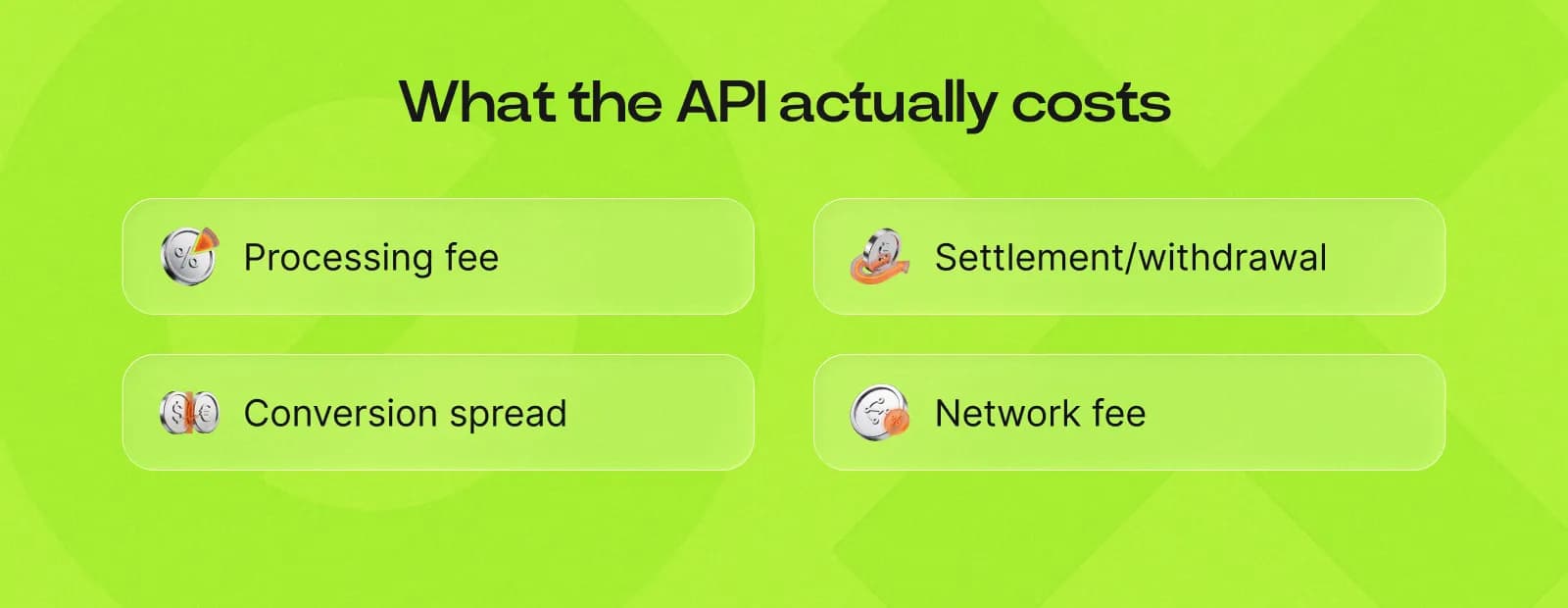
The API itself is free to call on every provider here; you pay on processed volume, not per request. The real cost lines:
- Processing fee. NOWPayments 0.5% (same-coin) or 1% (auto-convert). CoinGate flat 1%. Coinbase Commerce 1%. 0xProcessing and BVNK quote custom volume-based rates rather than a public sticker.
- Conversion spread. If you auto-convert to a stablecoin or fiat, there's usually a small spread on top of the headline fee. NOWPayments charges an explicit +0.5%; others fold it in.
- Settlement/withdrawal. Fiat off-ramp via SWIFT/SEPA can carry a banking fee. 0xProcessing advertises 0% payout fees; check each provider's withdrawal terms.
- Network fee. The on-chain cost is separate and depends on the chain, not the API. Sub-cent on Tron or Solana, potentially dollars on Ethereum under load.
For a developer, the takeaway is that the cheapest headline API fee isn't always the cheapest integration once conversion and settlement are factored in. Model your real flow, your chains, your conversion needs, before committing.
Integrating into a CMS or a custom framework
Not every integration is a from-scratch API build. Two common paths:
CMS platforms. If you run on Shopify, WooCommerce, Magento, or a similar platform, check whether the provider offers a plugin for your platform. CoinGate has prebuilt plugins for several CMS platforms; coverage varies provider to provider, so confirm your specific stack is supported rather than assuming it is. A plugin turns a multi-day API integration into a configuration task.
Custom frameworks. For a custom app on Laravel, Django, Rails, Express, or Next.js, you're integrating at the API level regardless of SDK. The pattern is the same everywhere: create the payment server-side (never expose your API key client-side), render the returned address or redirect, and handle the webhook on a dedicated route. An SDK in your language saves boilerplate, but a clean REST API plus an HTTP client gets you there in any framework. The webhook handler is the part that needs the most care; see the idempotency and signature notes above.
AI-agent readiness: the 2026 differentiator
This is the column that didn't exist a year ago. AI agents now pay for APIs, data, and compute autonomously, and they don't use browser checkouts. They speak protocols like x402, the HTTP-native payment standard from Coinbase and Cloudflare that revives HTTP 402 ("Payment Required").
For a crypto payment API, "agent-ready" means a few concrete things. A non-browser client can complete checkout without a redirect. Payments can be requested and authorized via HTTP headers (the x402 pattern: agent hits the endpoint, receives a 402 with payment terms, signs a stablecoin payment, then retries). And settlement works at sub-cent amounts, because agent payments are often micropayments.
If you're building anything an AI agent might consume, an API, a dataset, or compute time, this matters. A processor that supports SPL/stablecoin settlement on fast chains and x402-style flows lets you monetize per-call without rebuilding payment infrastructure. Processors that support stablecoin settlement on Solana are positioned for x402-style agent flows, since x402 settles in USDC on fast chains, including Solana. Confirm current x402 support directly with any provider you're evaluating; it's a fast-moving area, and vendor capabilities shift month to month. If agent traffic isn't on your roadmap, ignore this column. If it is, it's the most important one.
Rate limits and error handling
Every provider rate-limits, exceeds it, and you get an HTTP 429 ("Too many requests"), as 0xProcessing's error docs spell out. Build in exponential backoff on 429s rather than hammering the endpoint. Beyond that, handle the standard failure cases each API documents: a 404 for a wrong endpoint, validation errors for a malformed request (0xProcessing returns IncorrectModel and Incorrect amount, for example), and auth errors for a bad key. Fail loudly in logs, retry transient errors, and never assume a create-payment call succeeded without checking the response.
Bottom line
For a developer choosing a crypto payment API in 2026, the marketing pages won't tell you what you need. Read the webhook docs first; that's where you'll spend your integration time and where production breaks. Confirm the signature scheme (and whether you need to sort the payload, as with NOWPayments), confirm there's a retry policy, and make your handler idempotent from day one.
Match the API to your stack and your traffic. CoinGate, if you want mature multi-language SDKs and an EU-compliant flow. NOWPayments for the widest coin coverage and a non-custodial option. 0xProcessing for auto-conversion, high-risk verticals, and x402-style agent payments. Coinbase Commerce, if you're already in that ecosystem and want self-custody. Whatever you pick, test the full lifecycle, success, underpayment, expiry, and refund in the sandbox before you wire real money through it.
FAQ
What is a crypto payment API?
A REST interface that lets your application create crypto payments, receive a deposit address, and get notified via webhook when the payment confirms on-chain. It abstracts the blockchain watching, confirmation logic, and (optionally) fiat or stablecoin conversion.
How do I verify a crypto payment webhook?
Recompute the HMAC signature over the request body using your shared secret and compare it to the signature in the header. NOWPayments uses HMAC-SHA512 over a key-sorted JSON payload, while most others use HMAC-SHA256 over the raw body. Always use constant-time comparison.
Which crypto payment API has the best SDK coverage?
CoinGate offers official SDKs for PHP, Python, Node.js, and Ruby. Coinbase Commerce also ships solid official SDKs. NOWPayments and 0xProcessing are more REST-first, so you’ll usually call the endpoints directly or use community libraries.
Can I test a crypto payment integration without real crypto?
Yes. CoinGate provides a separate sandbox at sandbox.coingate.com with its own API keys. NOWPayments offers a Postman-based sandbox, and 0xProcessing has a dedicated test environment. Make sure to test the full flow – including underpayments and expirations – not just the happy path.
How are refunds handled through a crypto payment API?
Since blockchain payments are final, a refund is always a separate outbound transaction. Some platforms, like CoinGate, let you trigger refunds via API, while others require manual action through the dashboard. Check this early if automated refunds matter for your product.
Are crypto payment APIs ready for AI-agent payments?
Some are. Agent payments use protocols like x402 over HTTP, with no browser checkout and often sub-cent amounts. APIs supporting stablecoin settlement on fast chains and x402-style flows (such as 0xProcessing on Solana) can serve agent traffic; most legacy processors can't yet.