Enabling one USDT network on checkout? Make it TRC20 (Tron). It settles faster and costs the customer less to send, and on a small order that's what decides whether the payment goes through at all. ERC20 (Ethereum) still has its place. You want it when your customers pay from Ethereum wallets or DeFi, or when the sums are big enough that a gas fee barely registers.
Most of what's written on erc20 vs trc20 assumes you're the one sending USDT around. Treasury desks, rebalancing, moving funds between your own wallets. This is the other side of the counter: a customer is at your checkout, trying to pay you, and the trade-offs look nothing alike from there. A fee that's an annoyance to a treasury is a dead checkout to a merchant.
Same USDT, different roads
USDT is one thing. A dollar-pegged token from Tether. TRC20 and ERC20 aren't rival coins, they're that same USDT riding two different blockchains. TRC20 puts it on the Tron network. ERC20 puts it on Ethereum mainnet. A dollar is a dollar either way.
The road is what differs: the fee to move it, how fast it arrives, what the wallet address looks like, and which gas token you need to push the transaction through. That last one quietly eats real money, and it gets its own section further down. Numbers first.
TRC20 vs ERC20: fees and speed
These are October 2026 figures. They drift with network load and token prices, so read them as ballpark, not a quote you can hold anyone to.
|
TRC20 (Tron) |
ERC20 (Ethereum) | |
|
Network fee per transfer |
Roughly $2.2 to someone who already holds USDT, about $4.4 to a first-time recipient, if no energy is staked. Rent or stake energy and it drops to ~1–3 TRX |
Swings with network load, spikes when Ethereum is busy. Paid in ETH |
|
Block time |
~3 seconds |
~12 seconds |
|
Practical finality |
About a minute |
Roughly 13–15 minutes (two epochs) |
|
Gas token |
TRX (energy + bandwidth) |
ETH |
|
Address format |
T-address, starts with T, ~34 chars |
0x-address, starts with 0x, 40 hex chars |
|
Token standard |
TRC-20 |
ERC-20 (EIP-20) |
Network-fee data compiled by Cryptum puts a USDT transfer at roughly a minute to practical finality on Tron, against something closer to fifteen on Ethereum. For a merchant, that gap is more or less the whole argument.
A caveat on Ethereum fees, because it cuts both ways. On a dead-quiet day the base fee drops to almost nothing, and you'll find comparison posts waving around numbers in cents. Don't plan your checkout around the quiet day. Ethereum gas is priced by demand, and when the network's busy that same transfer can run several dollars or worse, landing on your customer right as they're trying to pay.
The fee is really a conversion problem
Abstract comparisons stop at "ERC20 fees are high." True, and not much use on its own. The number that matters is the fee as a slice of the order.
A customer buying something for $50. If ERC20 gas is running hot that day, they might be looking at a real chunk of the order value just to move their money across. Somewhere in there the math quits making sense, and they walk. That sale didn't die on your pricing. It died on the rail you picked.
Now put the same fee on a $5,000 B2B invoice and it vanishes into the rounding. ERC20 is completely fine there. The rule underneath both cases: the smaller the ticket, the more the network fee alone decides whether a payment ever completes. For ordinary consumer orders, a cheap network like TRC20 isn't a bonus, it's the line between a finished checkout and an abandoned cart.
How many confirmations before you hand over the order?
"Tron is faster" is trivia until you turn it into a rule you can actually run a shop on. The question worth answering: how many seconds before I can safely release the goods?
No two services agree on a confirmation count. Each sets its own risk tolerance, and block time on its own won't tell you a payment is safe. Still, a working default for a merchant looks like this. On TRC20, a transfer is usually fine to treat as settled about a minute after it lands, and plenty of sellers of low-value digital goods release the moment it confirms. On ERC20, give a larger payment the finality window, call it 13 to 15 minutes, before you treat it as locked in.
Selling a digital product or topping up an account? That minute-versus-fifteen gap is the difference between an instant handoff and a customer watching a spinner. Shipping something physical tomorrow? Then it hardly matters, so go with whatever's cheaper or easier. Fit the wait to what you're actually delivering instead of repeating the "crypto is instant" line.

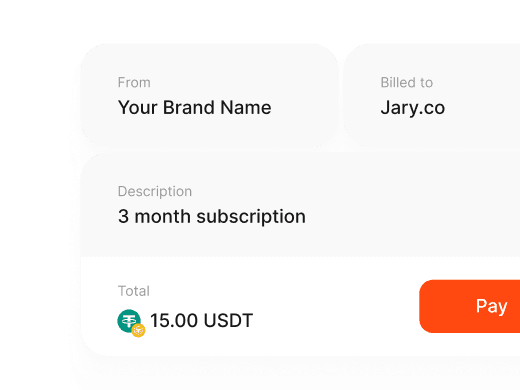
Want to accept crypto payments on your website?
The gas problem, right at the moment of payment
This is the one no treasury guide bothers with, because it only hurts the seller. Your customer holds USDT. They've got none of the gas token. Now what?
USDT is a smart-contract token on both chains, so moving it costs a separate fee in the chain's native coin. On Tron that's energy and bandwidth, backed by TRX. Zero TRX, nothing staked or rented, and the customer flat-out can't send their USDT. On Ethereum the transfer needs ETH for gas, and with zero ETH it won't go anywhere either, short of a wallet or relayer covering the gas for them.
To the customer it makes no sense. "I've got the money, why won't it send?" To you it's a payment that just quietly evaporates. They held the USDT, they meant to pay you, and the rail blocked them over a few dollars of some token they'd never heard of.
A checkout that drops a raw address on the customer and assumes they've sorted out gas is leaking sales. The way around it is to stop making gas the customer's problem: give them a payment path that doesn't ask them to pre-fund a native token, and fall back to a network where they do have it.
Losing payments because customers have no gas or picked the wrong network? With 0xProcessing they can pay in one click from a Web3 wallet, and Binance Pay settles the transfer straight from an exchange balance, with no on-chain network fee for the customer at all.
Get startedThe 0x address collision nobody warns about
TRC20 and ERC20 addresses look nothing alike, so almost nobody fat-fingers TRC20 USDT into an ERC20 address. The dangerous mix-up happens between EVM networks that share the exact same address format.
The mechanism is simple once you see it. An Ethereum-style 0x address comes from a private key, and Ethereum, BNB Chain, Polygon, Arbitrum, Base and Optimism all derive theirs the same way. One private key, therefore one identical 0x address across every one of those chains. Same address, but the balances and token contracts on each chain are completely separate.
That's the gap USDT falls through. A customer sets out to send ERC20 USDT to your 0x address, except their wallet's pointed at BNB Chain, so what actually leaves is BEP20 USDT. The transaction goes through fine. The funds show up at your address, only on BNB Chain, not Ethereum. Nothing bounces.
Can you get it back? Usually, if the private key behind that address is yours: flip your wallet over to BNB Chain, find the right USDT contract, and you can reach or bridge the funds, paying BNB for gas. If it went to an exchange or some service that doesn't support the network, you're at their mercy, and there's no guarantee. We're not going to pretend the money always comes home, because it doesn't.
Best defence is to check the network, not just the address, when a payment goes out, and to run a checkout that actually detects which network the money arrived on rather than assuming.
Past the big two: Solana, BEP20, L2s
TRC20 and ERC20 own most USDT payments, but they aren't the only roads, and for small tickets a few beat Tron on price.
Solana carries USDT as an SPL token, usually under $0.05 a transfer and quick, though a first-time token account adds a small one-time rent cost. BNB Chain runs BEP20 USDT somewhere around $0.03 to $0.50, gas in BNB. Polygon tends to be the cheapest of the lot, often a cent or two, gas paid in POL. The L2s, Arbitrum and Base, generally land under $0.30 with gas in ETH, but confirm the exact USDT token and that your provider supports it, since not every "USDT on an L2" is the issuer's own.
More networks, fewer dead checkouts, because people can pay on whatever chain their USDT already sits on. The flip side is more room for wrong-network slip-ups and more addresses to reconcile at the end of the day. Which is exactly the problem the next section is about.
Do you really need a multi-network routing layer?
Some guides, the ones written for big treasuries, land on "you need a routing layer that picks the best network per transaction." For a desk moving serious volume, sure, maybe. For a small or mid-sized online business, that's a solution to a problem you haven't got.
You don't have to buy routing infrastructure to take USDT properly. You need one setup that works: it accepts the networks your customers actually use (TRC20 first for everyday payments), it doesn't dump the gas problem on them, it tells you which network a payment came in on, and it folds whatever arrives into a single stable balance so you're not chasing the same dollar across six chains.
Not ready to think about routing at all? The honest starting point is way simpler than the enterprise write-ups suggest. Turn on TRC20. Add ERC20 for the customers who want it. Let a processor deal with the per-network mess underneath, and grow into more chains when people start asking.
0xProcessing fits a merchant taking USDT across several networks well, because it covers 100+ assets on 20+ networks and sorts the per-network detail out for you instead of leaving you with six wallets to reconcile. Whatever network the USDT shows up on, it can auto-convert to a single USDT or USDC balance at no extra cost, so you're holding one number, not a scattered pile. And when a payment comes up short or lands somewhere unexpected, you can trace it by transaction hash instead of writing it off.
Want USDT payments that just work across networks? 0xProcessing handles TRC20, ERC20, Solana, BEP20, L2s and more, with one-click Web3 payments, Binance Pay that spares the customer a network fee, and free auto-conversion into a single stable balance.
Get startedSummary
Start with TRC20 for everyday payments. It settles in about a minute and keeps the customer's fee small, which is what stops a small-ticket checkout from dying over gas. Bring in ERC20 when your customers live in the Ethereum world, or when a payment's big enough that the fee doesn't matter. Add Solana, BEP20 or an L2 as people ask for them.
The mistakes that actually cost merchants money have nothing to do with crowning a "best" chain. One is letting a customer hit a wall because they hold USDT but no gas. The other is letting a wrong-network transfer disappear because the checkout only ever looked at the address, never the chain. Fix those two and the whole TRC20-versus-ERC20 question mostly sorts itself out.
FAQ
What's the actual difference between TRC20 and ERC20 USDT?
Same USDT, two different blockchains. TRC20 rides on Tron, ERC20 on Ethereum. Identical dollar value, but the network fee, speed, address format and gas token all differ. TRC20 is usually cheaper and quicker for everyday payments; ERC20 suits the Ethereum crowd and large transfers.
Which network should I accept if I can only pick one to start?
TRC20 (Tron). For normal consumer-sized payments it clears in about a minute and the fee stays small, which keeps small checkouts from being abandoned over cost. Add ERC20 later for customers paying out of Ethereum wallets.
What happens if a customer sends USDT on the wrong network?
It lands at the address on whatever network they actually used, not the one you had in mind. Across EVM chains (Ethereum, BNB Chain, Polygon and the rest) the address is identical, so a wrong-network transfer still arrives at your address, just on the wrong chain. Control the private key and you can usually recover it by switching networks and paying gas. If it went to an exchange or an unsupported service, recovery's not guaranteed.
How many confirmations should I wait for before delivering an order?
No universal number, and block time alone doesn't prove a payment's safe. Working default: on TRC20, about a minute is generally enough to call it settled; on ERC20, give larger amounts the 13–15 minute finality window. Match the wait to what you're handing over, and follow your processor's own policy.
My customer has USDT but no gas token. What happens then?
They can't send it themselves. USDT is a smart-contract token, so moving it needs TRX on Tron or ETH on Ethereum for gas. With none of either, the transfer won't go through unless something sponsors it. It's a common way for payments to vanish quietly, and the fix is a checkout that doesn't make the customer pre-fund gas, or a route like Binance Pay that skips the on-chain fee altogether.
Is TRC20 always cheaper than ERC20?
Usually, not always, and not the cheapest overall. On a busy day ERC20 costs far more; on a quiet one the gap shrinks. And Polygon or Solana can undercut Tron on small transfers. Honest answer: TRC20 wins on cost for most everyday payments, but the cheapest network depends on the day and on what you and your customer both support.
 Crypto payments, Merchant strategies, How to, Crypto for business, Blockchain payments, Tether (USDT) payments

Lead Writer
Lucas Anderson